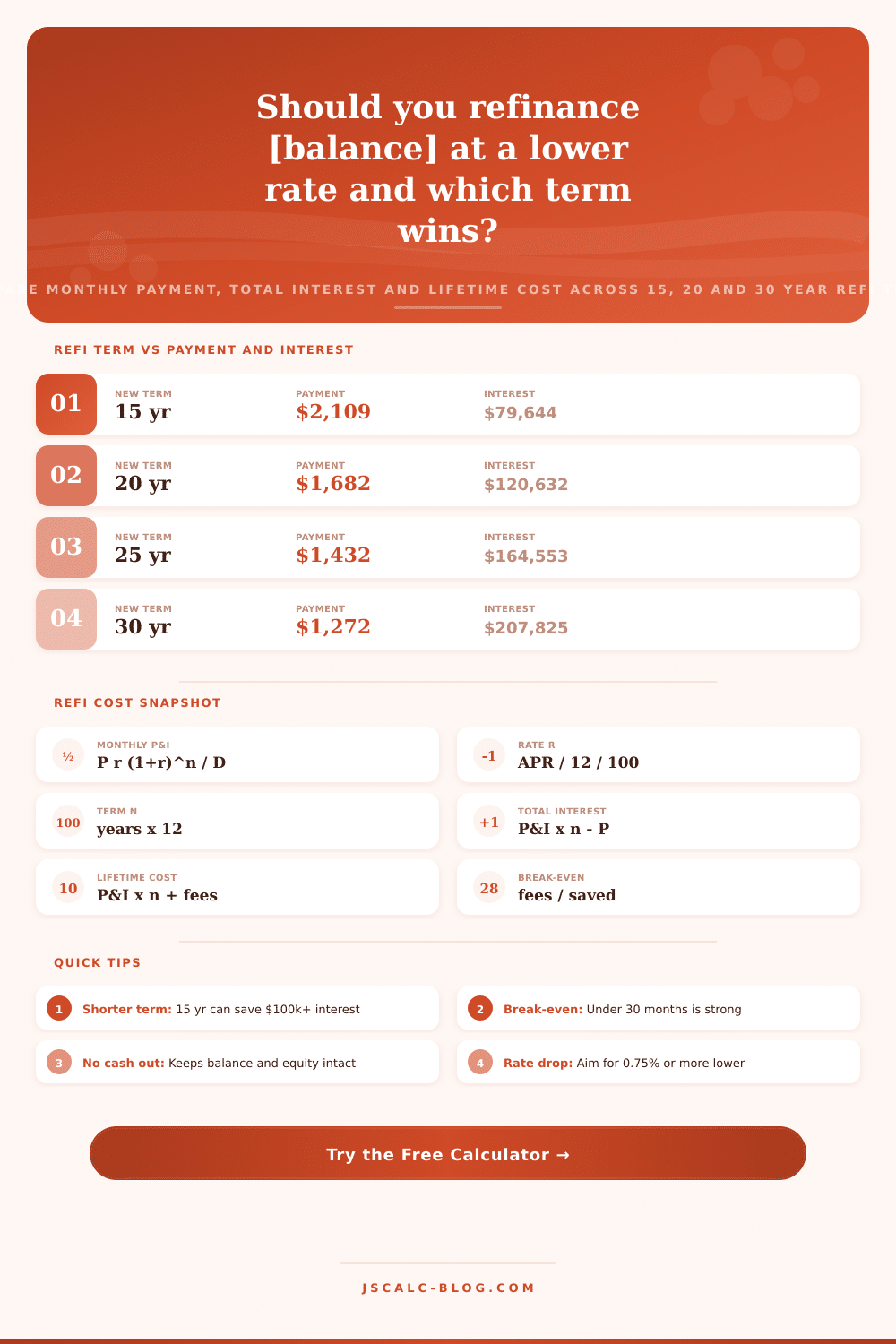
Rate and Term Refinance Comparison Calculator
Compare several rate-and-term refinance scenarios side by side with no cash out. Enter your current loan and a new rate, pick three new term options, and see the monthly payment, total interest, lifetime cost, break-even months and payoff date for each so you can weigh a lower payment against long-run savings.
🎯Real Refinance Scenarios
📝Loan and Refinance Inputs
Remaining principal owed; carried over unchanged (no cash out).
The annual rate on your existing mortgage.
Years left to pay on the loan you have now.
The rate quoted on the refinanced loan.
First side-by-side term to compare (e.g. 15).
Second term to compare (e.g. 20).
Third term to compare (e.g. 30).
Lender and title fees added to the lifetime cost of each refi.
Best-Value Refinance Option
| Metric | Current | Refi A | Refi B | Refi C |
|---|
🔢Formula Snapshot
📊Rate and Term Refinance Comparison Grid
| Scenario | New Rate | Term | Payment | Total Interest | Lifetime Cost | Monthly Change |
|---|---|---|---|---|---|---|
| Current loan | 6.75% | 27 yr left | $1,972 | $338,072 | $638,072 | baseline |
| Refi 15 yr | 5.75% | 15 yr | $2,491 | $148,404 | $454,404 | +$519 |
| Refi 20 yr | 5.75% | 20 yr | $2,106 | $205,540 | $511,540 | +$134 |
| Refi 25 yr | 5.75% | 25 yr | $1,889 | $266,547 | $572,547 | -$83 |
| Refi 30 yr | 5.75% | 30 yr | $1,751 | $330,301 | $636,301 | -$221 |
| Refi 10 yr | 5.75% | 10 yr | $3,297 | $95,655 | $401,655 | +$1,325 |
📋How Term Length Changes Interest ($200k at 5.75%)
| New Term | Monthly P&I | Total Interest | Total Paid |
|---|---|---|---|
| 10 years | $2,198 | $63,770 | $263,770 |
| 15 years | $1,661 | $98,936 | $298,936 |
| 20 years | $1,404 | $137,027 | $337,027 |
| 25 years | $1,259 | $177,698 | $377,698 |
| 30 years | $1,167 | $220,200 | $420,200 |
💵Break-Even by Closing Cost and Monthly Savings
| Closing Costs | Save $100/mo | Save $200/mo | Save $300/mo |
|---|---|---|---|
| $3,000 | 30 months | 15 months | 10 months |
| $4,500 | 45 months | 23 months | 15 months |
| $6,000 | 60 months | 30 months | 20 months |
| $8,000 | 80 months | 40 months | 27 months |
| $10,000 | 100 months | 50 months | 34 months |
| $12,000 | 120 months | 60 months | 40 months |
⚙Formula Breakdown
💡Smart Refinance Tips
If you’re still carrying a mortgage and you live in a market where rates have fallen, maybe you’re stuck with a high-interest mortgage that feels like a millstone around your ankle. Refinancing sounds like a great idea! … But here’s the thing: You know you could get a lower rate. That’s not the issue. The issue is, should you use this refinance chance to pay down your mortgage faster or simply keep your payments low?
These two options are realy two sides of the same coin. Most homeowners view them as distinct decisions; however, you can adjust both by doing a rate-and-term refi. So do you want to preserve your cash flow today or build up more wealth tomorrow?
To Refinance or Not to Refinance
Plug in your mortgage balance and your preferred terms into the calculator above, and let it crunch the payment schedules while you think about the strategy. The rate-and-term refi is simple in principle, but complex in execution. By definition, a rate-and-term refi keeps your principal level and shifts only how quickly it’s repaid. There is no additional equity at risk (and hence no new money to blow). All that changes is the interest rate (hopefully lower than what you’re paying) and the repayment period (which will be shorter if you want to pay off the loan faster, longer if you want to reduce monthly payments).
For example, you might choose to shorten the term to save more money over time. You can then compare that to a scenario where you stretch it back to 30 years, which has the opposite effect. Those tradeoffs create tension… And they must be handled carefuly. That’s why side-by-side comparisons is crucial.
Every calculation depends on conventional amortization math, how your balance gets divided up into monthly payments. Some portion of each month goes towards interest; some goes toward paying down the principal. As time passes, more of each month go to principal, and less goes to interest. The calculator calculates the cumulative interest for each scenario, just by taking the sum of all those months worth of payments, and subtracting off what you paid at the beginning. Then it adds your closing costs, calculating the true “lifetime cost.”
That’s the number that tells the story: How much did you pay now (in closing costs)? And how much are you going to keep paying, over the decades? Many people don’t realize they’re making a tradeoff here until it’s too late… That the big lifetime cost is the price they must pay for a low monthly payment.
The calculator also helps make this hidden debt explicit. By showing you the total cost of every choice, spelled out in plain English, it helps bring all the numbers into view. For example, at the same rate, how much would your monthly payment increase (or decrease) if you took out a 30-year versus a 15-year loan? If you go for the 15, yes, you’ll pay down your principal more quickly, which can save you six figures in interest during the course of the loan… So that payment might be higher than what you’d like. But if you choose the 30 year, well, the monthly payment will drop. You’ll have more room in your budget to breathe.
So neither option is superior. It’s all about your own financial comfort. Do you want to put yourself into a forced savings situation where you’re building wealth with each mortgage payment? Or do you want a little wiggle room in your budget, so you can invest someplace else?
The picture gets complicated when we include closing costs, that initial barrier to entry that has to get crossed before you begin saving. How many months worth of payments will it take to earn back those several-thousand-dollar closing fees? For anyone who anticipates moving in just a couple years, this break-even number matters. Unless you stay put longer than necessary to cover your closing costs, that refinance ends up costing you money.
That’s where the table on the page helps. It makes clear what types of closing-fee structures benefits your bottom-line and even shows whether you’d save more over time by paying up-front or opting for a no-closing-cost loan (which typically means you’ll pay a bit more interest each month). The tool gives you a set of presets so you don’t have to guess, simply click “late” on your mortgage to see the impact; try a one-percent reduction in your rate to determine the breakeven point; compare jumbo vs. Conforming loans by plugging them in. It will show you patterns that is hidden when you look at just the raw numbers.
For example, a lower-rate refinance won’t necessarily make sense for a loan with very little time remaining, since you’ve already paid down most of the front-end, high-interest portion of your loan. Knowing this will save you from making a costly mistake. And lastly, it converts a mess of choices into a simple comparison you can believe in, so that you can make the decision that’s right for your wallet (and your life).