Escrow Prepaid Reserves Calculator
Estimate the upfront escrow reserve deposit collected at closing under RESPA. Enter your annual property tax and homeowners insurance, choose how many months of each the lender collects, add an optional cushion, and see the total impound deposit, the ongoing monthly escrow, and the RESPA cushion cap.
🏦Real Closing Reserve Presets
📝Escrow Reserve Inputs
Full yearly county/municipal property tax bill.
Yearly hazard/homeowners premium (HO-3 policy).
Commonly 2-6 depending on the tax due date.
Often 2-3; use 12-14 if a full year is paid here.
Reserve buffer; RESPA caps this at 2 months.
Yearly PMI or FHA MIP if escrowed monthly.
Flood premium or other line escrowed monthly.
Months of the optional line collected upfront.
🔢Escrow Snapshot
📊Upfront Reserves by Tax Months Collected
| Tax Months | Tax Reserve | Insurance Reserve | Cushion | Total Upfront |
|---|---|---|---|---|
| 2 months | $0 | $0 | $0 | $0 |
🗄Reserve Comparison Grid: Tax Months x Insurance Months
| Scenario | 2 Ins Mos | 3 Ins Mos | 6 Ins Mos | 12 Ins Mos | 14 Ins Mos |
|---|---|---|---|---|---|
| 2 Tax Mos | $0 | $0 | $0 | $0 | $0 |
📅Typical Tax Months Collected by Due-Date Timing
| Closing vs Tax Due Date | Months Until Due | Typical Tax Months | Why |
|---|---|---|---|
| Closing right after taxes paid | 10-12 months | 2-3 months | Long runway before next bill |
| Closing mid-cycle | 5-7 months | 3-4 months | Moderate buffer needed |
| Closing just before due date | 1-2 months | 5-6 months | Bill hits soon, fund it fast |
| Two installments per year | varies | 2-5 months | Aggregate accounting per RESPA |
| Arrears state (paid behind) | varies | 3-6 months | Covers accrued unpaid period |
| Advance state (paid ahead) | varies | 2-4 months | Next bill already partly prepaid |
📏Escrow Terms and RESPA Rules Reference
| Term | Meaning | Rule of Thumb | Note |
|---|---|---|---|
| Prepaid reserves | Upfront escrow deposit | Months x monthly | Collected at closing |
| Cushion | Reserve buffer | Up to 2 months | RESPA 1/6 rule |
| Aggregate adjustment | Low-point true-up | Reduces deposit | Prevents over-collection |
| Escrow analysis | Annual review | Once per year | Adjusts monthly amount |
| Shortage | Under-funded escrow | Spread 12 months | Or pay lump sum |
| Overage | Surplus in escrow | Refunded over $50 | Within 30 days |
⚙Formula Breakdown
💡Escrow Reserve Planning Tips
You may see a large amount called prepaid reserves at closing. It is not a fee; it is money you hold in escrow. This sum will covers property insurance and property taxes. Your lender takes this money in case your bills come due before the end of the year. This means they needs a lump sum payment from you up front.
Plug your insurance premium into the calculator along with tax bill to estimate how much this will be. Knowing what’s being calculated will help you plan ahead.
What Are Prepaid Reserves?
Escrow is when the lender pay homeowners insurance and property taxes through an escrow account. A small amount goes in your mortgage payment each month. Before the first tax/insurance bill arrives, however, that escrow account must have money. The lender pulls several months worth when you close on the loan. These are called prepaid reserves.
It’s not part of the loan cost; it’s yours. But you need to provide cash at closing. Don’t confuse it with ongoing monthly payments.
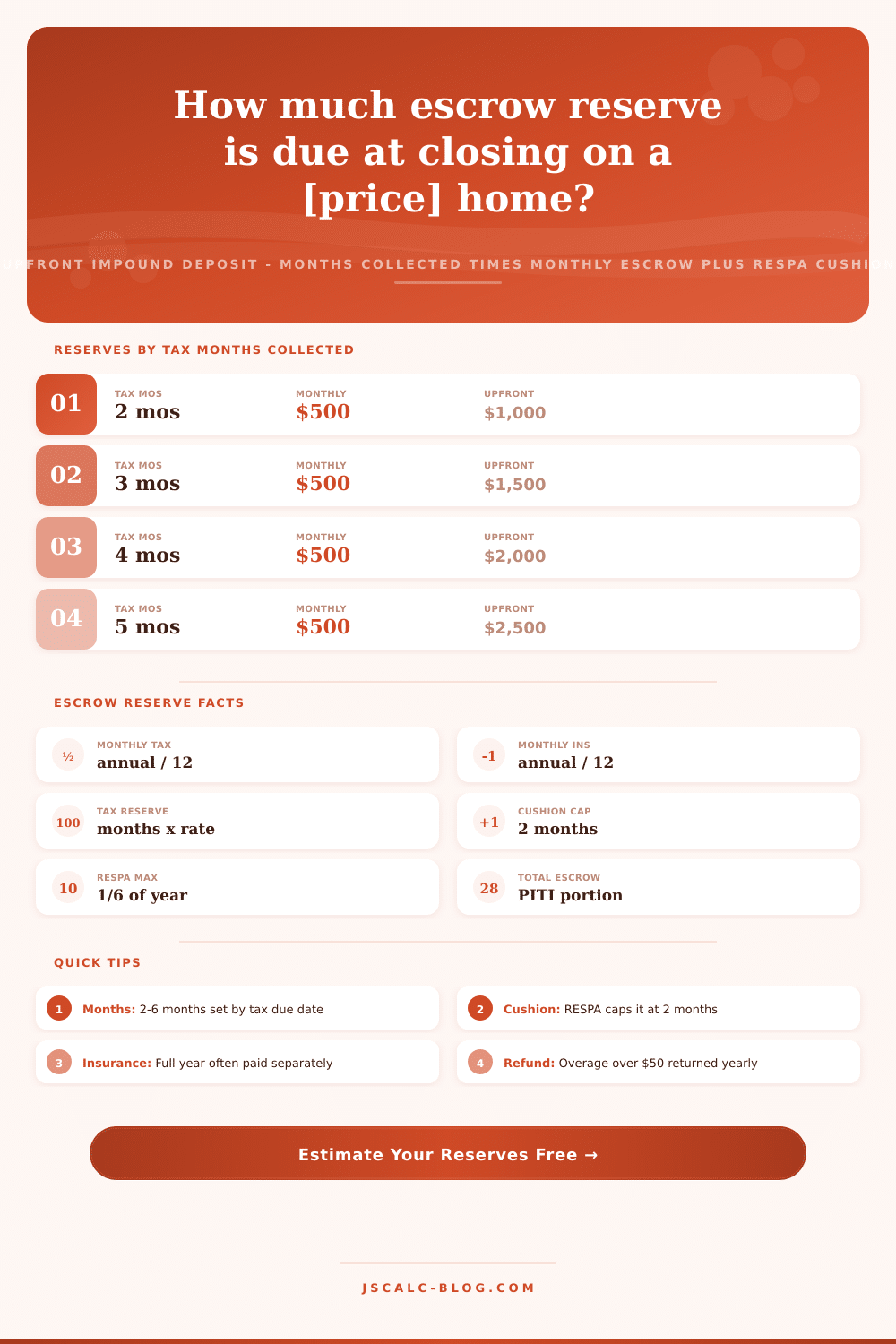
The math is a simple arithmetic calculation. Take the monthly property taxes (annual divided by 12). Repeat with insurance. Multiply those two figures (each in dollars per month) times number of months that you’ll collect them. So if your property has an annual tax of $6,000 and the bank collects four months worth, that’s $2,000. Do the same for insurance. Add everything else in your escrow account. Sum all those pieces plus the cushion. Voila! That’s how much goes into the deposit upfront.
There is no penalty; it is just a question of when. The deposit for similar homes varies by timing. When will bills hit? The lender need enough money in that account then. How much do they collect? Federal law limits their take. More months if you close ahead of a tax bill. There are fewer months if its already paid. Set # months 2-6 on the calculator. It displays a reference table matching each scenario with typical month counts. That tells if your lender’s estimate was conservative/aggressive.
Escrow accounts is regulated by the Real Estate Settlement Procedures Act (RESPA). This means that there’s a ceiling on how big a cushion a lender can maintain. Lenders is allowed to maintain a buffer, up to one-sixth of the total amount disbursed in any year. That’s two monthly payments. The calculator automatically respects this limit. But here’s why it matters: RESPA also requires a point-of-minimum-analysis to ensure lenders don’t collect too much money. If you see a cushion exceeding the two-month threshold on a Loan Estimate, ask about it. It’s a tiny thing but it keeps your money safe.
There is another wrinkle: homeowner’s insurance. In some transactions, the buyer pays initial year of insurance out-of-pocket at close. Then the lender recieve just two or three months worth for the following year. In other deals, the buyer includes an extra dozen or so months in the escrow deposit. Either pattern happen often. You can specify insurance months in the calculator separate from tax months. For most scenarios, enter “two” or “three” as starting amount. If the entire year of insurance will be paid via escrow, enter 12 or 14. That will adjust the overall cost in the comparison grid.
Four critical values are displayed in the results panel: Total Upfront Reserves = The total deposit required at closing. The Monthly Escrow Payment is the ongoing part of your payment that goes toward taxes and insurance. The RESPA Cushion Cap is the legal maximum for the cushion. The Tax Plus Insurance Reserve is the reserve amount without the cushion added.
The breakdown provides a detailed list of each step in the calculation. You can compare these numbers different than what your lender estimated. A big chunk of closing costs is prepaid reserves. These can vary by thousands based off how many months you collect. The calculator adjusts for lender’s collection period and converts annual amounts into monthly amount. It also applies the RESPA limit to the cushion.
Begin with a pre-populated figure; tweak the inputs for your local insurance/taxes. Review the breakdown line-by-line against your Loan Estimate. With that info, there would of been no surprises at closing.