Prepaid Interest at Closing Calculator
Estimate the odd-days interest a lender collects at closing. Enter your loan amount, rate, closing day, and days in the month to see the per-diem charge, the days billed from your closing date through month-end, the total prepaid interest due, and the date your first mortgage payment is due.
🎯Real Closing Scenarios
📝Loan and Closing Inputs
Financed principal, not the purchase price.
Your note rate, not the APR.
The calendar day your loan funds and disburses.
Sets the last billable day of the month.
Some lenders divide the annual rate by 360.
Lender convention varies; the common case includes it.
A reminder only; does not change the interest math.
Controls how dollar figures display.
🔢Formula Snapshot
📊Prepaid Interest by Closing Day (Your Numbers)
| Closing Day | Odd Days Billed | Prepaid Interest |
|---|---|---|
| Day 1 | -- | -- |
📋Per-Diem Interest by Loan and Rate (Actual/365)
| Loan Amount | 4.5% | 5.5% | 6.5% | 7.5% |
|---|---|---|---|---|
| $200,000 | $24.66 | $30.14 | $35.62 | $41.10 |
| $300,000 | $36.99 | $45.21 | $53.42 | $61.64 |
| $400,000 | $49.32 | $60.27 | $71.23 | $82.19 |
| $500,000 | $61.64 | $75.34 | $89.04 | $102.74 |
| $650,000 | $80.14 | $97.95 | $115.75 | $133.56 |
| $750,000 | $92.47 | $113.01 | $133.56 | $154.11 |
📅First Payment Timing by Closing Month
| Closing Month | Interest Collected For | First Payment Due | Months Skipped |
|---|---|---|---|
| Close in January | Rest of January | March 1 | February |
| Close in March | Rest of March | May 1 | April |
| Close in June | Rest of June | August 1 | July |
| Close in September | Rest of September | November 1 | October |
| Close in November | Rest of November | January 1 | December |
| Close in December | Rest of December | February 1 | January |
🗃Close Early vs Late Comparison Grid
| Closing Day | Odd Days (31-mo) | Diem $300k 6.5% | Prepaid Due | Vs Day 1 | Basis Note |
|---|---|---|---|---|---|
| Day 1 | 31 days | $53.42 | $1,656.16 | baseline | Actual/365 |
| Day 5 | 27 days | $53.42 | $1,442.47 | save $213.69 | Actual/365 |
| Day 10 | 22 days | $53.42 | $1,175.34 | save $480.82 | Actual/365 |
| Day 15 | 17 days | $53.42 | $908.22 | save $747.95 | Actual/365 |
| Day 20 | 12 days | $53.42 | $641.10 | save $1,015.07 | Actual/365 |
| Day 25 | 7 days | $53.42 | $373.97 | save $1,282.19 | Actual/365 |
| Day 28 | 4 days | $53.42 | $213.70 | save $1,442.47 | Actual/365 |
| Day 31 | 1 day | $53.42 | $53.42 | save $1,602.74 | Actual/365 |
⚙Formula Breakdown
💡Closing Date Cash Tips
If you’re a first-time homebuyer, seeing an “interest” line item on a bill before the loan even began is a jolt. Why should I pay interest on something that’s not yet earned? Where’s the hidden fee or penalty? Answer: It isn’t one. It’s just a case of calendar math.
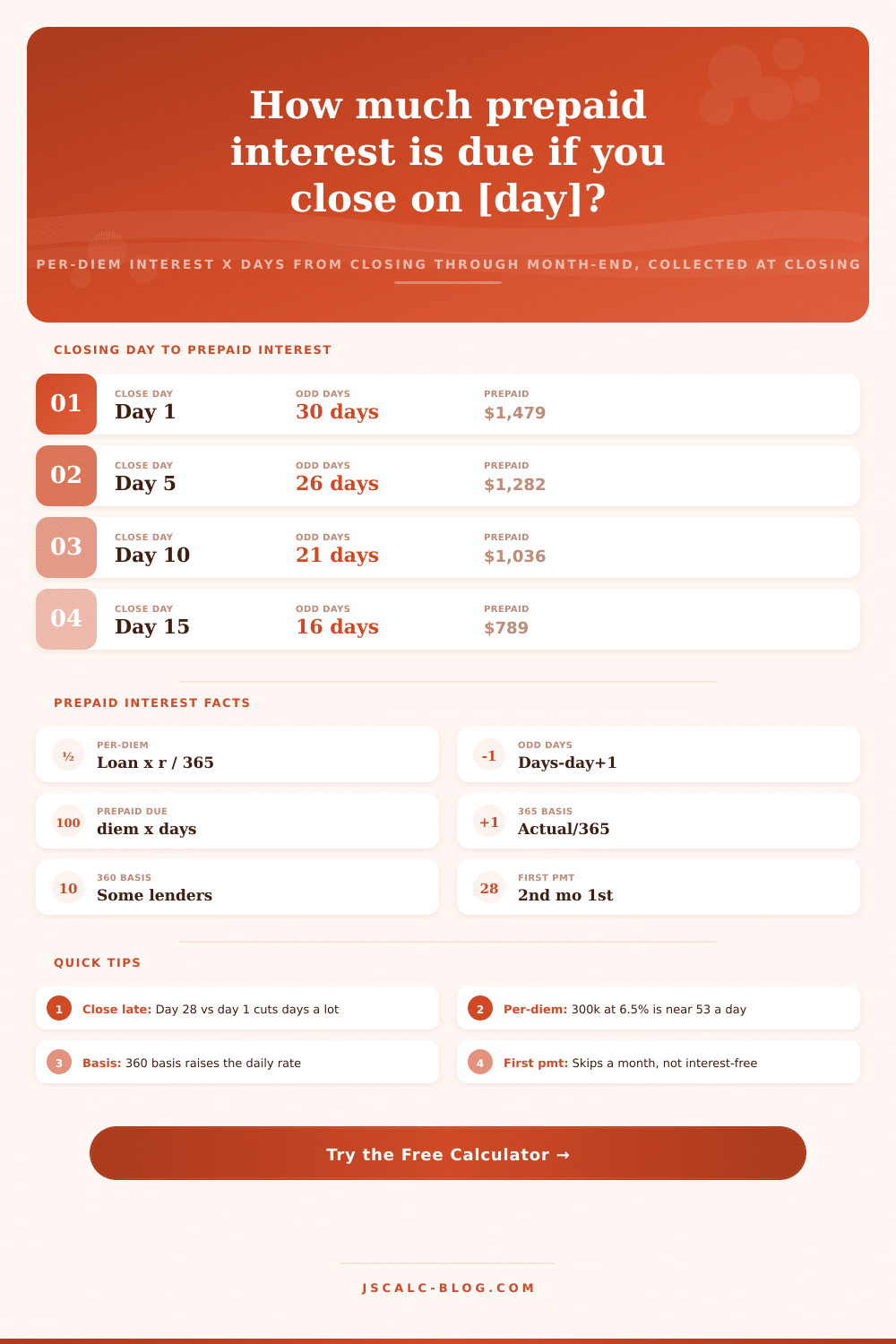
You pay mortgage interest in arrears, so your monthly mortgage payment will be calculated based off the previous 30 days. Your next payment won’t include anything for upcoming 30 days. If you closed on March 15th, you have 16 days remaining in the month. Regular payments won’t falls on those dates. The lender gets to collect interest on those days up-front, because he wants his loan ledger to begin as if it’s already April first. That’s why we call it “odd-days” interest (or sometimes per-diem interest).
What Is Odd-Days Interest?
It depends on nearly nothing except the day of the month you sign the papers. This section breaks out just this one line item. This way, you can see precisely what all that extra time will cost in cold hard cash.
Here’s how it does it: 1.) Multiply your loan amount by your annual rate. 2.) Divide that total by three hundred sixty-five days. 3.) Voila! You have your daily cost. That number… The daily cost, is the key to the entire equation. At a six-and-a-half percent rate on a three-hundred-thousand-dollar mortgage, the daily price tag come to about fifty-three bucks. Sounds like chump change … until you consider that you’re paying for as many as thirty of them.
Most lenders apply this three-sixty-five basis; others divide by three-sixty. The latter spreads same annual interest across fewer days, which increases your daily cost a little bit. You can switch back and forth between conventions with the tool, just make sure to match the math used by your lender.
Now you know the per diem amount, the question becomes: how long does it run? That’s it: just time. They’ll bill you from your closing to very last day of the month. Typically they include your closing day as part of total. Say you’re closing on the fifteenth; well, then you get charged for seventeen days if this is a thirty-one-day month. Some months has thirty, while others may have twenty-eight or twenty-nine.
And when you’re cash-strapped at the table, it’s actualy a good idea to schedule your close at the end of the month. Shifting the date from January 1st to the 28th might save more than a grand up-front on interest on an ordinary loan. This is real money, money you pocket yourself instead of prepaying.
The other thing that surprises people: there’s some weird timing going on here. Your first regular mortgage payment isn’t scheduled to arrive until the first day of the second month following closing. If you close in March, your first bill won’t show up until May first. So April seems like a free month. No need to write any checks! Not so fast, though. You did pay for late March when you closed, and the May payment will cover all of April. That interest didn’t magically dissapears; it simply got moved into buckets marked “prepaid.” This means you’ll need to budget for two payments during those first two months after moving in, even though you’ll write just one actual check.
But how does it work? What would that look like in practice? That’s where the tool comes into play. It removes the noise of taxes, title insurance, and other closing costs. It simply displays the interest math to show exactly when you’re getting billed and how much that adds up to based on your inputs. That makes it easy to run various scenarios against each other. For example, perhaps you’d prefer to close as soon as possible so you can move into the house earlier in the month. But maybe you don’t want to tie up a bunch of cash at closing time. Plug in some different dates and you can see the tradeoff: convenience versus cost.
So what’s in the line item? Understanding this line item will clear up some of the mystery surrounding the closing process. This isn’t a markup. This isn’t a fee. This is renting someone else’s money for those final days until your first full month starts. Know how that per-diem rate works, know how many days get counted up, and enter the closing table with confidence. Know exactly where the number came from. Know if you could of waited a few more days to sign to reduce the cost. Once you know that, the charge changes from something confusing to a simple matter of managing your calendar.