Origination Fee Calculator
Isolate exactly what the lender charges to make your loan. Enter your loan amount, origination points, optional discount points, and flat fees like underwriting, processing, and application, then see the origination fee in dollars, the discount points cost, the total lender charges, and those charges as a clean percent of the loan.
🎯Real Lender Fee Presets
📝Loan & Lender Fee Inputs
The principal the lender is financing.
1 point = 1% of the loan amount.
Prepaid interest that buys down the rate.
Flat charge for approving the loan file.
Flat charge for preparing the paperwork.
Flat upfront fee to start the file.
Note rate if you pay the origination fee.
Higher no-fee rate to compare against.
🔢Formula Snapshot
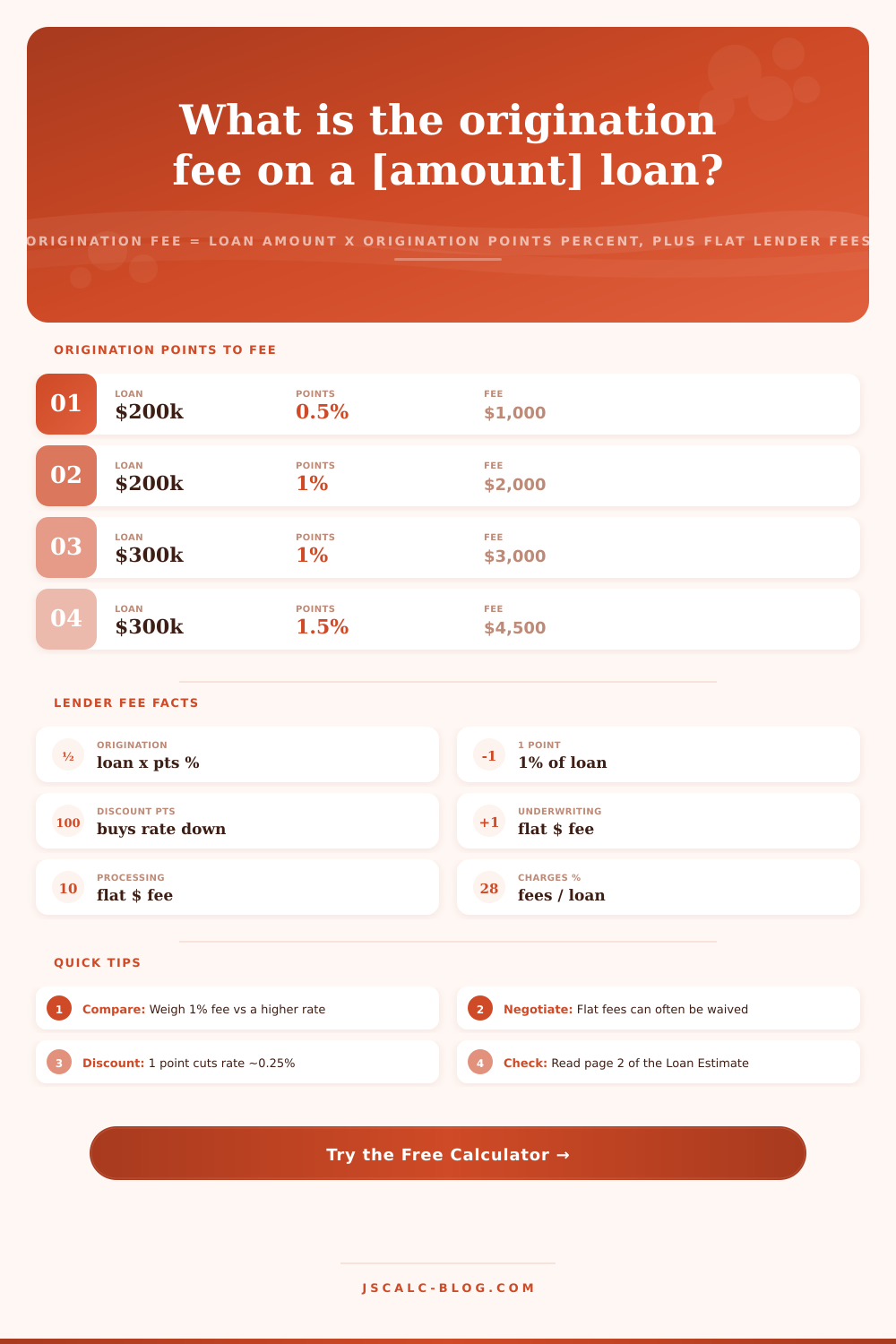
📋Origination Points to Fee Examples
| Loan Amount | Origination Points | Origination Fee | Reads As |
|---|---|---|---|
| $200,000 | 0.5% | $1,000 | Half point |
| $200,000 | 1% | $2,000 | One point |
| $300,000 | 1% | $3,000 | One point |
| $300,000 | 1.5% | $4,500 | Point and a half |
| $400,000 | 0.5% | $2,000 | Half point |
| $400,000 | 1% | $4,000 | One point |
| $500,000 | 1% | $5,000 | One point |
| $350,000 | 2% | $7,000 | Two points |
📊Typical Flat Lender Fee Ranges
| Flat Fee | Typical Range | What It Covers | Negotiable? |
|---|---|---|---|
| Underwriting | $400 - $1,500 | Approving the loan file | Sometimes |
| Processing | $300 - $900 | Preparing the paperwork | Sometimes |
| Application | $0 - $500 | Opening the loan file | Often waived |
| Document prep | $0 - $350 | Drafting closing docs | Often waived |
| Rate lock | $0 - $500 | Locking your rate | Sometimes |
| Origination pts | 0% - 2% | Making the loan | Negotiable |
| Discount pts | 0% - 3% | Buying rate down | Optional |
🧬Discount Points Rate Buy-Down Guide
| Discount Points | Cost on $300k | Approx Rate Cut | Example Rate |
|---|---|---|---|
| 0 points | $0 | 0.00% | 7.000% |
| 0.5 points | $1,500 | 0.125% | 6.875% |
| 1 point | $3,000 | 0.250% | 6.750% |
| 1.5 points | $4,500 | 0.375% | 6.625% |
| 2 points | $6,000 | 0.500% | 6.500% |
| 3 points | $9,000 | 0.750% | 6.250% |
🗃Lender Charge Comparison Grid
| Scenario | Loan | Origination | Discount | Flat Fees | Total Charges | % of Loan |
|---|---|---|---|---|---|---|
| 1% origination | $400,000 | $4,000 | $0 | $2,090 | $6,090 | 1.52% |
| No-origination | $400,000 | $0 | $0 | $1,500 | $1,500 | 0.38% |
| 0.5% + flat | $400,000 | $2,000 | $0 | $1,500 | $3,500 | 0.88% |
| 2 discount pts | $400,000 | $4,000 | $8,000 | $2,090 | $14,090 | 3.52% |
| Full lender | $300,000 | $3,000 | $0 | $2,090 | $5,090 | 1.70% |
| FHA first-time | $250,000 | $2,500 | $0 | $1,290 | $3,790 | 1.52% |
| Jumbo 1% | $750,000 | $7,500 | $0 | $2,590 | $10,090 | 1.35% |
| Refi 0.75% | $220,000 | $1,650 | $0 | $1,690 | $3,340 | 1.52% |
| Flat broker | $400,000 | $0 | $0 | $2,995 | $2,995 | 0.75% |
| Buy-down | $500,000 | $5,000 | $5,000 | $2,090 | $12,090 | 2.42% |
⚙Formula Breakdown
💡Lender Fee Money-Saving Tips
Here’s how it works: You cross the room and find yourself sitting opposite of a lender who slides an item called a Loan Estimate across the table. It’s a page full of tiny fonts and bureaucratic codes. Your eyes glaze over before you get to end of the page.
In all this bureaucracy, buried amongst the numbers, are fees that range wildly from one institution to another, while other fees, things like taxes and title fees, stay roughly fixed. These other fees change. They include flat fees for processing or underwriting, discount points, and origination points, which is where the real negotiation occur. Understanding the legal jargon isn’t as difficult than picking out which line items fall into each category.
Understanding Mortgage Fees and Points
The lender is charging you something to create your loan. Isolating those line items from the rest; understanding precisely what they’re charging you; has less to do with parsing legalese than it does finding those line items in the midst of the noise. This tool eliminates the confusion by cutting straight to part that matters most: What’s the lender collecting from you to close the deal? How does that compare to third party costs (county transfers, insurance, etc.)?
The cost of applying for a mortgage is called an origination fee, which is essentially price of admission. Lenders typically express this as points (one point = one percent of the loan), and it doesn’t sound like much until you hear how it applies to real money. You borrow four hundred thousand dollars from the bank, and the bank’s origination fee is a one-percent charge, also known as one point. That means you pay four thousand dollars up front.
Why don’t lenders just charge a flat dollar amount? Why the percentages? It scales. Processing a half-million dollar loan takes about the same amount of time as processing a $200,000 loan or a $500,000 loan. They can use one rate card and get by with charging the same thing on a modest first-home purchase as they do on a huge jumbo loan.
In fact, confusion between discount points and origination points, which both sound the same but mean different things… Remains the number-one source of closing-day jitters. Discount points represent pre-paid interest that you buy yourself, at a discount, to reduce your eventual interest rate. You pay money now, and (typically) recieve a quarter-of-a-percentage-point reduction in your rate. The origination point represents the lender’s fee for her work. In exchange for this fee, she provides you with … the loan! There is nothing more and no additional benefit beyond receiving the loan. It doesn’t matter when you sell or refinance. You’ll still pay the origination fee. Discount points, however, may not earn their keep if you sell or refinance before three years. So these two types of fees needs to be kept separate: one is an investment in saving money down the road, while the other is a cost of doing business.
Aside from those percentage fees, there are also fixed-dollar fees that you may not notice unless they add up. For example, every company will have at least some combination of application, underwriting, and processing fees (typically $300-1,500 per fee). They don’t sound like much individually, but combined, they can quickly hit two grand or more. Even if you see a lender with no origination points, chances are high it has hefty flat fees which cancel out any seeming benefit.
The calculator rolls all these various fees into one lump sum, and then divides that number by the size of your loan. That gives you a clear percentage figure, so you can compare offers fairly, whether the loans is big or small. The last one is the great equalizer: It standardizes the fee based off the size of the loan. On paper, a six-thousand-dollar charge feels identical, but as a fraction of a two-hundred-thousand-dollar loan it is significantly heavier than as a fraction of an eight-hundred-thousand-dollar loan. But as a fraction of an eight-hundred-thousand-dollar loan, it’s much lighter than as a fraction of a two-hundred-thousand-dollar loan. When everything is written in percent form, you immediately know which lender is cheaper (in relation to the amount of capital they’re using).
In the end, whether to pay a point or not will depend on the length of your mortgage term: It’ll take about seven years (seventy months) for you to recover the upfront point charge from a $45 per month savings on your bill. So if you think you’re going to sell within that period, you’re better off without extra fees. You get more money in your pocket when you close. But if you know you’ll be there for decades? Paying that interest rate down early will save you thousands across the lifetime of the mortgage. That’s why the calculator lets you flip between a traditional originator point fee scenario and a “no origination” one. This lets you test those scenarios quickly and watch how the bottom line changes.
Your closing costs are buried deep within paperwork intentionally written to dissuade anyone from looking too closely. The part of your closing costs that is most negotiable is lender charges. They’re also the easiest thing for lenders to hide behind by breaking them down into flat fees, discount points, and origination points. Then, after burying each one under a different name, the tool converts them into single percentage so you can actualy compare offers fairly.
Here’s how it works: enter the fixed percentage that matches your kind of loan, tweak it according to your actual quotes, and see what happens when you plug in the numbers. Whether you’ve just bought your first house or you want to refinance to cash out some equity, knowing exactly what your lender charges will save you thousands of dollars. This is the fastest way to make sure those thousands don’t get lost in the overhead while you try to pay attention to something else. Once you can separate the signal from the noise, the rest of the math are easy.