Real Estate Transfer Tax Calculator
Estimate the one-time transfer, deed, or documentary stamp tax due at closing. Stack state, county, and city rates, apply per-$500 rounding or a flat percent, add a mansion-tax surcharge above a threshold, and split the bill between buyer and seller by local custom.
🎯Real Jurisdiction Presets
📝Sale & Tax Rate Inputs
Gross contract price the tax is assessed on.
How your state and county rates are quoted.
Percent, or dollars per $500 / per $1,000.
County or parish add-on in the same basis.
Local or transfer-district rate, same basis.
Surcharge applies once price exceeds this.
Extra percent on the full price above threshold.
Local custom, but negotiable in the contract.
🔢Formula Snapshot
📋Sale Price to Total Tax Examples
| Sale Price | Combined Rate | Transfer Tax | Notes |
|---|---|---|---|
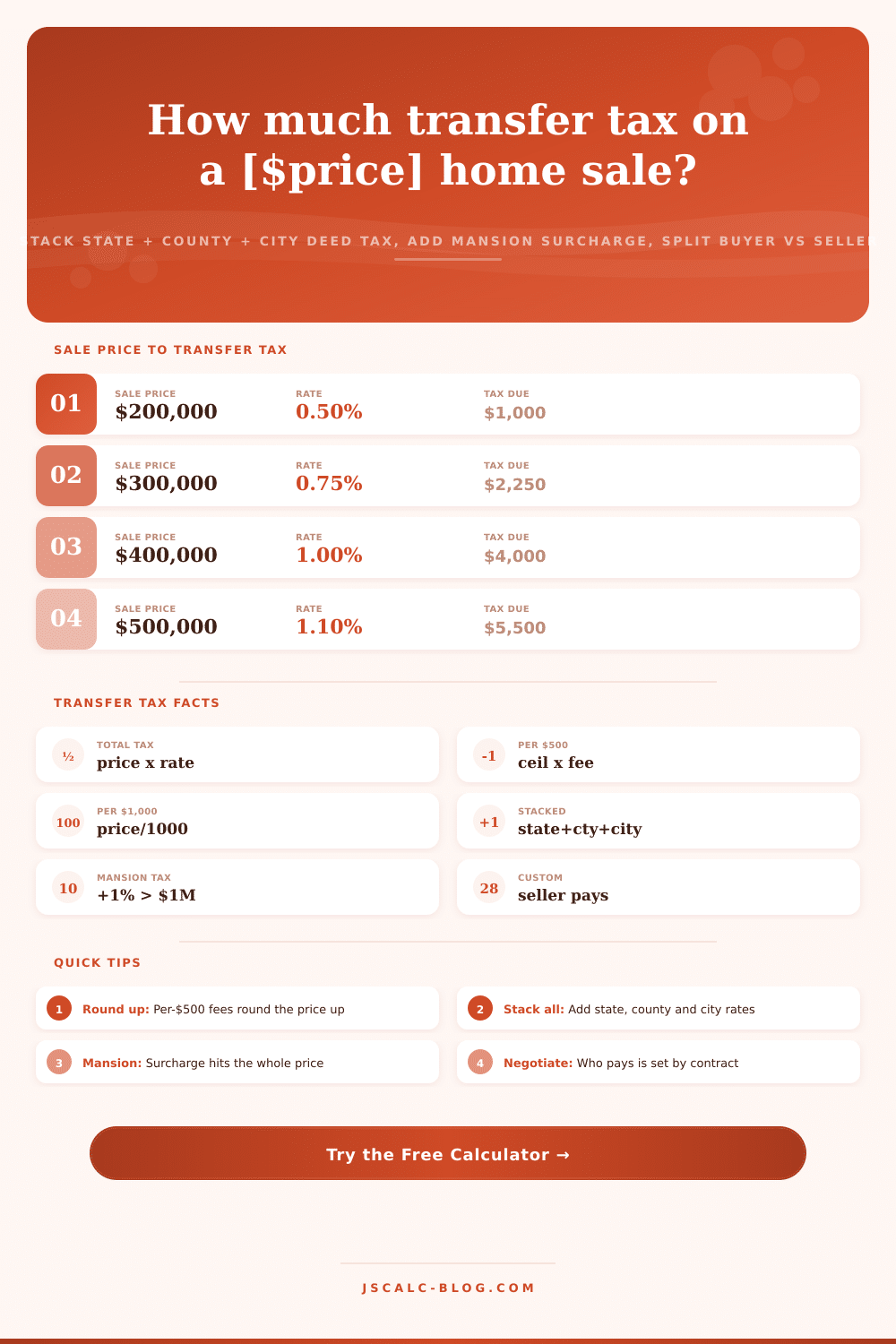
| $200,000 | 0.50% | $1,000 | Low-tax state |
| $300,000 | 0.75% | $2,250 | State + county |
| $400,000 | 1.00% | $4,000 | Flat 1 percent |
| $500,000 | 1.10% | $5,500 | City add-on |
| $650,000 | 1.25% | $8,125 | Stacked local |
| $750,000 | 1.40% | $10,500 | Urban district |
| $900,000 | 1.50% | $13,500 | High-cost metro |
| $1,000,000 | 1.80% | $18,000 | At threshold |
| $1,200,000 | 2.05% | $24,600 | Mansion tax on |
🏢Per-$500 vs Per-$1,000 Rate Basis
| Basis | Quoted As | On $500,000 | Formula | Equivalent % |
|---|---|---|---|---|
| Per $500 | $1.00 / $500 | $1,000 | ceil(price/500) × 1 | 0.20% |
| Per $500 | $2.20 / $500 | $2,200 | ceil(price/500) × 2.20 | 0.44% |
| Per $500 | $3.75 / $500 | $3,750 | ceil(price/500) × 3.75 | 0.75% |
| Per $1,000 | $1.00 / $1,000 | $500 | (price/1000) × 1 | 0.10% |
| Per $1,000 | $5.00 / $1,000 | $2,500 | (price/1000) × 5 | 0.50% |
| Per $1,000 | $8.10 / $1,000 | $4,050 | (price/1000) × 8.10 | 0.81% |
| Flat % | 1.00% | $5,000 | price × 0.01 | 1.00% |
🌐Typical Combined Rates by Jurisdiction Type
| Jurisdiction Type | State | County | City | Custom Payer |
|---|---|---|---|---|
| No transfer tax | 0.00% | 0.00% | 0.00% | N/A |
| Low flat state | 0.10% | 0.05% | 0.00% | Seller |
| Mid stacked state | 0.50% | 0.25% | 0.25% | Seller |
| High-cost metro | 0.75% | 0.25% | 0.50% | Split |
| Big-city luxury | 0.40% | 0.00% | 1.00% | Buyer |
| Per-$500 county | $1.10/$500 | $0.55/$500 | 0.00% | Seller |
| Per-$1,000 deed | $3.30/$1k | $0.00/$1k | $0.00/$1k | Seller |
🗃Stacked Level Comparison Grid
| Tax Level | Rate | On $400k | On $750k | On $1.2M | On $2M |
|---|---|---|---|---|---|
| State | 0.50% | $2,000 | $3,750 | $6,000 | $10,000 |
| County | 0.25% | $1,000 | $1,875 | $3,000 | $5,000 |
| City | 0.25% | $1,000 | $1,875 | $3,000 | $5,000 |
| Mansion +1% | 1.00% | $0 | $0 | $12,000 | $20,000 |
| Combined tax | varies | $4,000 | $7,500 | $24,000 | $40,000 |
| Effective rate | — | 1.00% | 1.00% | 2.00% | 2.00% |
| Seller share | 100% | $4,000 | $7,500 | $24,000 | $40,000 |
| Split share | 50% | $2,000 | $3,750 | $12,000 | $20,000 |
⚙Formula Breakdown
💡Transfer Tax Planning Tips
At this point, you are at the closing table. The check’s been written, the contract’s been signed, the money’s been wired, and it’s time for government to get its cut. That’s right: it’s time for the property-tax bill to come due.
Unlike the annual tax bill you recieve each year in the mail, this one is a single payment. It is charged as a one-time fee every time ownership change, and it is variously known as a conveyance fee, documentary stamp tax, or deed tax (depending on who records your deed). And because the size of the fee depend on where you live, what seems like a routine line-item closes becomes either a tiny part of the overall deal … or a significant chunk of the total that eats away at your take-home gain.
How to Calculate Property Transfer Taxes
The calculator will crunch the numbers for you if you enter your area’s rates, so there’s no need to wonder whether a per-five-hundred fee is cheaper then a flat percentage.
People think there’s one rate posted somewhere on a state web site. It is not true most of the time. There are multiple rates. The state impose a certain rate, the county throws on a rate above it, and the city (or some special transfer district) puts another one on top. They each do their own math and throw everything together as a final bill. In a metro sale, the state may have levied a half-percent rate; the county tacked on a quarter-percent above it; and the municipality threw in yet another quarter-percent. The total are one-and-a-half percent. Instead of two thousand dollars for a four-hundred-thousand-dollar home, it is six thousand dollars. And that makes a difference because buyers and sellers tends to plan for the headline state-only rate and get whipsawed by local surcharge when they meet at settlement table.
However, it’s at the math step that things get tricky. Most recent statutes cite a flat dollar amount of the sales price as a percent. But some older laws is still worded using fees per $1,000 (or sometimes per $500) of sale value. That’s because they’re a relic of the days when actual revenue stamps was affixed to deeds! If the rate is given as per $500, then the price is simply divided by 500, rounded up to nearest integer, and then multiplied by the fee. For instance, if the rate is two bucks and twenty cents per $500 on a five-hundred thousand dollar deal, that comes to two thousand two hundred bucks (one thousand units times the fee). Odd numbers rounds down but remain a complete unit. This tends to push the tax above what you would of expected from a percentage. It is slightly more than a straight-up percentage calculation suggest. The calculator does all this for you, so you can be sure you’re paying the exact amount the clerk want.
The same goes for high-value sales, which are subject to an even steeper cliff. Most jurisdictions has some sort of mansion tax surcharge kicking in after a certain value (in many cases, a million dollars). The painful part is that the surcharge is almost always applied to the full price. If you’re buying a one-point-two-million dollar house with a one-million-dollar-over-threshold surcharge at one percent, you’ll owe an additional twelve thousand dollars on top of base tax. Saving a couple grand in equity by negotiating your purchase price just below the million-dollar mark can mean far more then that. It’s a structural arbitrage that smart sellers will guard against, and smart buyers will take advantage of.
The negotiation includes who writes the check. By default, this will be based off local custom. In most cases, the seller pay; however, in the contract, either side may change this. If the deal size is large enough, changing from the seller paying 100 percent to a fifty-fifty split could move thousands of dollars in cash flow at closing. Instantly, the calculator models both outcomes. Change the threshold. Flip the payer. Watch the effective rate adjust. It takes a confusing mess of local rules and distills it down to one clear number.
Focus on the deal without getting bogged down by the arithmetic. Your budget will survive the closing table if and only if you know exactly what you owe before you sign that settlement statement.