Red Brick Calculator
Estimate standard red clay brick count, total wall weight in kilograms and tonnes, wall area, mortar allowance, and pallet loads using nominal red brick sizes plus the 10 mm joint rule.
🧱Red Brick Wall Presets
📝Wall and Brick Inputs
Total area of doors and windows to subtract.
🔢Formula Snapshot
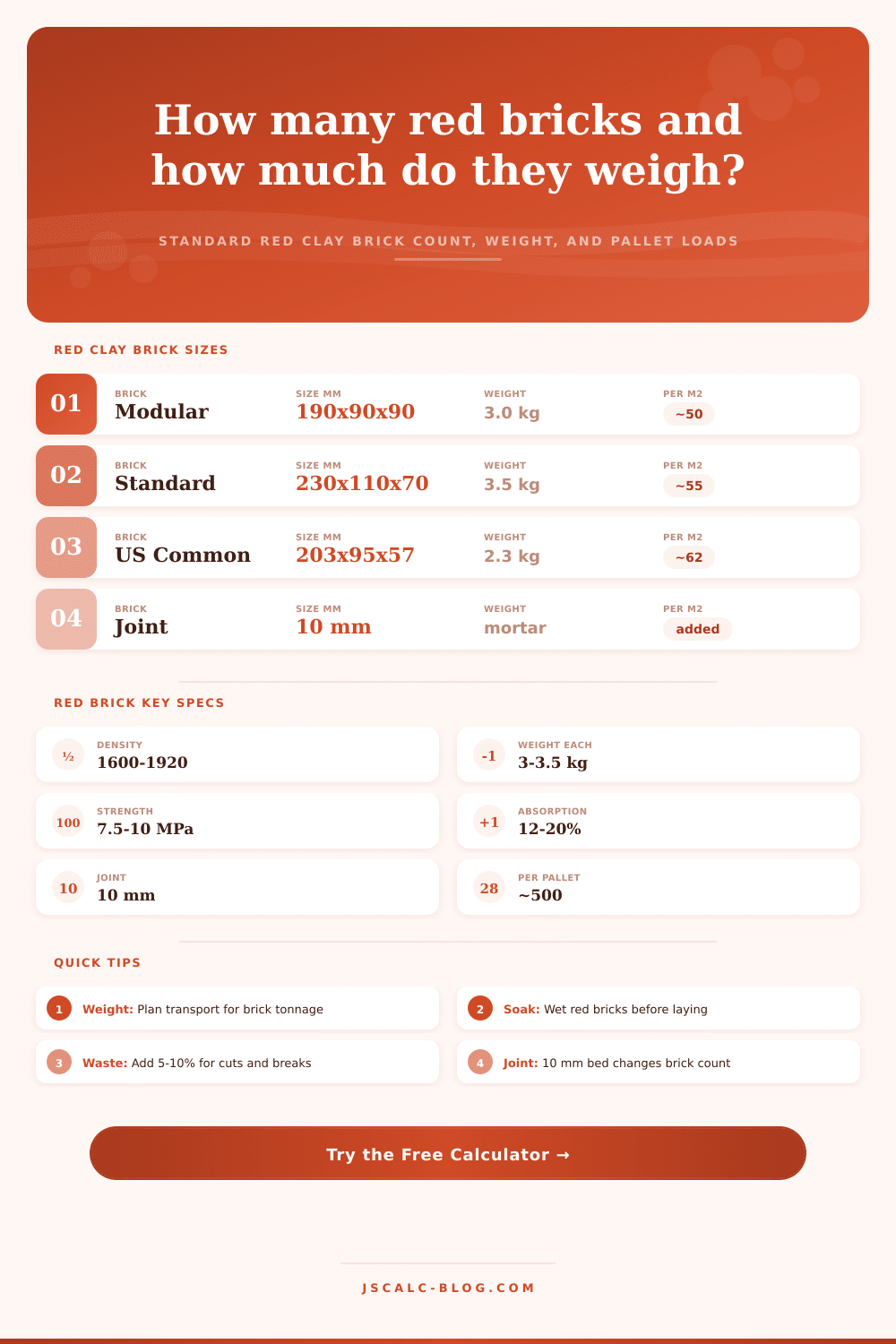
📏Standard Red Clay Brick Sizes and Weights
| Red Brick Standard | Nominal Size | Face L×H | Weight Each | With 10 mm Joint |
|---|---|---|---|---|
| Modular (India / IS 1077) | 190×90×90 mm | 190×90 mm | 3.0 kg | 200×100 mm |
| Standard (India traditional) | 230×110×70 mm | 230×70 mm | 3.5 kg | 240×80 mm |
| US Common red brick | 203×95×57 mm | 203×57 mm | 2.3 kg | 213×67 mm |
| UK Metric (BS EN 771) | 215×102.5×65 mm | 215×65 mm | 3.1 kg | 225×75 mm |
| US Modular red brick | 194×92×57 mm | 194×57 mm | 2.1 kg | 204×67 mm |
🗂Red Brick Comparison Grid
| Red Brick | Nominal Dims | Weight Each | Bricks / m² | Bricks / ft² | Weight / m² | Per Pallet |
|---|---|---|---|---|---|---|
| Modular India | 190×90×90 | 3.0 kg | 50 | 4.6 | 150 kg | 500 |
| Standard India | 230×110×70 | 3.5 kg | 54 | 5.0 | 189 kg | 500 |
| US Common | 203×95×57 | 2.3 kg | 62 | 5.8 | 143 kg | 500 |
| UK Metric | 215×102.5×65 | 3.1 kg | 60 | 5.6 | 186 kg | 400 |
| US Modular | 194×92×57 | 2.1 kg | 64 | 6.0 | 134 kg | 500 |
| Standard (2 wythe) | 230×110×70 | 3.5 kg | 108 | 10.0 | 378 kg | 500 |
| Modular (2 wythe) | 190×90×90 | 3.0 kg | 100 | 9.3 | 300 kg | 500 |
🧪Red Clay Brick Specification Reference
| Property | Typical Range | Common Value | Notes |
|---|---|---|---|
| Bulk density | 1600 – 1920 kg/m³ | 1760 kg/m³ | Fired red clay solid brick |
| Weight per brick | 2.1 – 3.5 kg | 3.0 kg | Varies with size and voids |
| Compressive strength | 3.5 – 35 MPa | 7.5 – 10 MPa | Class designation by grade |
| Water absorption | 12 – 20% | ≤ 15% | First class ≤ 20% by weight |
| Mortar joint | 8 – 12 mm | 10 mm | Standard bed and perpend |
| Efflorescence | Nil to slight | Nil | First class shows no deposit |
⚙Full Formula Breakdown
📋Bricks and Weight per Wall Area
| Wall Area | Modular Half Brick | Modular Weight | Standard Half Brick | Standard Weight |
|---|---|---|---|---|
| 1 m² | 50 bricks | 150 kg | 54 bricks | 189 kg |
| 5 m² | 250 bricks | 750 kg | 270 bricks | 945 kg |
| 10 m² | 500 bricks | 1,500 kg | 540 bricks | 1,890 kg |
| 16 m² (6×2.7 wall) | 810 bricks | 2,430 kg | 875 bricks | 3,062 kg |
| 25 m² | 1,250 bricks | 3,750 kg | 1,350 bricks | 4,725 kg |
| 100 sq ft | 465 bricks | 1,395 kg | 500 bricks | 1,750 kg |
💡Practical Red Brick Tips
Before you look at the plans, you see in your mind’s eye what a garden wall will look like. You think: Will this be the right color? What about the plant palette?
On site, though, it’s all about logistics; it’s not just an artistic gesture. Not only do you have to buy color, but mass. Weight counts, too, for each brick. Water absorption. Mortar increase size. Guessing won’t cut it when estimating.
Why Planning Your Brick Wall Matters
Weight and material counts is dealt with the calculator. You won’t make any more math mistakes that drive up your price. However, knowing the numbers requires seeing beyond the size of each brick. The mortar joint plays an important role many overlooks. Ten millimeters is average, and affects actual size of all units. When added to both height and length, this affects the density of the wall. Although it seems small, ignoring this on a large wall will cause you to order too few bricks. You might be out when you need them.
Weight is where 3D visualization fails most DIYers. One little clay brick seem lightweight in your hand. But when stacked into a two meter high wall, it becomes a heavy load on lintels and foundations. This tool shows weight in wythes (i.e. Layer depth). How thick is the wall? That’s called its wythe. Narrow footings can handle a half-brick fence. Double wythe mean twice as much weight right away. Know how much you’re asking before you pour concrete or hire transport.
Consider waste too. When you cut brick there are always some pieces that don’t make it into a wall. Some get chipped and broken in handling. Five to ten percent is realistic addition as a buffer. This covers units that gets cracked when handled and cuts required at corners. You can change that percentage in the calculator according to how experienced you are. More complex patterns results in more waste different than simple bonds.
The delivery logistics are important. Usually you recieve a large delivery of roughly five hundred units per delivery. That’s a lot of pallets! Knowing exactly how many pallets you need prevents partial deliveries that leave you stuck mid-project. Partial delivery mean stopping your project part way through.
That also speaks to how we prepare our sites. You don’t want to drop heavy loads of material onto unstable ground. They needs solid footing and clear access from the truck. One traditional step is soaking the red brick prior to laying. The clay draws water readily. Damp bricks pulls it away from new mortar. That creates a weaker bond that will crumble over time. To properly cure mortar, soak bricks until they are saturated, then let them become surface dry. Some contemporary builders omit this step; they fails earlier. Absorption rates varies by manufacturer. Look in their specs for what amount of water yours should absorbs.
Standard vs. Modular: Local traditions and availability determine this choice rather than strength (both are about equal for houses). Face dimensions affects how many units fit per square metre, but you can see small size changes in the reference table. Useful if you recieve prices in a different standard.
Red brick construction is a lesson in precision and patience. No skipping over the math, no rushing the mortar. The fewer worries you have about running out of something the better; it frees your mind to lay down a perfectly straight line. Adding a little math ensures that what looks good also lasts through wear and tear.