
Brick Arch Calculator: Voussoirs, Radius, Span, and Angle

Brick Arch Calculator

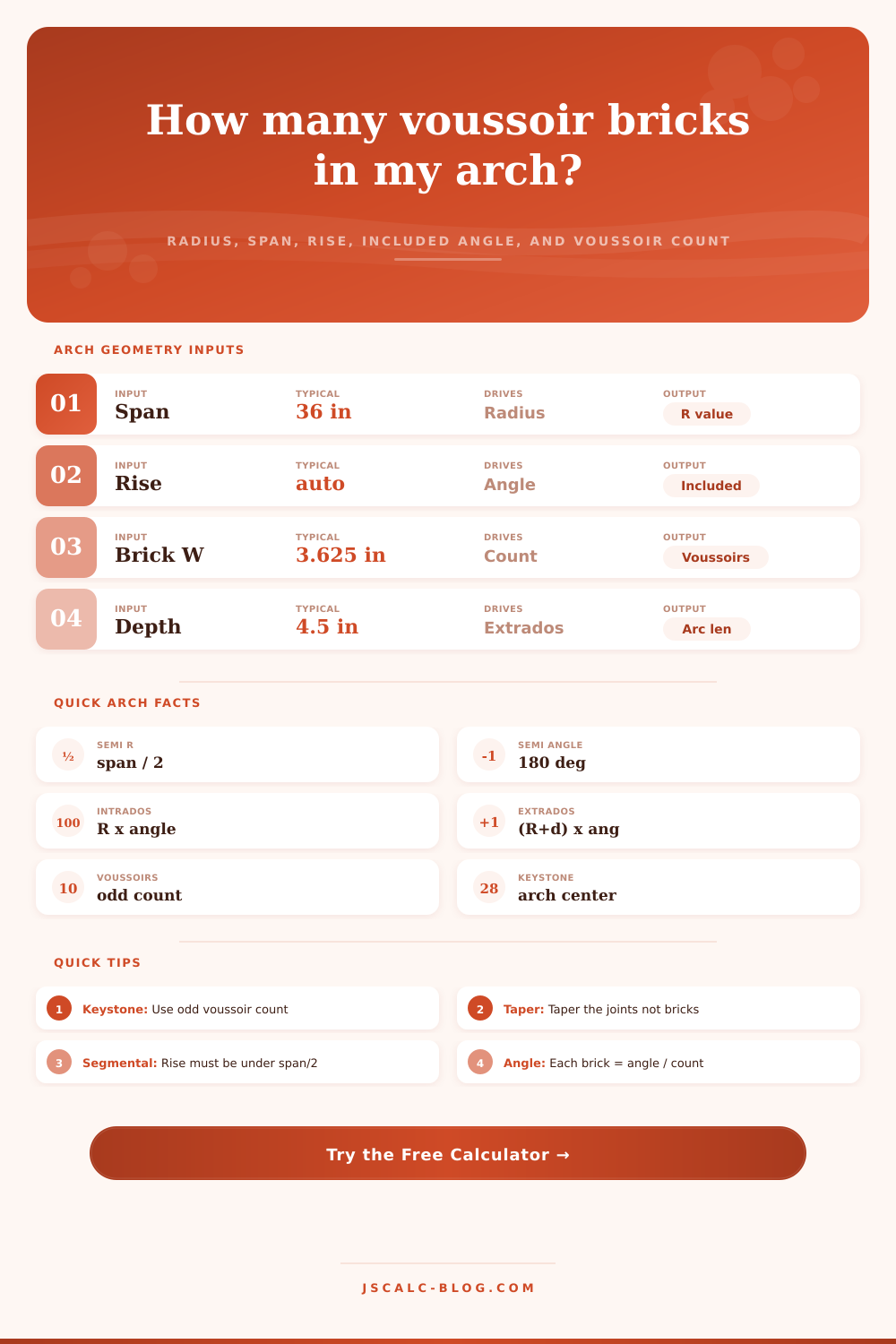
Work out the radius, rise, included angle, intrados and extrados arc length, voussoir brick count, and per-brick keystone angle for semicircular and segmental masonry arches using real trigonometry.

🎯Real Arch Presets

📝Arch Inputs

Clear width of the opening between the springing points.

Auto-set to span / 2 for a semicircular arch. Must stay under span / 2 for segmental.

Radial brick length from intrados to extrados (a single-ring arch).

Tangential brick dimension along the intrados curve.

Joint width measured at the inner (intrados) face.

Arch radius 0 intrados centre radius R
Voussoir bricks 0 including keystone
Intrados / extrados 0 inner and outer arc length
Per-brick angle angle each voussoir subtends

🔢Geometry Snapshot

RIntrados radius
θHalf included angle
dRing depth
NVoussoir count

📐Arch Type Formulas

Arch TypeRadius RIncluded AngleIntrados ArcExtrados Arc
Semicircularspan / 2180° (π rad)π × Rπ × (R + d)
Segmental(span²/4 + rise²) / (2 × rise)2 × asin((span/2) / R)R × angle(rad)(R + d) × angle(rad)
Half-round bullseyespan / 2180° upper halfπ × Rπ × (R + d)
Shallow segmentallarge R, low risesmall anglenear flat curveslightly longer

📏Span to Radius (Semicircular)

SpanRadius RRiseIntrados (πR)Extrados 4.5in Ring
24 in12 in12 in37.70 in51.84 in
30 in15 in15 in47.12 in61.26 in
36 in18 in18 in56.55 in70.69 in
42 in21 in21 in65.97 in80.11 in
48 in24 in24 in75.40 in89.54 in
60 in30 in30 in94.25 in108.38 in
72 in36 in36 in113.10 in127.23 in

🧱Voussoir Count by Span

Arch / SpanIntradosBrick + JointRaw CountOdd Keystone Count
Semi 24 in37.70 in3.875 in1011
Semi 36 in56.55 in3.875 in1515
Semi 48 in75.40 in3.875 in1919
Semi 60 in94.25 in3.875 in2425
Seg 48 in / 12 rise55.64 in3.875 in1415
Seg 72 in / 12 rise75.90 in3.875 in2021
Seg 108 in / 18 rise115.5 in3.875 in3031

🗂Arch Comparison Grid

ScenarioSpan / RiseRadius RIncluded AngleIntradosVoussoirs
Cellar window24 / 12 in12.00 in180.0°37.70 in11
Fireplace arch30 / 15 in15.00 in180.0°47.12 in13
Door arch36 / 18 in18.00 in180.0°56.55 in15
Segmental window48 / 12 in30.00 in106.3°55.64 in15
Porch arch60 / 30 in30.00 in180.0°94.25 in25
Segmental entry72 / 15 in50.10 in91.7°80.16 in21
Garage arch108 / 18 in90.00 in73.7°115.8 in31
Barn arch2000 / 1000 mm1000 mm180.0°3141.6 mm29

Full Geometry Breakdown

Semicircular radiusFor a half-round arch the intrados radius R = span / 2 and the rise equals R, so the included angle is a full 180° (π radians).
Segmental radiusR = (span² / 4 + rise²) / (2 × rise). This is the circle through both springing points and the crown when the rise is less than span / 2.
Included angleHalf-angle θ = asin((span / 2) / R). The full included angle = 2θ, converted to radians for arc length work.
Intrados arcInner curve length = R × included angle in radians. For the semicircle this reduces to π × R.
Extrados arcOuter curve length = (R + ring depth d) × included angle. The extrados is always longer than the intrados.
Voussoir countN = round(intrados / (brick width + intrados joint)). The keystone rule can bump N to the nearest odd number for a centered key.
Per-brick angleEach voussoir subtends included angle / N. The same wedge angle applies at every radius, so bricks stay radial.
Tapered jointsInner pitch = 2R × sin(half wedge). Outer pitch = 2(R + d) × sin(half wedge). The joint opens up from intrados to extrados.

📋Included Angle Reference

Rise vs SpanShapeHalf-Angle θIncluded AngleNotes
rise = span / 2Semicircular90.0°180.0°Full half-round
rise = span / 3Segmental67.4°134.8°Deep segment
rise = span / 4Segmental53.1°106.3°Common window
rise = span / 6Segmental36.9°73.7°Flat garage arch
rise = span / 8Segmental28.1°56.1°Very shallow
rise = span / 12Segmental18.9°37.8°Near flat, high thrust

💡Practical Arch Tips

Keystone tip: An odd number of voussoirs puts a single keystone dead centre at the crown, so the arch reads symmetrically. This calculator can force the count to the nearest odd value for you.
Taper tip: Keep every voussoir brick the same size and taper the mortar joints instead. The joint is thin at the intrados and opens toward the extrados as the radius grows.

There you are: standing at the mouth of a bricked-up hole with a gap that’s begging to be filled. That arch invite precision; it appears as if it were created by the effortless pull of gravity. So plug in your rise (height) and your span (width), and let the calculator above do the rest, spare yourself from guessing about conversions and coefficients. It is the difference between an arch that will last a century and one that sags into gaps between mortar.

First, understand: An arch is always a slice of a circle, not simply a curving line. A flat segmental arch still has a certain radius. And why does that matter? Because you don’t purchase bricks in a random swooping shape. There needs to be center point from which all units spread out.

How to Calculate Your Brick Arch

Enter the width of your opening, and the tool will find that concealed center, then apply the rise (and apply some trigonometry) to figure out what radius might be. With a semicircle, the rise is exactly half of the span, so easy. Most common door and window openings is not as shallow, though. Those are the segmentals. They appear flatter but require more math, since circle they’re part of exists farther out beyond your vision, larger than meets eye.

After establishing the radius, the rest is geometry. With the radius known, the calculator compute the included angle, and then the angle informs you what portion of the entire circle your arch cover. That informs the length of the intrados, or inner arc, on which your brick face will sit. Divide that by the width of a typical brick with a slight mortar joint, and you know how many voussoir you’ll need.

If you choose the keystone rule, the calculator insist on an odd number… Which is crucial. Any other number (i.e., an even one) result in two bricks coming together at the crown, forming a weak vertical mortar line exactly at the top. One keystone sits perpendicularly across from the arc, so it locks the wedge in place. It’s an old Roman trick that still works today, and it’s just that: a tiny bit of structure.

You can see from the output what angle each of those stones should be relative to the next one, that’s the per-brick angle. And if you don’t pay attention to that, you’ll end up with parallel joints. If you use parallel joints different than the correct kind, you will end up with thick mortar on the outside face and no mortar at all on the inside face. That’s bad for shedding water; and looks wrong on the arch itself. Keeping the bricks nice and rectangular keeps the cuts fast and cheap, because you’re cutting the mortar, not the brick.

The calculator shows you the length of the extrados, too, which helps you imagine the difference between the inner curve, and the width of the outer edge. As the depth of the ring increase, or the radius decreases, that gap widens.

Once you have the numbers down, there’s a cadence to the layout of the arch that’s nearly musical: Begin at the outsides and move in toward the middle, with the keystone reserved for last; the last clasp on a bag. This one keeps all the pressure downward and in, pressing it against the abutments. Without this inner locking piece, the outward thrust push outward against nothing but air.

The tool teaches you not to underestimate how much curve a span requires. A six-foot garage arch appears to be pretty flat, until you calculate the angle being formed, which turns out to be quite narrow, requiring each brick to have a slight wedge shape. Mess up on this, and what you’ve got isn’t a smooth arch, but a stack of steps.

Working in brick is a balance between the strengths of the material and the humility required to work within its limitations. With the calculator, you don’t have to worry about the math of geometry. You simply get to enjoy the math of masonry: Measure. Cut. Lay. The math exists solely to make sure the top of the curve closes up perfectly.

That’s no magic, it’s math made to look like masonry. When you set down the last keystone and feel how the whole thing locks into place, you would of understood exactly why all that precision was needed every step of the way.
Brick Arch Calculator: Voussoirs, Radius, Span, and Angle