Rational Exponent Calculator
Evaluate a base raised to a fractional exponent a^(m/n), then read the equivalent radical form, the simplified exponent, and the reciprocal for negative powers. Convert radical to rational exponent and back, with odd-root sign handling and full worked steps.
🎯Real Fractional Exponent Presets
📝Base and Fractional Exponent Inputs
Evaluate finds the decimal. The two conversion modes rewrite the expression in the other notation.
The number being raised to the power, or the radicand inside the root. May be negative when the denominator n is odd.
The top of the fraction. It is the power applied to the base inside the radical.
The bottom of the fraction. It is the index of the root, so n = 2 is a square root and n = 3 is a cube root.
Turning this on takes the reciprocal, so a^(-m/n) equals 1 divided by a^(m/n).
Controls rounding on the decimal value card and the worked steps.
🔢Perfect Root Snapshot
√Perfect Roots Reference Table
| Number | Square root a^(1/2) | Cube root a^(1/3) | 4th root a^(1/4) |
|---|---|---|---|
| 1 | 1 | 1 | 1 |
| 4 | 2 | 1.5874 | 1.4142 |
| 8 | 2.8284 | 2 | 1.6818 |
| 16 | 4 | 2.5198 | 2 |
| 27 | 5.1962 | 3 | 2.2795 |
| 64 | 8 | 4 | 2.8284 |
| 81 | 9 | 4.3267 | 3 |
| 256 | 16 | 6.3496 | 4 |
🔄Rational Exponent to Radical Conversions
| Rational exponent | Radical form | Read it as | Value |
|---|---|---|---|
| a^(1/2) | √a | square root of a | 9^(1/2) = 3 |
| a^(1/3) | ∛a | cube root of a | 27^(1/3) = 3 |
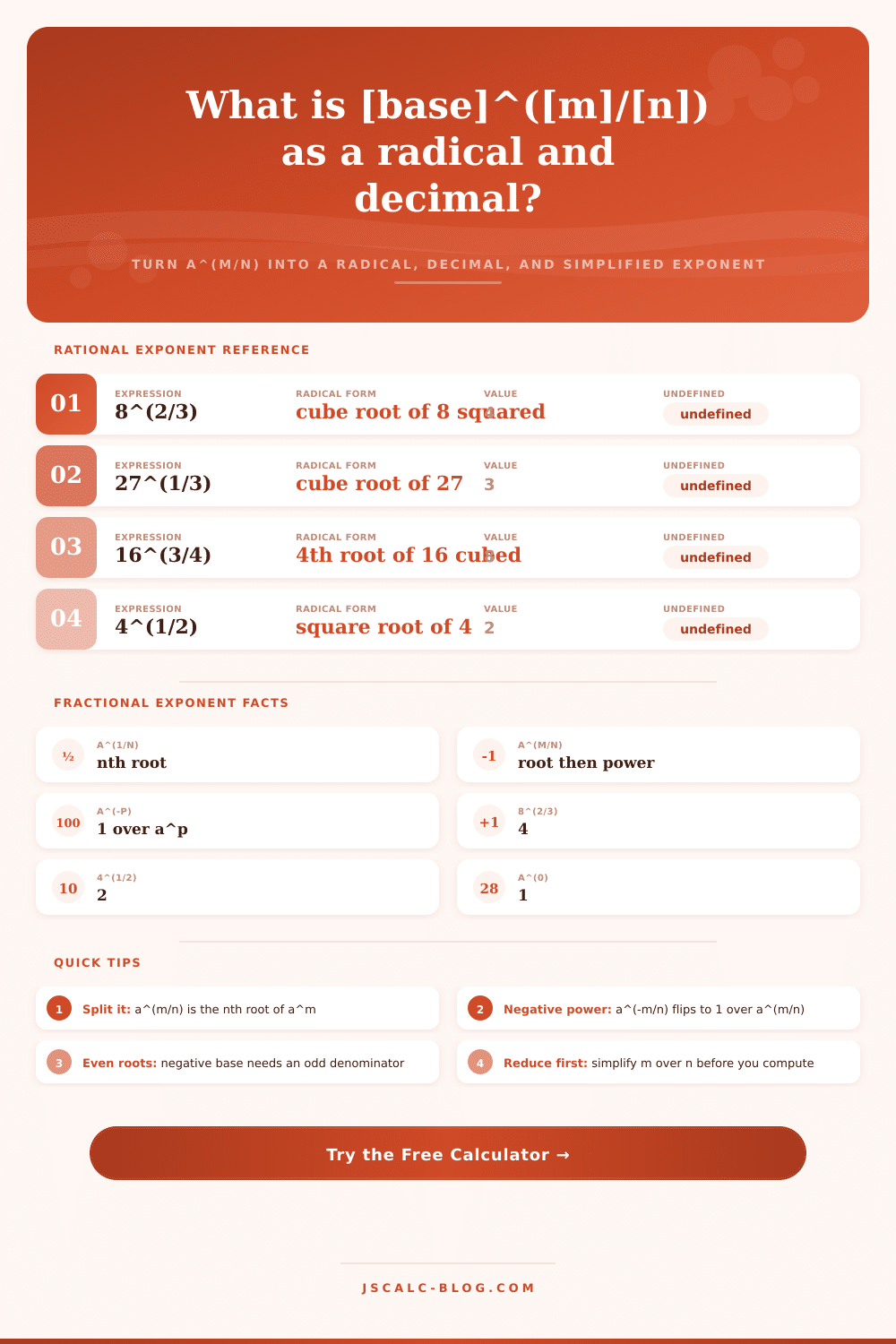
| a^(2/3) | ∛(a²) | cube root of a squared | 8^(2/3) = 4 |
| a^(3/2) | (√a)³ | square root of a, cubed | 25^(3/2) = 125 |
| a^(3/4) | ∜(a³) | 4th root of a cubed | 16^(3/4) = 8 |
| a^(2/5) | √[5]{a²} | 5th root of a squared | 32^(2/5) = 4 |
| a^(5/6) | √[6]{a⁵} | 6th root of a to the fifth | 64^(5/6) = 32 |
−Negative Exponent Reciprocals
| Expression | Rewrite | Radical | Value |
|---|---|---|---|
| 4^(-1/2) | 1 / 4^(1/2) | 1 / √4 | 0.5 |
| 8^(-1/3) | 1 / 8^(1/3) | 1 / ∛8 | 0.5 |
| 9^(-1/2) | 1 / 9^(1/2) | 1 / √9 | 0.3333 |
| 16^(-3/4) | 1 / 16^(3/4) | 1 / ∜(16³) | 0.125 |
| 27^(-2/3) | 1 / 27^(2/3) | 1 / ∛(27²) | 0.1111 |
| 32^(-2/5) | 1 / 32^(2/5) | 1 / √[5]{32²} | 0.25 |
📊Common Fractional Exponents
| Base a | a^(1/2) | a^(1/3) | a^(2/3) | a^(3/2) |
|---|---|---|---|---|
| 1 | 1 | 1 | 1 | 1 |
| 2 | 1.4142 | 1.2599 | 1.5874 | 2.8284 |
| 4 | 2 | 1.5874 | 2.5198 | 8 |
| 8 | 2.8284 | 2 | 4 | 22.627 |
| 9 | 3 | 2.0801 | 4.3267 | 27 |
| 16 | 4 | 2.5198 | 6.3496 | 64 |
| 25 | 5 | 2.9240 | 8.5499 | 125 |
| 27 | 5.1962 | 3 | 9 | 140.30 |
| 64 | 8 | 4 | 16 | 512 |
⚙How the Identity Works
🔭Base Comparison Grid
| Base a | a^(1/2) | a^(1/3) | a^(2/3) | a^(3/2) | a^(5/2) |
|---|---|---|---|---|---|
| 2 | 1.4142 | 1.2599 | 1.5874 | 2.8284 | 5.6569 |
| 3 | 1.7321 | 1.4422 | 2.0801 | 5.1962 | 15.588 |
| 4 | 2 | 1.5874 | 2.5198 | 8 | 32 |
| 5 | 2.2361 | 1.7100 | 2.9240 | 11.180 | 55.902 |
| 8 | 2.8284 | 2 | 4 | 22.627 | 181.02 |
| 9 | 3 | 2.0801 | 4.3267 | 27 | 243 |
| 16 | 4 | 2.5198 | 6.3496 | 64 | 1024 |
| 25 | 5 | 2.9240 | 8.5499 | 125 | 3125 |
📋Domain and Rule Notes
| Case | Rule | Result | Reason |
|---|---|---|---|
| a > 0 | a^(m/n) defined | a positive number | roots of positives are real |
| a = 0, m/n > 0 | 0^(m/n) | 0 | zero to a positive power is zero |
| a < 0, n odd | sign carries | can be negative | odd roots keep the sign |
| a < 0, n even | no real value | undefined (real) | even root of a negative |
| exponent = 0 | a^0 | 1 for a not 0 | empty product convention |
| n = 0 | divide by zero | undefined | root index cannot be 0 |
💡Practical Radical Tips
Writing down an exponent that’s a rational number joins together the operation described above into a single symbol. It feels more like a riddle than a list of instruction! But don’t worry, if you’ve ever raised a number to an integer power (like cubed it or squared it), then you’re already familiar with part of what’s going on here.
If the exponent is a fraction (say two thirds) then the numerator indicate the power you want to use and denominator says which root you’re taking. That’s what connects powers and radicals into a unified system, the laws of exponents holds for cube roots and square roots too.
How Fractional Exponents Work
This tool solve that problem for you. It takes that abstract fraction and converts it to a concrete decimal (and shows you equivalent radical form too). That’s because there’s an identity that says raising a base to the m/n power is the same as raising that base to the m and then taking its nth root. Mathematically speaking, those two orderings are identical, so pick the one that makes the rest of the arithmetic simpler.
The tool will evaluate the result, simplify the fraction if appropriate, and show you reciprocal if exponent is negative. This means you don’t need to second-guess whether to go root first or power first. Taking the root out first (the safer method for most) mean working with smaller and more manageable number throughout calculation. With roots, you can always take the base, say eight, take the root first; in this case, the cube root, and then raise that result to a power, like two-thirds.
In our example above, if we took the cube root of eight, which equals two, and then squared that two, we would of ended up at four, all while never having to work with a middle value like 64. Working from the left side by squaring eight first makes the right-hand side messier fast, especially as your numbers gets larger. The calculator performs the calculation step-by-step and shows you logic behind why a certain sequence results in clean values compared to others. It also automaticly reduces fractions down to their lowest terms.
A common mistake arises from confusing a negative base with a negative exponent. The former makes the answer a reciprocal; the latter will not produce a negative answer unless the base was negative already. For example, 8 to the negative one-third power equals one over (the cube root of) eight, or half. That’s where many student stumble: They think that the negative in front of an exponent simply instructs them to return a negative answer, whereas it reverses the fraction.
With a negative base, however, you must also consider whether you’re taking a real root of a negative number, and that happens only if the index of the root is odd. So for example, while negative two is indeed the cube root of negative eight, the square root of a negative number does not exist as a real number. The tool clearly points out such domain problems so that you don’t accidently try to compute an imaginary number instead.
This structure make it easier to reason through algebra problems, rather than memorize different rules, think of powers and roots as two forms of the same idea. First, you reduce the fraction, so that four to the two-fourths is literal the square root of four! Look up those rows and columns in the reference tables given on the page; they illustrate what happens with common numbers when a perfect power are raised to various fractional exponents. Those lookup charts come in handy if you’re doing financial or physical calculations involving scale factors or growth rates.
Fractional powers can model compound interest over partial time intervals or relationship between area and volume. Remember: Rational exponents represent a series of steps. The calculator simply removes the notation so that you can see what’s realy going on. When you realize that every time you encounter a radical, it’s really a fraction waiting to happen, suddenly there’s nothing scary about them. You’re not solving some riddle; you’re taking the order of operations and adding a little more precision. This transforms an algebraic puzzle into something simple to calculate.