Exponent Properties Calculator
Pick a law of exponents, enter your base and powers, and this calculator names the rule, shows the symbolic simplification step by step, gives the resulting exponent, and confirms the answer with a numeric check.
🎯Real Exponent Law Presets
📝Expression Inputs
The result cards, steps, and numeric check all update to match the law you choose here.
The main base. For product and quotient rules the two bases must match.
Used only for power of a product (ab)^n and power of a quotient (a/b)^n.
First exponent. In power of a power this is the inner exponent.
Second exponent. For zero and negative rules only one exponent is needed.
🔢Common Powers Snapshot
📚The 7 Laws of Exponents
| Law | General form | What you do | Worked example |
|---|---|---|---|
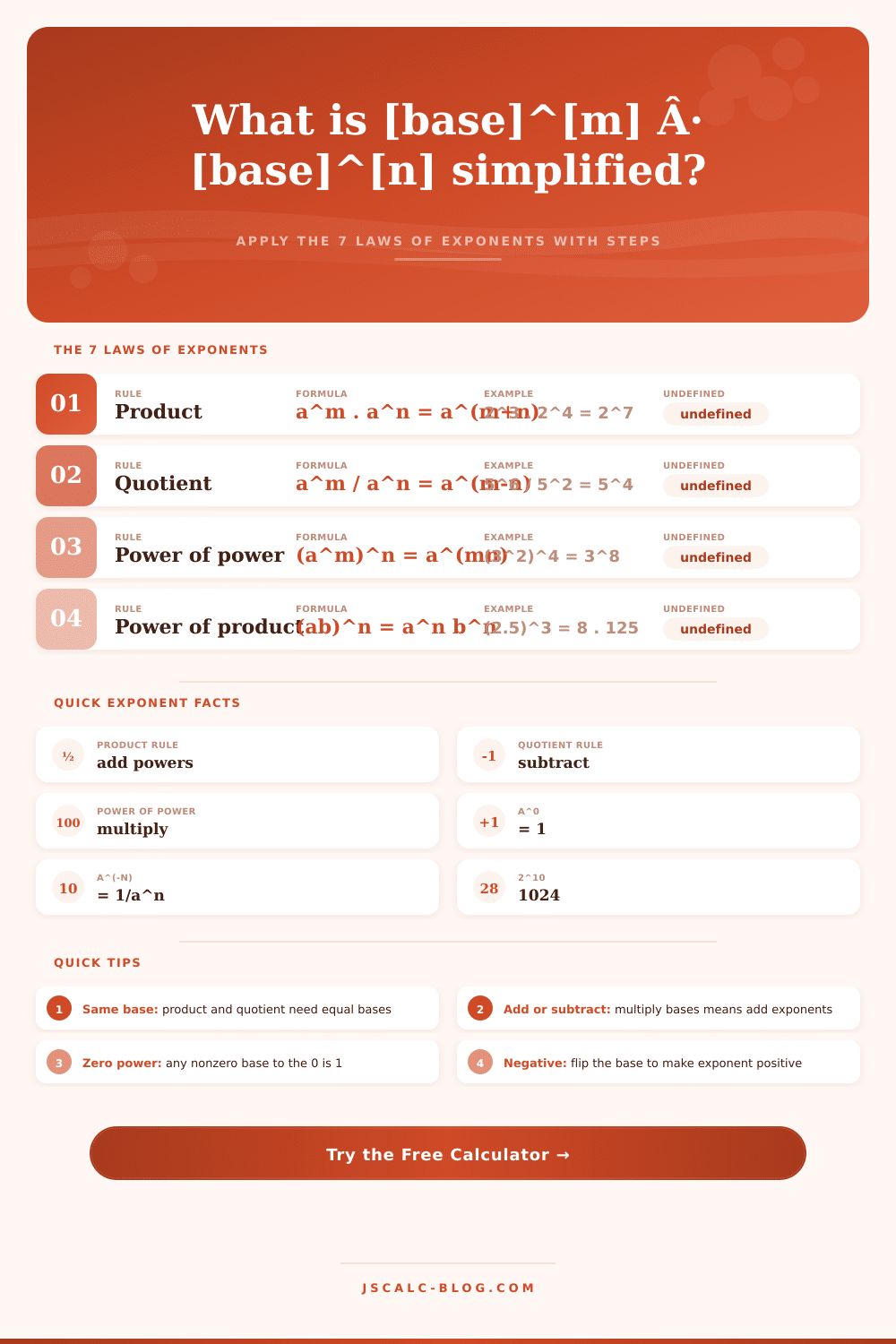
| Product rule | a^m · a^n = a^(m+n) | Add the exponents | 2³ · 2⁴ = 2⁷ = 128 |
| Quotient rule | a^m / a^n = a^(m−n) | Subtract the exponents | 5⁶ / 5² = 5⁴ = 625 |
| Power of a power | (a^m)^n = a^(mn) | Multiply the exponents | (3²)⁴ = 3⁸ = 6561 |
| Power of a product | (ab)^n = a^n · b^n | Distribute the exponent | (2·5)³ = 2³·5³ = 1000 |
| Power of a quotient | (a/b)^n = a^n / b^n | Distribute over the fraction | (6/2)² = 36/4 = 9 |
| Zero exponent | a^0 = 1 | Return 1 for any nonzero a | 7⁰ = 1 |
| Negative exponent | a^(−n) = 1 / a^n | Reciprocal, flip the sign | 4⁻² = 1/16 = 0.0625 |
📈Zero and Negative Exponent Examples
| Expression | Rule used | Rewritten | Numeric value |
|---|---|---|---|
| 9⁰ | Zero exponent | = 1 | 1 |
| (−3)⁰ | Zero exponent | = 1 | 1 |
| 2⁻¹ | Negative exponent | 1 / 2¹ | 0.5 |
| 2⁻³ | Negative exponent | 1 / 2³ | 0.125 |
| 5⁻² | Negative exponent | 1 / 5² | 0.04 |
| 10⁻³ | Negative exponent | 1 / 10³ | 0.001 |
| 0⁰ | Indeterminate | not defined | undefined |
📏Rule Comparison Grid
| Rule | General form | Example input | Simplified | Resulting exponent | Numeric |
|---|---|---|---|---|---|
| Product | a^m · a^n | 2³ · 2⁴ | 2⁷ | 7 | 128 |
| Quotient | a^m / a^n | 5⁶ / 5² | 5⁴ | 4 | 625 |
| Power of power | (a^m)^n | (3²)⁴ | 3⁸ | 8 | 6561 |
| Power of product | (ab)^n | (2·5)³ | 2³·5³ | 3 each | 1000 |
| Power of quotient | (a/b)^n | (6/2)² | 6²/2² | 2 each | 9 |
| Zero exponent | a^0 | 7⁰ | 1 | 0 | 1 |
| Negative | a^(−n) | 4⁻² | 1/4² | −2 | 0.0625 |
| Combined | a^m · a^n / a^p | 2⁴·2³/2² | 2⁵ | 5 | 32 |
🧮Fractional Exponent Preview
| Expression | Meaning | Rewritten | Numeric value |
|---|---|---|---|
| a^(1/2) | Square root | √a | 4^(1/2) = 2 |
| a^(1/3) | Cube root | cube root of a | 27^(1/3) = 3 |
| a^(m/n) | Root and power | n-th root of a^m | 8^(2/3) = 4 |
| a^(−1/2) | Reciprocal root | 1 / √a | 9^(−1/2) = 0.3333 |
Note: this calculator focuses on the seven integer laws of exponents. For rational and radical exponents like a^(m/n), use the dedicated rational exponents tool on JSCalc-Blog.com. The same product, quotient, and power rules still apply to fractional exponents.
⚙How Each Rule Works
📋When Each Rule Applies
| Situation | Use this rule | Key condition | Quick check |
|---|---|---|---|
| Multiplying same base | Product rule | Bases must be equal | Add exponents |
| Dividing same base | Quotient rule | Bases must be equal | Subtract exponents |
| Exponent outside a power | Power of a power | Single base raised twice | Multiply exponents |
| Exponent outside a product | Power of a product | Factors inside parentheses | Give each factor the power |
| Exponent outside a fraction | Power of a quotient | Fraction inside parentheses | Top and bottom get the power |
| Any base to the 0 | Zero exponent | Base not equal to 0 | Answer is 1 |
| Negative power | Negative exponent | Base not equal to 0 | Take the reciprocal |
💡Exponent Rule Tips
Simplifying expressions involving a square root in the numerator and a negative power in the denominator is no walk in the park. They start off innocently enough… Exponents are easy! But as the symbols pile onto the page, it’s more like assembling a puzzle without any of the pieces fitting together. You don’t want another black box that simply spits out a number. You want it to show you what rule was applied and how the answer looks the way it does.
This calculator closes that gap, naming the law, showing the expression symbolically, and verifying the answer numerically. It makes abstract algebra into a step-by-step process you can follow. These aren’t willy-nilly rules to memorize; these are result of what it means to multiply something by itself a certain number of times, which is why exponents behave logically.
Understanding Exponent Rules Step by Step
For example: 2 cubed times 2 to the fourth equals 7 because you’re adding up all the factors for each factor of two. Two cubed has three twos (two times two times two). And two to the fourth have four twos (two times two times two times two). There are seven total factors, or 2^7. The reason the exponents add is that you’re piling on factors. You want to count the number of total factors.
Where people go off track is that they try to pile on the bases. The base remain constant; the count shifts. That’s the product rule.
But what about division? Five divided by five is one. Six divided by two is three. But five divided by five squared is same as five to the sixth power divided by five squared. What happened here? We canceled out two fives from denominator and two from the numerator. We’re left with four leftover factors. This is why quotient rule subtracts the exponent: it’s subtraction pretending to be algebra.
The power of a power rule multiplies the exponents. Why? Because you’re taking this group of factors and multiplying them by themselves again, multiple times over. Three squared are nine. To raise something to the fourth means multiply it by itself four times. With prime factors, you multiply the number of twos in inside term by the number of groups on the outside.
Parentheses require a shift in thinking. Any time an exponent appears outside of the quotient (or product), it gets distributed to all that’s within the parenthesis. And that’s where sign errors come into play. With a negative fraction raised to a power, you need to distribute that power across the fraction’s numerator and denominator individually. That’s what the tool can help you see; that the exponent gets distributed so you don’t forget to apply it to any single part. It displays middle step: where does the exponent land on individual parts before evaluating?
The most confusing elements of this system are the zero and negative exponents. Zero exponents do not makes the value go away. It makes result equal one if the base isn’t zero. That is a result of quotient rule. Subtracting the same exponents results in zero, and dividing any number by itself always equals one.
Negative exponents are simply reciprocals. Don’t think they make the number negative. That’s not true. Four to the negative second power is not minus sixteen. It’s one sixteenth. You know that because calculator displays it as its reciprocal prior to calculating it. So you don’t have to guess at the signs anymore.
To try out these ideas, simply load one of the pre-sets. For instance, try loading in a problem such as “two cubed times two to the fourth”. Fill up the inputs and it shows complete answer. In addition to being an educational tool, this also serves as a study tool; it displays the input, the rule name, the symbolic simplification, and the final number.
Below are summary tables that pull together the logic in a form you can easily glance over if studying later. But actual learning comes from playing with the interactivity here. Change something, watch the structure react. The mistakes happen when people get confused about which operation they apply to the exponents. They’ll add where they’re supposed to multiply or vice versa and their answer will be incorrect in no time. Then there’s subtracting when they should of distribute, but that’ll give them an incorrect answer too.
The benefit is that the tool essentially serves as a guard rail: It states exactly what law it’s applying so if it says “power of a power” then you know you have to multiply and if it says “product rule,” then you know you have to add. That’s a form of feedback, and that feedback loop can help students internalize the pattern without having to memorize it.
Mathematics isn’t so much about mastering a series of magic tricks as it’s about learning a set of rules. If you can grasp that exponents simply represent shorthand for repeated multiplication, then the rules begins to fall into place intuitively. The product rule adds since you’re adding up counts. The quotient rule subtracts since you’re removing counts. The power rule multiplies since you’re increasing the number of counts. It’s all much easier to remember when you understand why.
This calculator combines the numerical check with the symbolic simplification. So whether you’re looking at a difficult problem, or studying for an exam, it makes applying the laws of exponentiation a methodical, trustworthy system. It removes any guessing about how to apply each rule, allowing you to see pattern in all expressions. That is the difference between confusion and confidence.