Exponent and Variable Calculator
Evaluate a monomial a·x^n at any variable value, read the simplified symbolic form, and multiply or divide two terms with the product and quotient rules. Every mode shows a full step-by-step breakdown so the exponent work is easy to follow.
🎯Ready-Made Examples
📝Term Inputs
Evaluate mode plugs a number into one term. Combine mode applies the product or quotient rule to two terms that share the same variable.
The number in front of the variable. Use 1 for a plain x^n term.
Just a label for display. It does not change the arithmetic.
Whole-number power. A negative n means a reciprocal, and n = 0 gives 1 for any nonzero base.
The number substituted for the variable in evaluate mode.
Coefficient of the second monomial (combine mode).
Exponent of the second monomial (combine mode).
Multiply adds the exponents, divide subtracts the second from the first.
Used to show the numeric value of the combined term.
🔢Signature Values
📊Powers of 2 to 10 Table
| Base b | b² | b³ | b⁴ | b⁵ |
|---|---|---|---|---|
| 2 | 4 | 8 | 16 | 32 |
| 3 | 9 | 27 | 81 | 243 |
| 4 | 16 | 64 | 256 | 1,024 |
| 5 | 25 | 125 | 625 | 3,125 |
| 6 | 36 | 216 | 1,296 | 7,776 |
| 7 | 49 | 343 | 2,401 | 16,807 |
| 8 | 64 | 512 | 4,096 | 32,768 |
| 9 | 81 | 729 | 6,561 | 59,049 |
| 10 | 100 | 1,000 | 10,000 | 100,000 |
🧮Exponent Rules Quick Reference
| Rule | Formula | Worked Example | Result |
|---|---|---|---|
| Product | x^m × x^n = x^(m+n) | x³ × x² = x^(3+2) | x⁵ |
| Quotient | x^m ÷ x^n = x^(m−n) | x⁵ ÷ x² = x^(5−2) | x³ |
| Coefficients | (c₁x^m)(c₂x^n) = c₁c₂x^(m+n) | 2x³ × 3x² | 6x⁵ |
| Power of power | (x^m)^n = x^(m×n) | (x²)³ = x^(2×3) | x⁶ |
| Zero power | x⁰ = 1 | 7⁰ = 1 | 1 |
| Negative power | x^−n = 1 / x^n | 2^−3 = 1/8 | 0.125 |
| First power | x¹ = x | 9¹ = 9 | 9 |
✕Monomial Operations Examples
| First term | Operation | Second term | Combined | At x=2 |
|---|---|---|---|---|
| 2x³ | × | 3x² | 6x⁵ | 192 |
| 4x⁴ | × | 5x | 20x⁵ | 640 |
| x⁶ | × | x² | x⁸ | 256 |
| 8x⁵ | ÷ | 2x² | 4x³ | 32 |
| 12x⁶ | ÷ | 3x² | 4x⁴ | 64 |
| 9x⁴ | ÷ | 9x⁴ | 1 | 1 |
| 10x³ | ÷ | 2x⁵ | 5x^−2 | 1.25 |
±Sign Rules for Negative Bases
| Expression | Exponent type | Sign of result | Example | Value |
|---|---|---|---|---|
| (−x)^n | even n | positive | (−3)² | 9 |
| (−x)^n | odd n | negative | (−3)³ | −27 |
| −x^n | any n | negative of x^n | −3² | −9 |
| (−x)^n | even, base −2 | positive | (−2)⁴ | 16 |
| (−x)^n | odd, base −2 | negative | (−2)⁵ | −32 |
| a·(−x)^n | even n | sign of a | 4·(−2)² | 16 |
📈Powers Comparison Grid
| Base x | x¹ | x² | x³ | x⁴ | x⁵ | x⁶ |
|---|---|---|---|---|---|---|
| −3 | −3 | 9 | −27 | 81 | −243 | 729 |
| −2 | −2 | 4 | −8 | 16 | −32 | 64 |
| 2 | 2 | 4 | 8 | 16 | 32 | 64 |
| 3 | 3 | 9 | 27 | 81 | 243 | 729 |
| 4 | 4 | 16 | 64 | 256 | 1,024 | 4,096 |
| 5 | 5 | 25 | 125 | 625 | 3,125 | 15,625 |
| 6 | 6 | 36 | 216 | 1,296 | 7,776 | 46,656 |
| 7 | 7 | 49 | 343 | 2,401 | 16,807 | 117,649 |
| 10 | 10 | 100 | 1,000 | 10,000 | 100,000 | 1,000,000 |
⚙Full Method Breakdown
💡Handy Tips
Built by JSCalc-Blog.com as a free algebra helper for evaluating and simplifying monomials with a variable raised to an exponent. Always double-check homework results against your own working.
To solve for something such as three x to the fourth power, you don’t have to be math whiz. But you do have to understand order of operations.
The size of the items are represented by variable; this is what you’re starting from. The number of them is called the coefficient; this is how many groups we’re talking about. Then there’s exponent, which changes your thinking from linear growth (one, two, three) to exponential growth (ten, one hundred, ten thousand).
How to Solve Algebra Problems with Exponents
Most people mess up here, trying to multiply the coefficient first and then raise variable to its power. That’s just missing point of how notation is working. A calculator does the rest of work, but understanding why it’s coming up with those answers are the difference between knowing and guessing.
A monomial is nothing more than one algebraic term with a variable, its exponent, and its coefficient. So five x cubed is just a monomial. Five is the coefficient. X is placeholder for whichever number we’re trying to test. The three tell us to multiply that number by itself two more times.
The variable name doesn’t matter. What’s important here is that x are a label. That could be called t or y; it doesn’t matter. Changing the label only changes what appears on page. And this is helpful when you’re looking at multiple problem side by side and want to compare them. Here you can swap out those variable names until your answer match the letter in your book.
So for example when you’re evaluating an expression, you have to take base to power before multiplying it out. For example, if you have x squared plus three x squared and you say x is equal to two, you don’t take the three times two and multiply it out to get six and then take that to power of two. You take x to the power of two to get four. Then you multiply by the three to get 12.
And here’s why: The step-by-step breakdown make it obvious what’s happening. It lays out exponent as a series of multiplications, letting you see precisely where final value arises. So you’ll notice that it avoids frequent mistake of performing operations in incorrect order. Seeing the intermediate values also give you something to check against your own mental calculations.
The rules for combining terms are as follows: To combine monomials with same variable, just multiply the coefficient of both terms and add exponent on the variable. For example, 4×2 times 3×2 = (4*3)x2. That’s product rule. This happens because you are combining like factors. But dividing them is different than before. You divide coefficients and subtract exponents. That’s quotient rule.
Those are two things that people gets confused about. They multiply the exponents instead of adding them or vice versa. The calculator knows to make that distinction. So, you tell it whether you want to divide or multiply, and it does right thing.
The other wrinkle: what about negative bases? Negative times a negative equals a positive, so anything raised to an even power will be positive (the negative cancels itself out when paired). Anything raised to an odd power remain negative.
So, for example, while negative three squared is negative, negative x squared is positive. Why? In one case, the negative is part of the base because it is inside the parentheses. In the other case, it is not part of the base because it is outside the parentheses and are added after square is computed.
Tables can make that clear with some actualy numbers. You see that sign shifts to match the oddness/evenness of exponent. These tools also let you plug in your own problem and get help checking work, or even create practice problems for yourself. There are presets, so you don’t have to type it all out again if you’re working on volume change problems or squaring a number. You should of used them more often.
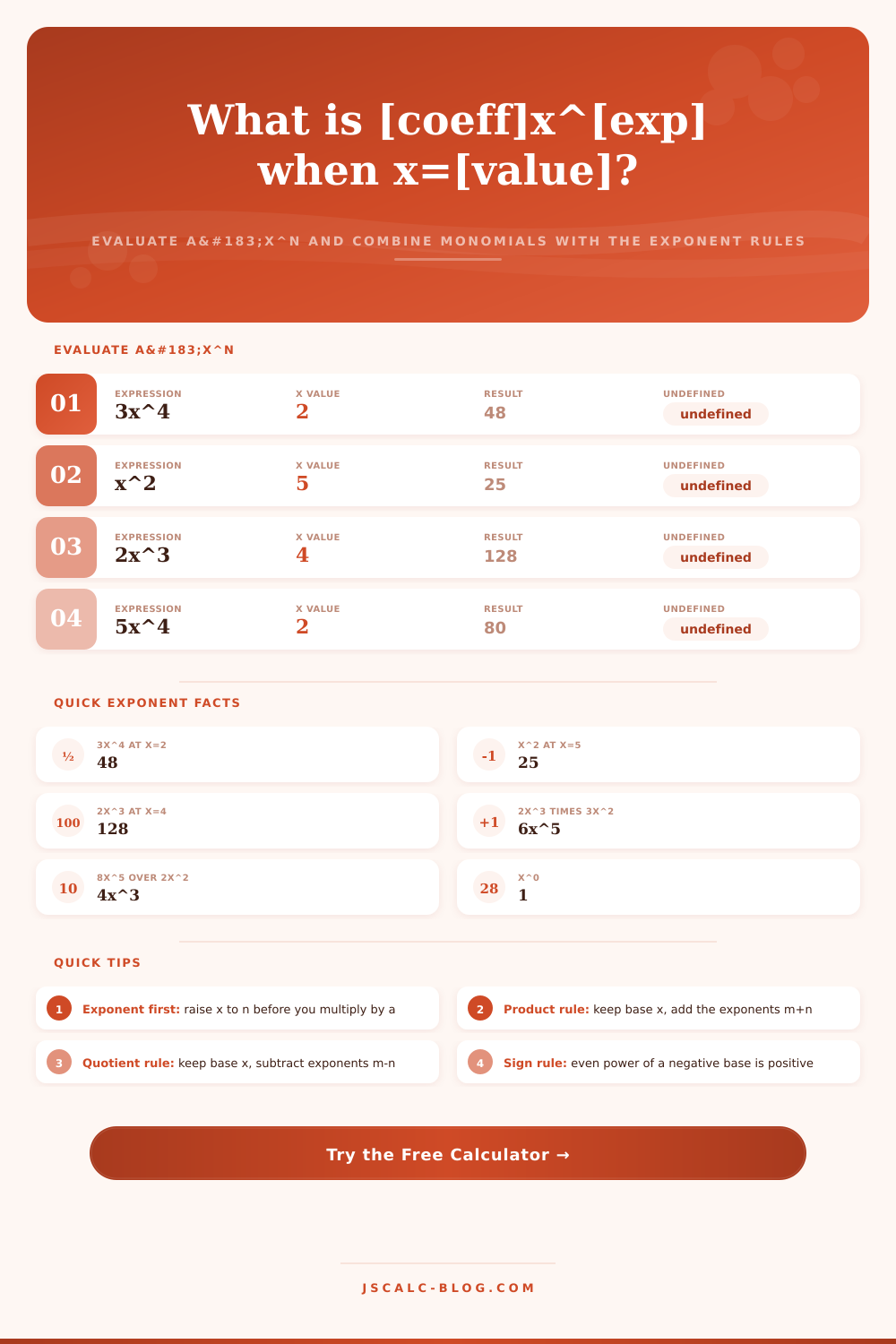
It helps make the symbols into something more concrete: when you know 2 x cubed at x equals four = 128, well, then there’s nothing much to be afraid of anymore. It is just some plain old arithmetic. You want to go from fearing the symbol to understanding the symbol and feeling confident about manipulating it.
The idea is to evaluate expression, which goes from being an abstraction when first presented to something concrete; now you have numbers. Then solving equation isn’t mysterious, but simply a matter of following steps to get to answer.