Quadratic Equation Calculator Step by Step
Enter the coefficients a, b, and c to solve ax² + bx + c = 0. This solver shows every step: it identifies a, b, c, computes the discriminant, substitutes into the quadratic formula, and returns exact and decimal roots plus the vertex, axis of symmetry, and factored form.
🎯Real Equation Presets
📝Coefficient Inputs
Must not be 0, or the equation is linear, not quadratic.
May be positive, negative, or zero.
The value with no x attached.
Step-by-Step Solution
🧮Equation Summary
🔗Factored Form
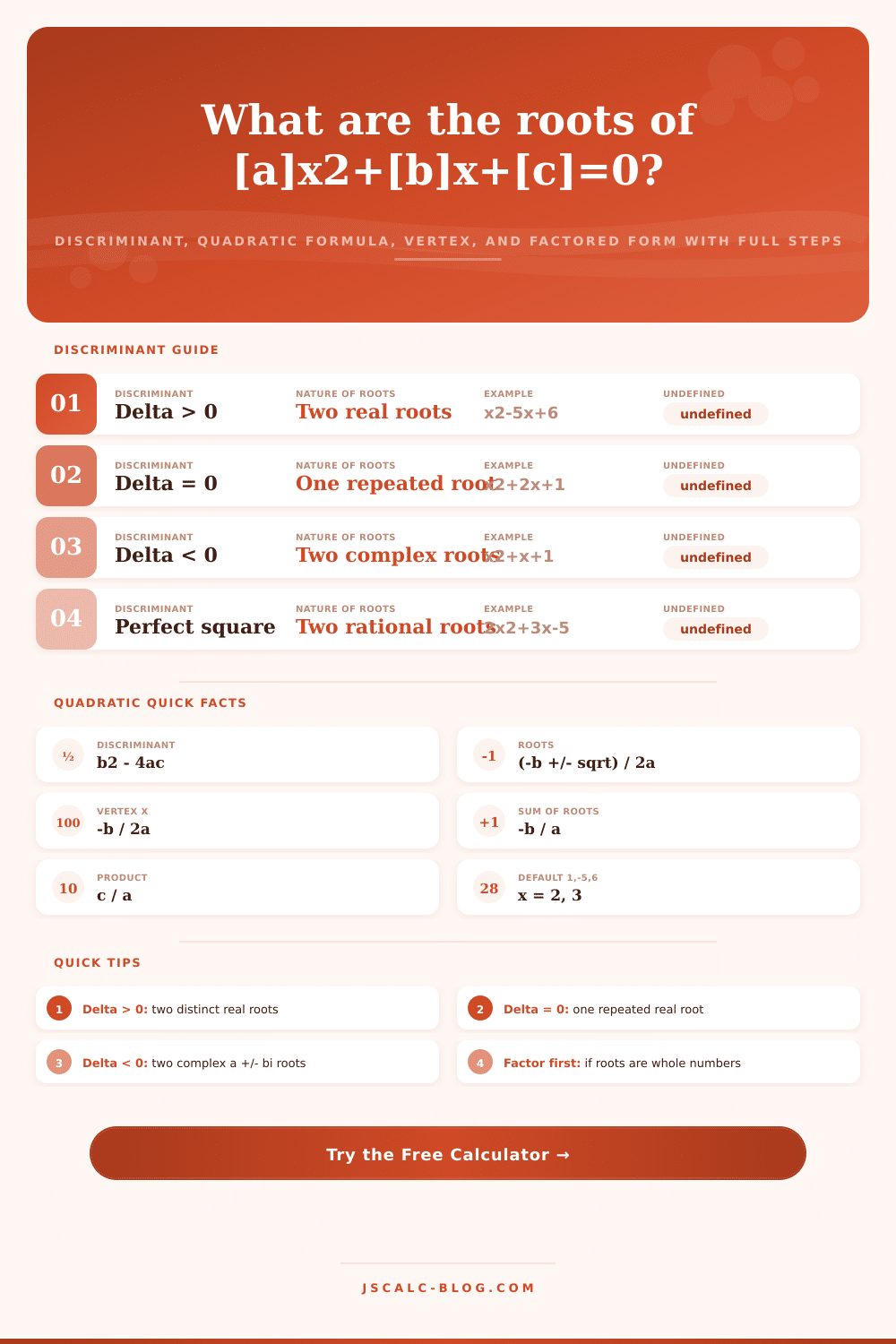
📊Discriminant Sign to Root Nature
| Discriminant Δ | Nature of Roots | Root Form | Example Equation |
|---|---|---|---|
| Δ > 0, perfect square | Two distinct rational roots | Two fractions or integers | x² − 5x + 6 |
| Δ > 0, not a square | Two distinct irrational roots | p ± q√m form | x² − 2 |
| Δ = 0 | One repeated real root | x = −b / 2a | x² + 2x + 1 |
| Δ < 0 | Two complex conjugate roots | a ± bi form | x² + x + 1 |
| Δ = b² | c = 0, one root is zero | x = 0 and x = −b/a | −16t² + 64t |
⚙Quadratic Formula Parts
| Part | Expression | Meaning | Note |
|---|---|---|---|
| Formula | x = (−b ± √Δ) / 2a | Both roots at once | ± gives x₁ and x₂ |
| Discriminant | Δ = b² − 4ac | Under the square root | Sign decides root type |
| −b | Opposite of b | Centers roots on axis | Splits into ± halves |
| 2a | Twice the lead a | Common denominator | Never zero here |
| √Δ | Square root of Δ | Half-spread of roots | Imaginary when Δ < 0 |
📐Vertex and Axis Formulas
| Feature | Formula | For 1x²−5x+6 | Description |
|---|---|---|---|
| Axis of symmetry | x = −b / 2a | x = 2.5 | Vertical mirror line |
| Vertex x | h = −b / 2a | 2.5 | Same as the axis |
| Vertex y | k = f(h) | −0.25 | Min if a>0, max if a<0 |
| Sum of roots | x₁ + x₂ = −b / a | 5 | Vieta relationship |
| Product of roots | x₁ × x₂ = c / a | 6 | Vieta relationship |
🗂Worked Example Comparison Grid
| Equation | a, b, c | Discriminant Δ | Roots | Nature |
|---|---|---|---|---|
| x² − 5x + 6 | 1, −5, 6 | 1 | 3 and 2 | Two rational |
| x² − 4 | 1, 0, −4 | 16 | 2 and −2 | Two rational |
| x² + 2x + 1 | 1, 2, 1 | 0 | −1 (repeated) | One real |
| 2x² + 3x − 5 | 2, 3, −5 | 49 | 1 and −2.5 | Two rational |
| x² + x + 1 | 1, 1, 1 | −3 | −0.5 ± 0.866i | Two complex |
| x² − x − 1 | 1, −1, −1 | 5 | 1.618 and −0.618 | Two irrational |
| −16t² + 64t | −16, 64, 0 | 4096 | 0 and 4 | Two rational |
| x² − 2 | 1, 0, −2 | 8 | ±1.414 | Two irrational |
| 3x² − 12x + 9 | 3, −12, 9 | 36 | 3 and 1 | Two rational |
🔄Sum and Product of Roots (Vieta)
| Equation | Sum −b/a | Product c/a | Quick Check |
|---|---|---|---|
| x² − 5x + 6 | 5 | 6 | 3 + 2 = 5, 3 × 2 = 6 |
| 2x² + 3x − 5 | −1.5 | −2.5 | 1 + (−2.5) = −1.5 |
| x² + x + 1 | −1 | 1 | Conjugates sum to −1 |
| x² − x − 1 | 1 | −1 | Golden ratio pair |
| 3x² − 12x + 9 | 4 | 3 | 3 + 1 = 4, 3 × 1 = 3 |
📚How the Steps Work
💡Solving Strategy Tips
A parabola’s intersection with an axis is a moment shown by quadratic equations. A satellite dish curving as deep as it should, costs matching profits, or a projectile reaching terminal velocity are all moments of rise and fall described precisly by those equations. When you set out to solve such an equation by hand, you’re juggling fractions, square roots, and signs simultaneously. One wrong move and you’ll turn a plus sign into a minus sign ruining your answer. This quadratic equation calculator take all that away from you. Type in three coefficients, and it lays out each step of the solution. You identify terms, calculate the discriminant, and simplify the outcome until you reach final roots. What was once math stress becomes a clear path forward.
Here’s where the trusty ol’ quadratic formula come in. It shows that x = (-b ± √discriminant) / 2a. Notice the +/- sign which includes both answers within the same equation. When you add square root you have one solution. When you subtract it, you have another. The beauty of the formula is that it will spit out an answer regardless of whether the roots are complex, irrational or even whole number based. As long as you plug your numbers into this equation, you’re always going to end up at the right place.
Why Use a Quadratic Equation Calculator?
This is core of this tool for each of these answers. It gives you the answer, the axis of symmetry, and vertex as well. Before calculating the root, there’s a number that will tell you what to expect. It’s called the discriminant and is written as delta equals b squared minus four ac. That piece are inside the square root sign in the equation. The sign on the discriminant tells you something about the roots. If delta is larger then zero, then parabola intersects the x-axis twice: two distinct real roots. If delta is equal to zero, the square root dissapears from the equation. Because the parabola only barely grazes the axis at its vertex, the two roots joins up into one repeated real root. If delta is smaller than zero, the square root of a negative number yields an imaginary number. You have no real roots, but a pair of complex conjugate roots. The calculator spells out in English why your answer appears as it does.
Not all quadratics gives us nice solutions. In those situations, we care about the step-by-step approach. Consider the equation x squared minus two equals zero for example. Its discriminant is eight, which isn’t a perfect square so its roots will be irrational numbers. A rounded off decimal representation will lose some information. Here, it displays the decimal approximation next to exact and simplified radical representation. By pulling out the perfect-square factors from under the radical, it reduces the number inside to its simplest form. If the discriminant of your equation is a negative number, such as with x squared plus x plus one equals zero, the tool knows there are no real roots. It then goes into complex mode, showing results as a real part plus or minus an imaginary part. The root display selector lets you view just decimals, just exact radicals, or show them both at once. Having this level of control allows you to quickly get a sense of what’s going on without getting caught up in the notation.
A parabola has more than just roots. It also have a vertex, which is where it turns, located where x equals negative b over two a. Plug that back into the equation for its corresponding y-value. The axis of symmetry has that exact same value of x. It’s the vertical mirror line that divides the graph into two equal pieces. A positive value of a (the leading coefficient) make the vertex a minimum. A negative value produce a max. When the roots are rational, the calculator also displays the factored form, allowing you to reconstruct the starting equation and verify your results. Two quick sanity checks comes from Vieta’s formulas. The sum of the roots will always be negative b over a. And their product will always be c over a. These relationships allow you to quickly confirm the solution in seconds without repeating all the algebra.
If the discriminant is a perfect square, and all coefficients are whole numbers, you might want to factor it in, too. Otherwise, the quadratic formula is usually faster if roots aren’t simple whole numbers. But with difficult numbers, or a negative (or not a perfect square) discriminant, the quadratic formula is the best choice. It never fails; it requires no guess work and it’s always correct. The quadratic formula comes from taking the general equation and completing the square. That’s also why that x-coordinate for the vertex of -b/2a shows up again in the vertex form. The square-root part give the distance between the axis of symmetry and those roots.
Seconds and you’re off and running. Tap any of the preset keys or enter your own a, b and c values to watch what happens with each kind of root. Choose decimal or exact roots, and select how many decimal places are shown. As you enter things in, it all updates on the fly. A button to print gives you a nice, clean version for lesson notes or homework. For more math tools, explore full library at JSCalc-Blog.com. It can help convert those boring calculations by hand into something easy to see, follow along with and check your work.