Gold Tip FOC Calculator
Dial in front of center for your Gold Tip arrow build. Enter arrow length, shaft GPI, point weight, insert, nock, fletching and wrap, or type your measured balance point, and get FOC percent, total grain weight, GPI, balance location, kinetic energy and momentum.
🏹Real Arrow Build Presets
📝Arrow Build Inputs
Components mode finds the balance point for you.
Carbon-to-carbon cut length of the shaft.
Used in measured mode. Balance on a straight edge.
Gold Tip Hunter XT 340 is about 8.9 GPI.
Gold Tip points: 100, 125, 200, 300 gr.
Accu-Lite aluminum runs 10 to 16 gr; brass more.
Three 2in vanes are roughly 18 to 24 gr.
Chronograph reading beats the IBO sticker.
Used for grains per pound (GPP) safety check.
🔢FOC Formula Snapshot
🎯FOC Range Guide
| FOC Band | Range | Flight Trait | Best Use | Trade-off |
|---|---|---|---|---|
| Normal FOC | 7% to 10% | Flat, fast, forgiving | Target, 3D, flat trajectory | Less forward drive on impact |
| High FOC | 10% to 15% | Stable with good drop | All-round hunting | Slightly steeper arc downrange |
| Extreme FOC (EFOC) | 15% to 19% | Deep-driving, planing nose | Big game penetration | Drops faster, harder to tune |
| Ultra-EFOC | 19% and up | Bone-splitting momentum | Heavy bone, dangerous game | Rainbow arc, needs stiff spine |
🏹Gold Tip Point and Insert Options
| Component | Weight (gr) | Fits | FOC Effect | Typical Setup |
|---|---|---|---|---|
| Field point / broadhead | 100 | .246 and .204 ID | Baseline forward weight | Target and light deer rigs |
| Field point / broadhead | 125 | .246 and .204 ID | Moderate FOC bump | Whitetail and hog hunting |
| Field point / broadhead | 150 | .246 ID shafts | Pushes into EFOC | Elk and heavy arrow builds |
| FACT / hunting point | 200 | .246 ID shafts | Strong Ultra-EFOC | Deep-penetration setups |
| Accu-Lite aluminum insert | 10 to 16 | Most Gold Tip hunter shafts | Small forward gain | Speed-focused builds |
| Brass / FACT weight insert | 25 to 100 | .246 ID shafts | Big forward gain | EFOC and Ultra-EFOC builds |
📏GPI By Shaft Spine
| Spine | Typical GPI | Bare Shaft at 29in | Common Draw Weight | Notes |
|---|---|---|---|---|
| 500 | 7.3 | 212 gr | 40 to 55 lbs | Lighter, faster shafts |
| 400 | 8.2 | 238 gr | 55 to 65 lbs | Popular all-round spine |
| 340 | 8.9 | 258 gr | 60 to 75 lbs | Gold Tip Hunter XT default |
| 300 | 9.3 | 270 gr | 65 to 80 lbs | Stiffer, heavier point ready |
| 250 | 10.9 | 316 gr | 75 lbs and up | Heavy EFOC and trad |
🦄KE Thresholds By Game
| Game Class | Minimum KE | Comfortable KE | Example Animals | FOC Note |
|---|---|---|---|---|
| Small game | Under 25 | 15 to 25 | Rabbit, turkey, squirrel | FOC less critical |
| Deer and antelope | 25 to 41 | 30 to 40 | Whitetail, mule deer | 10 to 15% works well |
| Larger game | 42 to 65 | 45 to 60 | Elk, black bear, hog | 12 to 18% aids penetration |
| Big / tough game | 55 to 65 | 60 to 65 | Moose, big elk, red stag | 15%+ EFOC favored |
| Dangerous game | 65 plus | 80 plus | Cape buffalo, brown bear | Ultra-EFOC and heavy mass |
📊Point Weight Comparison Grid
| Point Weight | Total Weight | FOC % | Balance | KE at 280 fps | Recommendation |
|---|---|---|---|---|---|
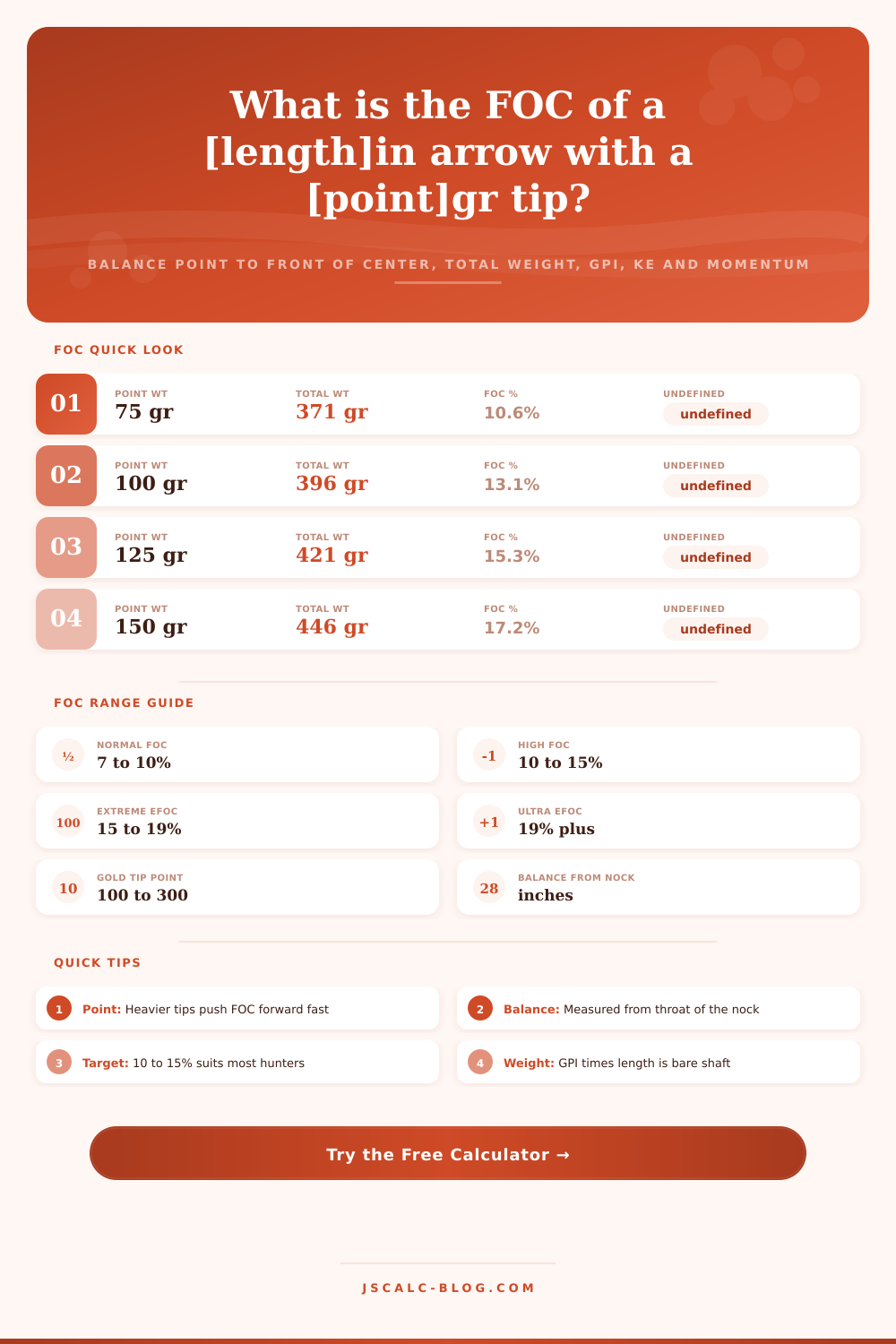
| 75 gr | 371 gr | 10.6% | 17.6 in | 64.5 | Flat target and 3D |
| 100 gr | 396 gr | 13.1% | 18.3 in | 68.9 | All-round deer setup |
| 125 gr | 421 gr | 15.3% | 18.9 in | 73.2 | Whitetail and hog hunting |
| 150 gr | 446 gr | 17.2% | 19.5 in | 77.6 | Elk and big game EFOC |
| 175 gr | 471 gr | 19.0% | 20.0 in | 81.9 | Edge of Ultra-EFOC |
| 200 gr | 496 gr | 20.5% | 20.4 in | 86.3 | Deep penetration builds |
| 250 gr | 546 gr | 23.2% | 21.2 in | 95.0 | Heavy bone, dangerous game |
Grid assumes a 29in, 8.9 GPI shaft with a 20gr insert, 10gr nock and 24gr fletching. Change the inputs above to model your own Gold Tip build.
⚙Full Formula Breakdown
📋Input Reference Values
| Input | Common Entry | How It Is Used | Effect On FOC |
|---|---|---|---|
| Arrow length | 27 to 32 in | Sets L and true center | Longer shaft lowers FOC |
| Balance point | 17 to 21 in | Distance A from nock | Further forward raises FOC |
| Shaft GPI | 7 to 11 | Bare shaft mass | Heavier shaft lowers FOC |
| Point weight | 100 to 300 gr | Front mass, KE, momentum | Biggest lever to raise FOC |
| Insert weight | 10 to 100 gr | Front mass near tip | Raises FOC with the point |
| Nock and fletch | 28 to 40 gr | Rear mass near nock | Lowers FOC slightly |
💡Practical FOC Tuning Tips
Built by JSCalc-Blog.com. Gold Tip is a registered trademark of its owner; this free tool is independent and provided for arrow-building estimates only. Always confirm broadhead flight and follow your local regulations before hunting.
Before you build the arrow, the calculator finds front of center. Simply plug in your point weights and shaft details and let the tool do the math. No more guesswork for balance points.
So what is front of center? It is how far forward the balance point of the arrow are from the geometric midpoint of the arrow. If an arrow was perfecty balanced it would have zero percent front of center. The tip weighs down the arrow, which adds weight forward. That weight help the nose get through air. It also stabilizes the arrow to make it fly straight and help it recover quicker from archer’s paradox. Too much front of center will cause the arrow to lose elevation too fast at distance. Too little will cause the arrow to fishtail. Find the balance where it flies well but stays stable in the air.
What is Front of Center?
Although the physics is complicated, the math is simple. To determine its balance point, lay the completed arrow down on a flat surface. Mark where the nock touches then measure from this mark to halfway up the arrow’s length. For example, let’s say your 29-inch arrow balances out at 18.5 inches up from the nock; that means it has roughly 4 inches of forebow position ahead of center. Divide that distance by the overall length to get the percent position. The closer the bow position is to dead center, the less the arrow will wander during flight.
Next to spine, this is perhaps the greatest variable. Target shooters generally likes their arrows to have 7 to 10 percent of their weight in the front. For them, flatter trajectory and less drop at long distance are a priority. Hunters generaly like more front of center in the 10 to 15 percent range. They shoots for high front of center most of the time. This provides extra penetration from forward mass. Trajectory is about speed but it’s momentum that gets it done when the arrow connects with animal.
The arrows don’t have to be complete. One cool feature of the calculator is that you can enter multiple component of an arrow. You can also enter their weights and their location on the arrow. Each weight get multiplied by its distance from the butt end. That determines a theoretical balance point. Which comes in handy when ordering parts online, and you want a brass insert all the way to the extreme front of center or so. The heavier the points are, the more they will push the balance forward. The rear nocks and fletchings will pull it back a bit.
Arrow weight and spine affects kinetic energy, which is how much punch an arrow has. But momentum matter more in terms of penetrating power, which considers both weight and direction (front of center). Often, that means a heavy arrow will penetrate better then a light arrow. And that’s where many bowhunters adds weight to their tips. Usually this is done by either adding an insert or changing the weight on the point. Shortening the shaft change the spine, and that messes everything up. So don’t try to fix things quickly by shortening the shaft, you should of just checked first.
After any change, always test the broadheads and field points together to see if they is hitting the same place. If not, you’ve got something out of whack with your balance. “An arrow isn’t just about raw power; it’s about control. An arrow needs to be tuned properly so that it will fly true. It has to have enough forward drive to work as intended when it impacts. It’s a balancing act between patience and physics. When the numbers jibe you have a clean-flying arrow.