Discount Point Break-Even Calculator
Buying mortgage points lowers your rate but costs cash upfront. This tool prices your points, compares the monthly payment with and without them, and shows exactly how many months it takes to break even, plus your net savings by the day you plan to sell or refinance.
🎯Real Point-Buydown Scenarios
📝Loan & Points Inputs
The financed balance, not the home price.
Your quoted rate after buying the points below.
1 point = 1% of the loan amount.
Used only when cost mode is set to Override.
Years before you sell or refinance.
🔢Payment Snapshot
📊Points Buydown Comparison Grid
| Points | Point Cost | Rate | Monthly Payment | Monthly Savings | Break-Even | Net at 5yr | Net at 10yr |
|---|---|---|---|---|---|---|---|
| Enter your loan details above to compare buying 0 to 3 points. | |||||||
📈Break-Even By Hold Time
| Years in Home | Months Held | Payment Saved | Point Cost | Net Position | Verdict |
|---|---|---|---|---|---|
| The hold-time decision guide appears after calculation. | |||||
💰Typical Points to Rate Reduction
| Points Bought | Cost on $320k | Typical Rate Cut | Rate 7.0% Becomes | Best For |
|---|---|---|---|---|
| 0 points | $0 | – | 7.00% | Short stays, tight cash |
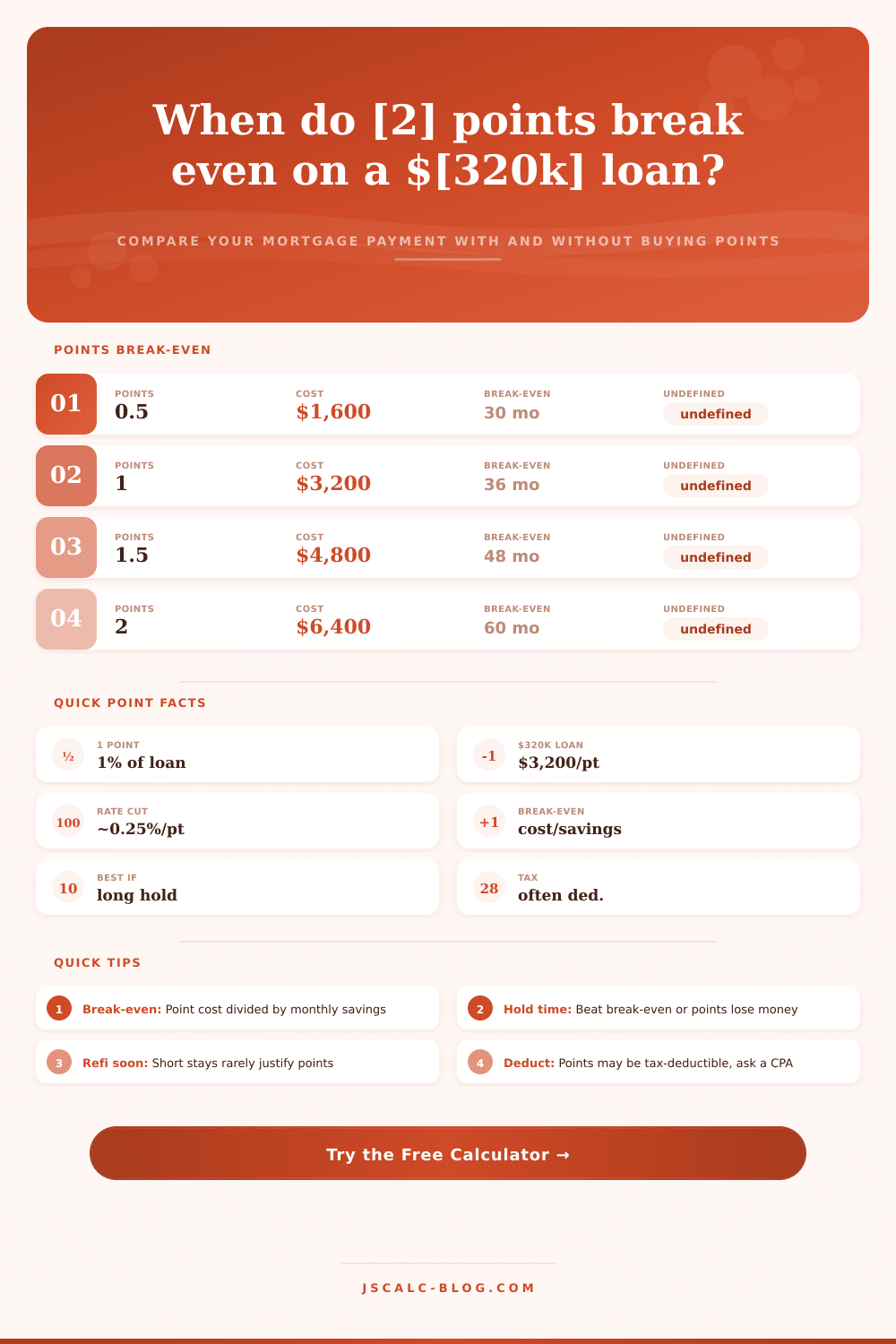
| 0.5 point | $1,600 | ~0.125% | 6.875% | Small nudge on the rate |
| 1 point | $3,200 | ~0.25% | 6.75% | Common single-point buy |
| 1.5 points | $4,800 | ~0.375% | 6.625% | Moderate buydown |
| 2 points | $6,400 | ~0.50% | 6.50% | Long-term hold, strong cash |
| 3 points | $9,600 | ~0.75% | 6.25% | Max buydown, forever home |
Rate cuts per point vary by lender, credit, and market. Roughly 0.25% per point is common, but always confirm with your own loan estimate.
⚙Formula Breakdown
💡Points Buying Tips
📚How To Use This Calculator
Your mortgage rate has risen, and your lender’s calling: “We have a special for you …” You’ll lower your monthly payment if you buy down your interest rate with a couple of grand at closing. This sounds like an attractive offer, but here is what every borrower want to know: Do I save money over time by paying these points? Or am I simply giving the bank cash that I will never see again?
This page’s discount point break-even calculator compares your loan with points to the same loan without points. It will tell you whether or not you’ll save money over time based off your own timeline.
Do Buying Mortgage Points Save You Money?
Prepaid interest come in the form of a discount point. A point is one percent of your loan amount. If you have a three hundred twenty thousand dollar mortgage, one point will cost thirty two hundred dollars. You pay this up front to the lender in exchange for having them reduce your interest rate by a certain amount. Usually this is about a quarter of a percent for every point, again, depending upon the market and your credit.
Buying points is never mandatory. Origination fees are just charges from the lender that does not change your rate. A permanent lower monthly payment is what appeals to them. The catch is paying a lump sum of money to get a lower payment. You pay for the lower payment up front in a lump sum. When you do this you’re making this payment at the same time as you’re writing big checks for closing costs and a down payment.
It all boils down to one number: The break-even point. Most people gets this part wrong. They focus on the lower monthly payment without thinking about the cash they just paid to get it.
You do have to enter your loan information. Then the calculator does all the math for you (so you don’t have to mess around with the formulas). It calculates your payment according to the normal formula: P + interest = (P x r) x (1 + r)^n And it runs this twice: once at your regular rate without points, and again at your lower discount rate after purchasing them. Your net saving is the amount you’ll pay each month WITHOUT points minus the amount you’ll pay WITH points. Take the price of points and divide by your monthly savings.
That’s how many months until break-even. With a typical example: Two percent, or two points, on a three hundred twenty thousand dollar mortgage can run you six thousand four hundred bucks. But they’ll save you about one hundred seven bucks a month. That results in a break-even time of about five years, or sixty months. Go past that point and the points pay for themselfs. Go before and you’re out of pocket.
Four cards are presented, which taken together paint the complete picture: How much money do I have to pay upfront at closing? (That’s the first.) How much lower will each payment be? (That’s the second.) Then how many months will it take before you recover the cost of the spend? (Third card.) And finally, what’s the true profit/loss after you multiply by the actual duration of time you’ll retain the property? This is the fourth card. The point cost is subtracted from your monthly savings multiplied by the months you’ll be there, giving you a real-world profit/loss according to your own time frame, not some imaginary neverending holding period.
If you think you might relocate for work within the next three years, it doesn’t matter if a home has a five-year breakeven. The horizon calculation grounds the decision in reality. They’re points; they reward patience. The biggest factor in determining whether they work out is how long you own the house. It depends on how long you have the mortgage. Selling resets the clock like refinancing does. You would of thrown away most of that up-front cost if you buy points and then refinance a year later.
As a rule of thumb: Buy points if you’re confident you’ll hold this loan beyond the “break even” month. Buy points if you’ve got the cash to pay for ’em without dipping into your emergency fund. Don’t buy points if your breakeven is more distant than you think you’ll hold the mortgage. Take the higher rate, keeping your cash is generally smarter then buying points.
In fact, this may be true at times, you could do the exact opposite of buying points: negotiate with your lender to provide credits toward closing costs, which will increase your interest rate slightly but give you CASH. If you need cash today more than a reduced payment tomorrow, it’s the right decision.
The IRS views discount points as prepaid interest on your mortgage. For example, if you buy a house and pay 3 percent in discount points, that’s fully deductible in the year paid. If you refinance, then points are typically spread out as an interest deduction over time. In general, points paid on a refinance can only be deducted slowly over the loan term. Deductions depend on your situation: Is your point payment itemized? Does your tax rate even allow deductions? Tax rules change. View this potential benefit as icing on the cake, not the cake itself. Run the numbers by a qualified tax pro before assuming this will apply to you.
Is buying mortgage points a scam? No. Is it a slam-dunk winner? Not always. It’s simply an exchange, some upfront money for reduced payments over time. The question of whether it makes sense for you can be answered only by running your own numbers on your own timeline. Plug in your rate and the number of years you expect to live in the house, then watch the calculator tell you when it breaks even, before you ink anything.
You’re not trying to get your payment down; you’re trying to get your net worth up at sale/refi-time. That’s what transforms a good deal into a great one.