PSI to Bar Pressure Converter
Convert between psi, bar, kilopascals, megapascals, atmospheres, millimeters and inches of mercury using exact pascal-based factors, with instant equivalents, tire references, and a full conversion breakdown.
💨Common Pressure Presets
📝Conversion Inputs
Enter the number, then choose the unit it is measured in.
Gauge mode adds 1 atmosphere to the pascal value.
🔢Conversion Snapshot
📊All-Unit Equivalents
| Unit | Value | Factor to Pa | Note |
|---|---|---|---|
| Enter a value above to see every unit equivalent. | |||
🗂Conversion Factor Table
| Unit | Symbol | Equals in Pascals | Equals in PSI | Equals in Bar |
|---|---|---|---|---|
| Pound per sq inch | psi | 6,894.757 Pa | 1.000000 | 0.068948 |
| Bar | bar | 100,000 Pa | 14.503774 | 1.000000 |
| Kilopascal | kPa | 1,000 Pa | 0.145038 | 0.010000 |
| Megapascal | MPa | 1,000,000 Pa | 145.037738 | 10.000000 |
| Atmosphere | atm | 101,325 Pa | 14.695949 | 1.013250 |
| Millimeter mercury | mmHg | 133.322 Pa | 0.019337 | 0.001333 |
| Inch of mercury | inHg | 3,386.39 Pa | 0.491154 | 0.033864 |
| Pascal | Pa | 1 Pa | 0.000145 | 0.00001 |
🚗Tire Pressure Reference
| Application | PSI | Bar | kPa |
|---|---|---|---|
| Compact car (front) | 30 | 2.07 | 206.8 |
| Sedan / SUV typical | 32 | 2.21 | 220.6 |
| Full-size / loaded SUV | 35 | 2.41 | 241.3 |
| Light truck (LT) | 50 | 3.45 | 344.7 |
| Road bike tire | 100 | 6.89 | 689.5 |
| Mountain bike tire | 30 | 2.07 | 206.8 |
🌍Common Pressure Examples
| Scenario | PSI | Bar | kPa | atm |
|---|---|---|---|---|
| Sea level atmosphere | 14.696 | 1.013 | 101.325 | 1.000 |
| Espresso extraction | 130.5 | 9.000 | 900.0 | 8.883 |
| Home water supply | 60.0 | 4.137 | 413.7 | 4.083 |
| Air compressor tank | 100.0 | 6.895 | 689.5 | 6.805 |
| Scuba tank (full) | 3000 | 206.8 | 20684 | 204.1 |
| Blood pressure 120 mmHg | 2.320 | 0.160 | 16.00 | 0.158 |
⚙Full Formula Breakdown
💡Practical Conversion Tips
Comparing measurement systems is a key part of checking tire pressure. You’ve got an owner’s manual in one hand, and a tire gauge in the other. But the two don’t line up. Your pump shows psi; the manual say bar. Before you even know what those numbers say about your car, there has to be some translation. Units of pressure are the unseen borders separating one region from another. They outlast political barriers.
A tire pressure converter eliminate this friction by converting psi to bar (and others) with the click of a button. No more remembering conversion factors as you’re balancing a heavy nozzle. Without all the jargon, it’s easy enough to understand how these things relate. A psi is defined as a pound of pressure exerted on a square inch. That makes it an imperial unit that derives from both distance and weight. Bar is a metric unit intended to represent typical air pressure at mean sea level. Specifically, there are exactly 100 kilopascals in a bar; this gives us a nice round number for making sciencey calculations.
How to Convert Tire Pressure Units
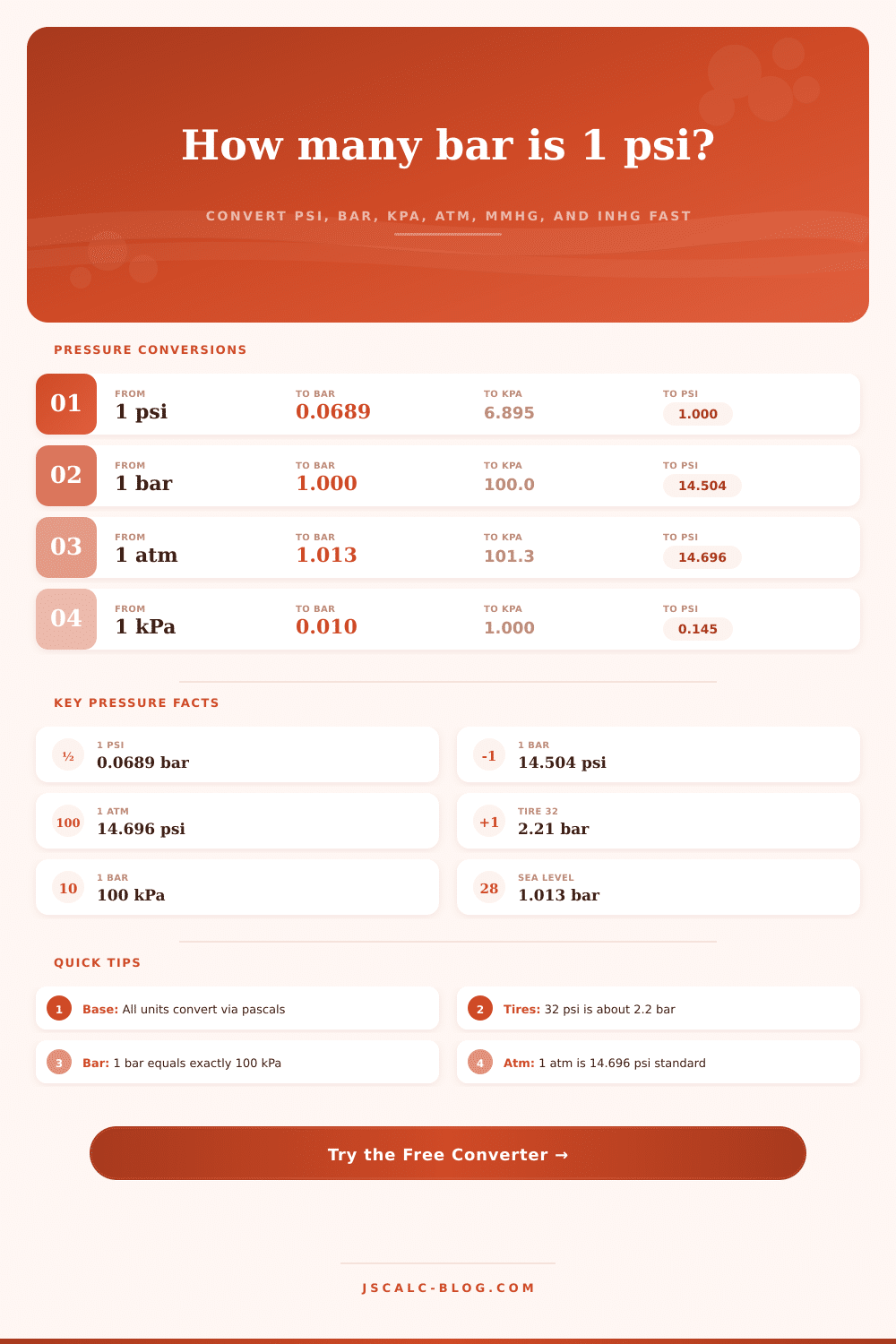
The thing is, these aren’t identical measurements. In fact, one psi is about 0.069 bars. So if you want to know what it takes to reach a full bar of pressure, you multiply by ~14.5. Keep this in mind when you do not have a calculator. The problem is, they look so close that people get confused, but once you zoom down into the decimal points it makes sense. For example, 32 looks like it would be 32 bar, so you think you just pumped up the tires but you actualy over-inflated them dangerously. Or maybe you read it as 2 bar, which is more different than 2 psi… way under-inflated!
So what’s the deal? Well the tool has a handy reference table to explain all of this. It will confirm that 32 psi on your regular sedan tire is more like 2.2 bar. That precision helps you know if it’s safe. It also affects fuel economy. There’s more: Absolute vs. This is gauge pressure. If you take a basic tire gauge out into the open air, it will read zero. It isn’t measuring the full force of all atmosphere bearing down upon you. It is measuring the force of whatever air is in your tire minus the force of the air surrounding you. In science, they want absolute pressure, meaning including that baseline of atmosphere. To do that with this tool, simply add an atmosphere to what it says. This applies if you’re trying to figure out how much liquid pressure there is, say when filling up a scuba tank, or any other situation where you’re dealing with fluid dynamics. If you’re merely topping off your bike tire, who cares?
You’ll also see other units like atmospheres and kilopascals in your search. The atmosphere is an older standard reference measurement based off atmospheric air pressure at sea level. The kilopascal (kPa) is the common scientific unit for things like labels on tires and weather reports in Europe. You’ll frequently see them both listed together with their bar equivalents. It’s kind of fun to see how many different numbers there are, but it really helps put into perspective just how much force we’re talking about here. When you realize that 3000 psi in a scuba tank equates to more than 200 bar, you get a sense of what sort of energy is packed into that little cylinder.
The preset buttons is handy if you have some of these common situations. This allows you to compare your readings to a typical range. For example, with a home espresso machine, something like 9 bar (which is almost 130 psi) is usually optimal. Knowing that 1 bar = X pounds per square inch helps explain why an American pump doesn’t perform as well in Italy. It’s all about how much force needs to push water through those packd-in coffee grounds.
The definition of pressure is simple: force per unit area. Whether you are in Tokyo, Milan, or Detroit the math is the same. All you have to do is apply the correct filter and read it. Using the appropriate units for your gear eliminates the guessing when doing maintenance work. So the next time your gauge doesn’t line up with your manual, keep in mind that 14.5 bridges the gap between them. It’ll keep the pressure in check and whatever you think is safe would of actually be.