Prorated Salary Calculator
Estimate gross pay for a partial payroll period using calendar days, workdays, annual salary, pay-period salary, unpaid leave, and FTE percentage.
Annual-day denominator uses the period start year.
Used for annual salary options and annualized comparisons.
Used when salary basis is set to period salary.
The calculator clips eligibility to the pay period.
Used by the calendar-day method.
Used by the workday method.
100 means full-time, 50 means half-time.
Pay-period method: prorated pay = salary per pay period x paid eligible days / total days in period x FTE percent
Annual workday method: prorated pay = annual salary x paid eligible workdays / total workdays in the year x FTE percent
Calendar annual method: prorated pay = annual salary x paid eligible calendar days / total calendar days in the year x FTE percent
| Formula Step | Calculation | Payroll Meaning | Watch Point |
|---|---|---|---|
| Find period denominator | Count all calendar days or scheduled workdays from period start through period end. | Sets the full-period divisor for most payroll-cycle calculations. | Dates are inclusive. |
| Clip eligibility | Use the later of period start or eligible start, and the earlier of period end or eligible end. | Prevents days outside the pay period from being paid in this check. | Useful for hires and terminations. |
| Subtract unpaid leave | Paid eligible days = clipped eligible days - unpaid leave days for the selected method. | Handles unpaid time off inside the otherwise eligible date range. | Do not subtract the same leave twice. |
| Apply FTE | Gross after days x FTE percent. | Reduces salary for part-time schedules or temporary FTE changes. | Apply after day proration. |
| Compare benchmark | Full benchmark - prorated pay. | Shows the unpaid or ineligible portion of the period. | Use exact cents for reconciliation. |
| Annual denominator | Annual salary x eligible annual-method units / annual total units. | Matches policies that use annual workdays instead of period salary. | Leap years change calendar days. |
| Frequency | Periods Per Year | Common Period | Period Salary Formula | Common Proration Use |
|---|---|---|---|---|
| Weekly | 52 | 7 calendar days | Annual salary / 52 | New hire or leave within one weekly run |
| Biweekly | 26 | 14 calendar days | Annual salary / 26 | US payroll cycles and leave adjustments |
| Semi-monthly | 24 | 1st-15th or 16th-end | Annual salary / 24 | Mid-period starts and exits |
| Monthly | 12 | Full calendar month | Annual salary / 12 | Calendar-day or workday monthly policy |
| Quarterly | 4 | 3-month period | Annual salary / 4 | Long assignment or stipend periods |
| Annual | 1 | Full year | Annual salary | Annual contracts and academic appointments |
| Method | Denominator | Counts Weekends? | Best Fit | Practical Note |
|---|---|---|---|---|
| Calendar-day pay period | All days in the pay period | Yes | Monthly policies that divide by calendar days | February, 30-day months, and 31-day months produce different daily rates. |
| Workday pay period | Scheduled workdays in the pay period | No, unless 6-day or 7-day workweek is selected | Office payroll and employment changes | A holiday may still need manual exclusion if policy treats it as unpaid or non-eligible. |
| Annual calendar denominator | 365 or 366 days in the year | Yes | Annual contracts that pay by calendar-day service | Leap-year proration uses 366 calendar days. |
| Annual workday denominator | Scheduled workdays in the year | No, unless schedule includes them | Policies stated as annual salary times eligible workdays divided by total workdays | The year can have 260, 261, or 262 Monday-Friday workdays. |
| FTE-adjusted proration | Selected method denominator | Depends on method | Part-time or temporary schedule changes | FTE is a percent of the prorated gross salary. |
| Leave-adjusted proration | Selected method denominator | Depends on method | Unpaid leave inside an active employment period | Enter leave in the matching calendar-day or workday field. |
| Adjustment | Input Example | Where It Applies | Effect on Pay | Check Before Payroll |
|---|---|---|---|---|
| Full-time employee | 100% FTE | After day proration | No FTE reduction | Confirm salary is full-time equivalent pay. |
| Half-time appointment | 50% FTE | After day proration | Multiplies prorated pay by 0.50 | Use full-time annual salary if policy stores FTE salary separately. |
| Four-day schedule | 80% FTE or 4-day workweek | Depends on policy | FTE reduces amount; workweek changes day counts | Do not use both if the policy already embeds one adjustment. |
| Unpaid work leave | 2 workdays | Workday method only | Subtracts from eligible workdays before pay is calculated | Match timekeeping records. |
| Unpaid calendar leave | 3 calendar days | Calendar-day method only | Subtracts from eligible calendar days before pay is calculated | Use when the policy counts all calendar dates. |
| Short final paycheck | Eligible end before period end | Eligibility clipping | Pays only active dates in the period | Confirm final employment date and paid leave payout separately. |
| Scenario | Method | Paid Units | Factor | Gross Pay | Difference |
|---|---|---|---|---|---|
| Current inputs | Workday | 0 | 0% | $0.00 | $0.00 |
Calculator reference prepared for JSCalc-Blog.com.
Mid-month hires always make for an awkward moment in the payroll department. How much should they be paid, 11 days‘ worth, or two weeks‘? For example, if an employee starts on the fourteenth and leaves on the twenty-eighth, how much should they be paid? (Fourteenth.) And when does it end? (Twenty-eighth.)
It sounds like a mathematical question, but it’s actualy a policy puzzle: Which days will count as part of an employee’s paycheck, and which won’t? One option would be to treat any given day that falls within the month as belonging in the employee’s paycheck. This includes weekends, when no one is around to use office. Alternatively, you might consider counting only the days the employee was scheduled to work. Both approaches are reasonable. But they lead to different checks.
Simple Rules for Paying Staff
What matter here is who gets to define what a work period look like. Companies generaly follow a basic rule: Divide your yearly salary by how many times you get paid in a year. Then, take whatever fraction of the year you’ve been working and multiply it. It seems easy enough, unless you remember that not every month has the same amount of day. A monthly salary divided by thirty days yields a different daily rate then one divided by thirty-one. And those tiny differences adds up over years, leading certain employers to use workdays instead of calendar days.
Since not all months is created equal (February is shorter than July), using workdays, just Monday-Friday, help even out the numbers. Your paycheck should becomes more predictable; the math becomes less messy.
Here’s the catch: what exactly are you getting paid for? Time spent on-the-job? Time available to do so?
There is another issue: unpaid leave. What happens when an employee goes on vacation three days, unpaid? Don’t just deduct three days (of what?) from her total number of workdays during the pay period. First check the unit, is this payroll system counting calendar days or workdays? Do you use calendar days? Then you deduct three calendar days. Workdays? Three workdays.
You can see how easy it is to get this wrong, you might mix up the units, which looks like a typo but is actualy a failure of logic. The calculator will figure it out for you, if you choose the type (calendar day or workday) that corresponds with your company’s employee handbook. It figures out which dates gets clipped and does the unpaid leave subtractions. You would of no longer have to count by hand every weekend in a leap year.
And there’s FTE in the mix too. If your employee works part-time and earns 70% of what a full-timer would get, you should applies their proration after you determine how many days they worked. First figure out their prorated full-time earnings, then divide that amount by the percentage. That avoids rounding errors that accumulate through the year if you do it the reverse way. Small, yes, but it matters if you’re trying to keep your audits clean.
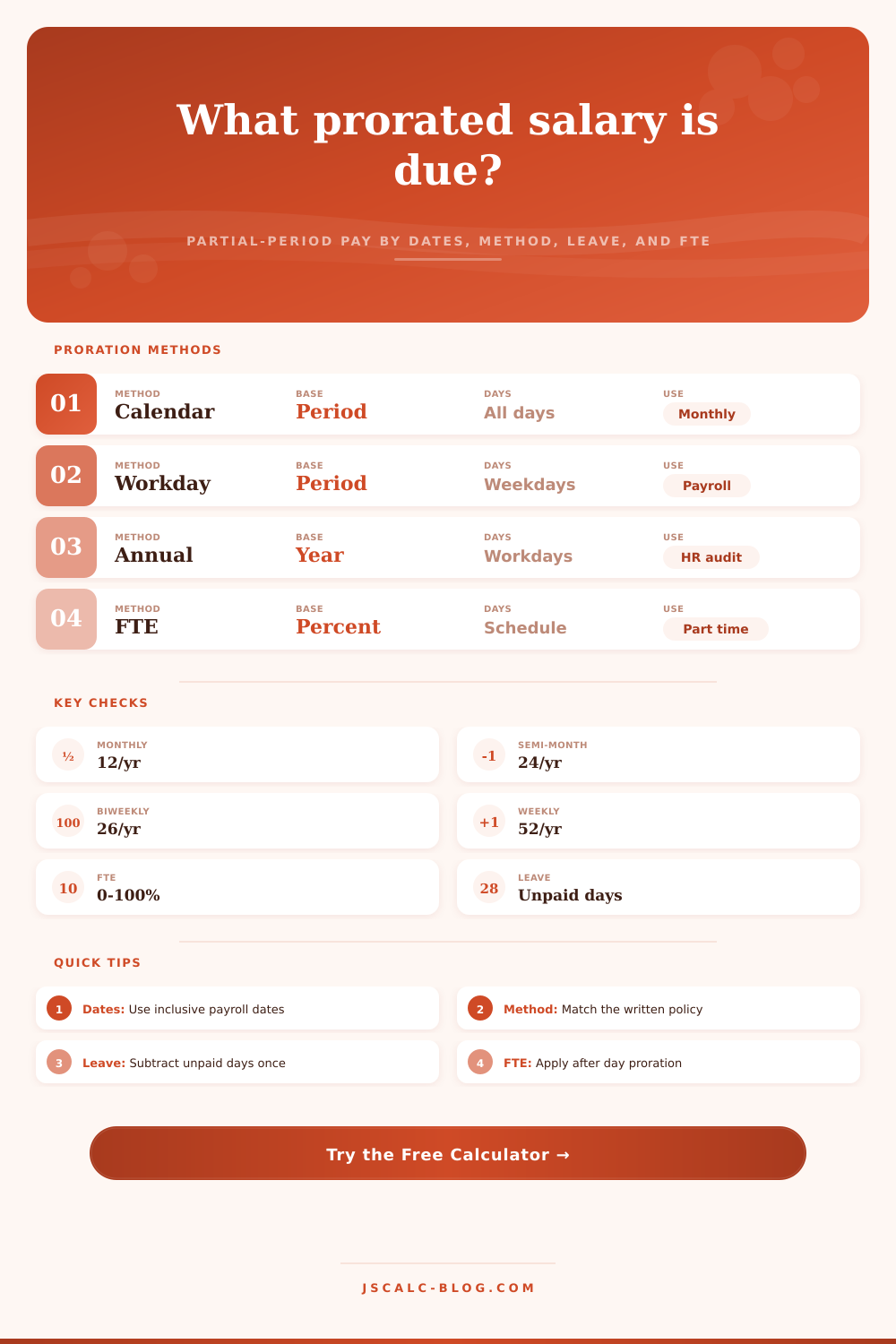
The page has a reference table that explains how various pay frequencies impact denominator. Same principle applies, whether you pay someone monthly, every two weeks, or even each week: define the total units, count the eligible units, and apply the rate.
Don’t think of payroll as a cash transfer. Think of it as a test of clarity and reliability. Even if the numbers is correct, people pick up on strange check patterns. Clear explanations matter. Pick a method and go with it. If you switch between calendar and workday methods for different employee, there will be questions that linger far beyond the initial calculation.
You’re trying to pay people the right amount on the right day without ever questioning the policy. Ultimately, it’s about fairness: people gets paid for what they do. No more; no less. You don’t have to guess when someone started or stopped working, or took vacation. The numbers start making sense once you realize what you’re counting.
That middle-of-the-month employee isn’t a source of panic anymore (it’s one more entry in the routine). Watch out for those dates, sure. But at least the math isn’t fighting back.