Semi-Monthly Pay Calculator
Estimate each of the 24 paychecks in a semi-monthly payroll schedule using salary or hourly gross pay, overtime, supplemental pay, pre-tax deductions, withholding, and post-tax deductions.
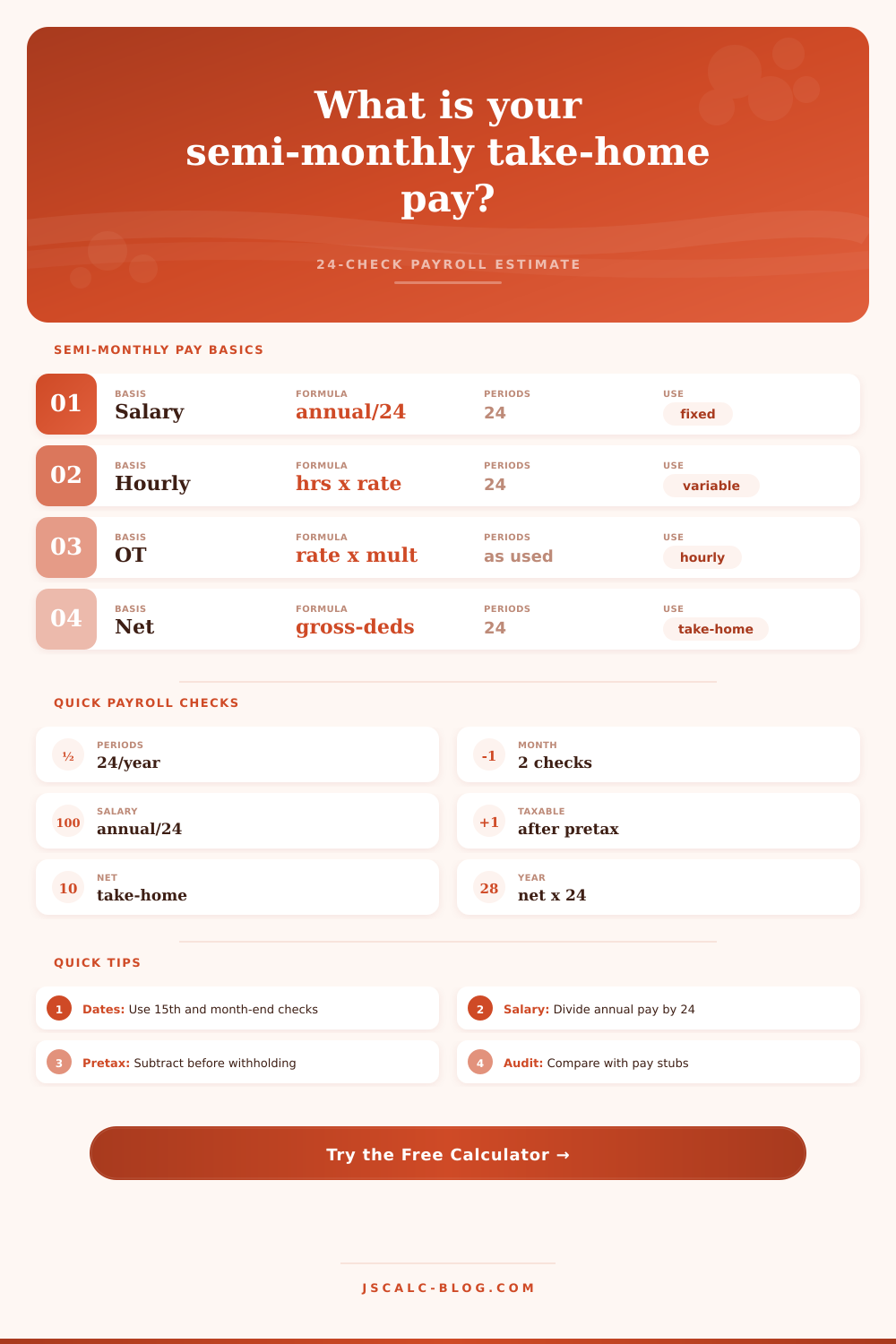
Salary gross pay: semi-monthly salary pay is calculated by dividing annual salary by 24 regular pay periods.
Hourly gross pay: regular hours are paid at the base rate, while overtime is paid at the base rate multiplied by the selected overtime multiplier.
Hourly period gross = (regular hours x hourly rate) + (overtime hours x hourly rate x overtime multiplier) + supplemental payTaxable wages and net pay: pre-tax deductions reduce taxable wages before percentage withholding. Fixed withholding and post-tax deductions are subtracted after that.
| Payroll schedule | Checks per year | Checks per month | Salary divisor | Common timing | Planning note |
|---|---|---|---|---|---|
| Weekly | 52 | 4 or 5 | Annual / 52 | Same weekday | Smallest individual checks |
| Biweekly | 26 | 2 or 3 | Annual / 26 | Every other week | Two extra-check months |
| Semi-monthly | 24 | 2 | Annual / 24 | 15th and end | Even monthly check count |
| Monthly | 12 | 1 | Annual / 12 | Month end | Largest single check |
| Daily casual | Varies | Varies | Hours x rate | After shift | Best tracked by hours |
| Commission draw | 24 typical | 2 | Draw plus earned | Set payroll dates | Supplemental pay matters |
| Contract stipend | 12 or 24 | 1 or 2 | Contract / periods | Contract terms | Withholding may differ |
| Shift differential | 24 typical | 2 | Hours plus premium | Payroll cutoff | Use supplemental field |
| Annual salary | Semi-monthly gross | Monthly gross | Equivalent biweekly gross | Difference vs biweekly |
|---|---|---|---|---|
| $36,000 | $1,500.00 | $3,000.00 | $1,384.62 | $115.38 higher |
| $48,000 | $2,000.00 | $4,000.00 | $1,846.15 | $153.85 higher |
| $60,000 | $2,500.00 | $5,000.00 | $2,307.69 | $192.31 higher |
| $72,000 | $3,000.00 | $6,000.00 | $2,769.23 | $230.77 higher |
| $84,000 | $3,500.00 | $7,000.00 | $3,230.77 | $269.23 higher |
| $96,000 | $4,000.00 | $8,000.00 | $3,692.31 | $307.69 higher |
| Weekly schedule | Annual hours | Average period hours | At $20/hr gross | At $35/hr gross |
|---|---|---|---|---|
| 20 hours/week | 1,040 | 43.33 | $866.67 | $1,516.67 |
| 30 hours/week | 1,560 | 65.00 | $1,300.00 | $2,275.00 |
| 35 hours/week | 1,820 | 75.83 | $1,516.67 | $2,654.17 |
| 37.5 hours/week | 1,950 | 81.25 | $1,625.00 | $2,843.75 |
| 40 hours/week | 2,080 | 86.67 | $1,733.33 | $3,033.33 |
| 45 hours/week | 2,340 | 97.50 | $1,950.00 | $3,412.50 |
| Step | Line item | Calculator field | Taxable impact | Formula role |
|---|---|---|---|---|
| 1 | Base earnings | Salary or hourly | Adds taxable wages | Starts gross pay |
| 2 | Overtime earnings | Overtime hours and multiplier | Adds taxable wages | Raises hourly gross |
| 3 | Supplemental earnings | Supplemental pay | Adds taxable wages | Adds to gross |
| 4 | Pre-tax deductions | Pre-tax deductions | Reduces taxable wages | Subtracts before rate |
| 5 | Basic withholding | Withholding rate | Based on taxable wages | Taxable x rate |
| 6 | Extra withholding | Fixed withholding | No taxable change | Subtracts after rate |
| 7 | Post-tax deductions | Post-tax deductions | No taxable change | Subtracts from net |
When I say “twice a month,” most people imagine their paycheck size remaining constant, it usually doesn’t.
A semi-monthly paycheck give you a reliable rhythm: 24 per year. This makes some sense to many employees; sometimes biweekly payment feels haphazard. But for most people, the math behind those checks can feel opaque without a payroll spreadsheet to look at. Maybe you’re used to seeing your yearly salary, but how do you turn that sum into a single deposit? How do you account for timing and deductions?
How to Calculate Your Semi-Monthly Paycheck
The calculator on this page answer all those questions when you input your pay information. No more guesswork about conversions.
First, there’s the divisor. If you get paid every other week, that means dividing your yearly paycheck into twenty-six periods. If you get paid semi-monthly, that’s dividing into twenty-four. Why? Because each check will be slightly bigger then if you were paid bi-weekly. If your salary is seventy-two grand per year, for instance, you’ll have about two-hundred and-thirty more bucks in each check. And most of us don’t realize this when we accept a new job.
The increased size of your check are nice but you must budget accordingly. Remember: cash flow doesn’t happen as often as you might expect based off either a biweekly or weekly cycle.
For hourly employees, the issue is that calendar doesn’t exactly line up with your day. Maybe one of your periods was slightly more than twelve days; another was almost sixteen. That’s going to change your regular hours and with them, your gross pay. When using the tool, enter actual regular and overtime hours worked during this period. You won’t need the historical average for each month. But having an idea, say, eighty-six point six-seven hours per week represents a forty hour week, gives you something to go off of.
If you do get overtime, be aware that the multiplier can varies. Usually it’s just time-and-a-half (standard), but certain positions may pay out double time on extreme shifts/holidays.
Pre-tax deductions lowers your taxable income, which means you pay fewer taxes on less money. Examples include retirement accounts (traditional 401(k), traditional IRA, etc.), health savings accounts and flexible spending plans.
Post-tax items includes things such as Roth contributions or union dues. They come out of your paycheck after tax has been withheld.
These categories are important for a few reasons:
• Your net pay will depend on the order of operations. The order in which these items hit your paycheck will affect how much you get paid. Here’s why: You’re paying taxes on what remains after pre-tax deductions, but they’re subtracted from your take-home pay after post-tax deductions.
There’s also supplemental pay to consider. Shift differentials, commissions, and bonuses can be taxed at varying rates compared to your regular paycheck. If you get a bonus check, withholding could increases substantialy. It will reduce what you have available during the timeframe, but don’t worry, it’s on reserve until tax time. Having this perspective helps avoid the panic that many employees feel when their bonus check look smaller than they anticipated.
The breakdown chart illustrates salary vs. Hourly vs. The breakdown chart illustrates salary vs. Hourly vs. Supplemental income so you know which part affects your final payout.
If you’re on a semi-monthly payroll, adjust your thinking so that you view it as being on a twenty-four check schedule (not twelve or twenty-six). This determines your annual cash flow. By lining up loan/rent payments with paychecks, you’ll also minimize the stress. You should of adjusted for this earlier. You want to be able to precisely calculate what’s left over for discretionary spending once you’ve paid for necessities.
With this knowledge, paycheck will fit into your financial plan. It’s simple math, but make sure you get the timing right and livig within your means is easier.