Biweekly Pay Calculator
Estimate gross pay, pre-tax deductions, basic withholding, and take-home pay for a standard 26-paycheck year.
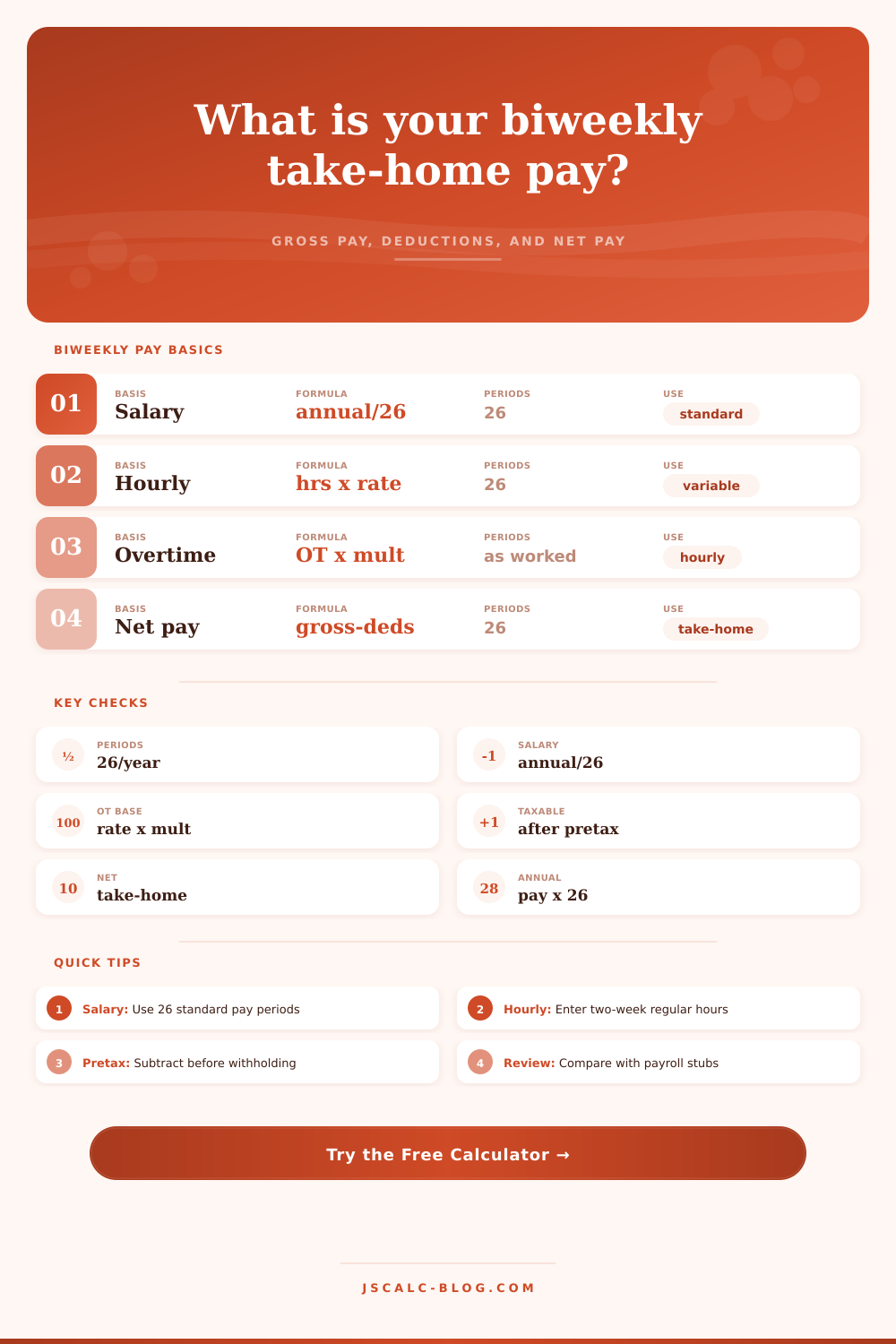
Salary mode uses the standard biweekly formula: annual salary / 26.
Used only in salary mode.
Used only in hourly mode.
Typical full-time biweekly payroll is 80 regular hours.
Enter only hours paid above the regular rate.
Hourly overtime gross = overtime hours x rate x multiplier.
Percent of gross pay deducted before basic withholding.
Health, dental, vision, FSA, or similar payroll deductions.
Simple percentage estimate only; actual payroll tax depends on official tables and your Form W-4.
Use 0 if no state or local withholding applies.
Flat dollar amount withheld in addition to percentage estimates.
Examples include after-tax insurance, repayment, or other payroll deductions.
| Payroll item | Formula | What it means | Calculator use |
|---|---|---|---|
| Standard salary gross | Annual salary / 26 | Spreads a salary across 26 biweekly paychecks. | Used whenever pay basis is salary. |
| Hourly regular gross | Regular hours x hourly rate | Base pay for the two-week pay period. | Used in hourly mode before overtime. |
| Hourly overtime gross | Overtime hours x hourly rate x multiplier | Additional premium earnings for overtime hours. | Added to regular hourly gross. |
| Taxable pay estimate | Gross pay - pre-tax deductions | Simple taxable wage base before percentage withholding. | Used for federal and state/local estimates. |
| Net pay estimate | Gross pay - all deductions and withholding | Approximate take-home pay for the paycheck. | Floored at zero if entered deductions exceed gross. |
| Input | Timing | Applied to | Example entry | Important limit |
|---|---|---|---|---|
| Pre-tax retirement percent | Before withholding | Gross biweekly pay | 5% | Calculator does not test annual plan limits. |
| Pre-tax benefits | Before withholding | Flat amount per paycheck | $180 | Enter only payroll deductions taken every check. |
| Federal withholding estimate | After pre-tax deductions | Taxable pay estimate | 12% | Not a substitute for official payroll tables. |
| State and local estimate | After pre-tax deductions | Taxable pay estimate | 4% | Use 0 where no state or local withholding applies. |
| Extra withholding | After percent estimates | Flat amount per paycheck | $25 | Useful for matching a recent pay stub. |
| Post-tax deductions | After withholding | Flat amount per paycheck | $50 | Does not reduce the taxable pay estimate here. |
| Scenario | Gross pay | Pre-tax | Taxable pay | Withholding | Net pay |
|---|---|---|---|---|---|
| Current inputs | $0 | $0 | $0 | $0 | $0 |
| No overtime | $0 | $0 | $0 | $0 | $0 |
| Five extra overtime hours | $0 | $0 | $0 | $0 | $0 |
| No pre-tax benefits | $0 | $0 | $0 | $0 | $0 |
| Ten percent retirement | $0 | $0 | $0 | $0 | $0 |
| Extra withholding removed | $0 | $0 | $0 | $0 | $0 |
| Post-tax deductions removed | $0 | $0 | $0 | $0 | $0 |
| Salary spread across 27 checks | $0 | $0 | $0 | $0 | $0 |
| Pay frequency | Checks per year | Salary per check formula | Common schedule |
|---|---|---|---|
| Weekly | 52 | Annual salary / 52 | Every week |
| Biweekly | 26 | Annual salary / 26 | Every other week |
| Semimonthly | 24 | Annual salary / 24 | Twice per month |
| Monthly | 12 | Annual salary / 12 | Once per month |
| Hourly biweekly | Varies | Hours x rate plus overtime | Every other week |
| 27-paycheck year | 27 cash dates | Employer policy controls | Calendar timing issue |
JSCalc-Blog.com: This biweekly pay calculator uses standard gross-pay math and user-entered withholding assumptions for planning. It is not tax filing, payroll compliance, or benefits eligibility advice.
Your paycheck appears in your direct deposit account. And it’s lower then anticipated. Is this because of inflation? A new health plan? Taxes?
JSCalc-Blog.com calculates gross pay, take-home pay, basic withholding, and pre-tax deductions for both hourly and salaried employee. It translates complex payroll codes into something that makes sense: a picture of how much money lands in your bank account (biweekly).
How to Understand Your Paycheck
You may believe you’ve got a handle on how much money you earn but very few people grasp the structure of their paycheck. Once you input your hourly rate (or salary), the calculator will do the math for you. You no longer need to guess what conversion factor or coefficient to use.
Gross pay form the base layer. It splits out your annual salary across twenty-six pay periods (the usual amount found in most two-week pay schedules). Alternatively, if you’re paid an hourly wage, it take the rate you input, multiplies it by your normal hours worked and applies the overtime rate to any excess time you’ve spent. It might seem basic but it sets the foundation for all future calculations. If there’s nothing to base it off, then it’s all guesswork.
Most people blow their budget here. Your employer subtracts pre-tax items from your gross pay such as health insurance premiums or 401(k) contributions. They then calculate federal and state taxes on what is left. Pre-tax deductions decreases your taxable income, resulting in smaller withholding amounts. Because the calculator estimates your taxable pay, these pre-tax amounts is deducted from your gross. It’s a subtle point, but a big one for net cash flow. By decreasing your tax burden, you’ll save more; but you’re also deferring part of your take-home pay to the future. Know that this is a tradeoff.
The next step are government claims. These are based off estimates (percentages) for how much to withhold for both the state and feds against that adjusted taxable base. If your prior year return showed you were under-withholding, or if you’d like to reduce your refund liability, enter a flat extra amount to withhold here.
Finally, post-tax deductions comes out last. This includes things like after-tax insurance or student loan repayments. Why? Because these don’t decrease your tax bill; they only decrease your take-home pay. They’re post-tax, meaning they don’t decrease your taxable income. To understand what your check does and doesn’t cover, it helps to know the order of operations.
People confuse semimonthly with biweekly payment schedules. Twice a month (two times a month) equals twenty-four checks per year. Every two weeks (biweekly) equals twenty-six checks per year. The math may seem unimportant, that’s what makes it hard to grasp. But the amount of each check change. The table on the page explains the difference.
When your boss moves from twenty-six to twenty-four checks, even though your annual rate remains the same, your weekly cash flow will be lower. And that’s where people go wrong. They think their annual rate shields them against any shift in cash flow rhythm. Nope: Cash flow isn’t just about the yearly sum; it’s about the rhythm of those payments.
The tool also allow you to select from its presets and see various scenarios. Want to know what the minimum wage would look like with deductions? Hit that hourly entry level button. Or try the salaried manager preset… How do you think your higher income bracket will get taxed? This helps show you the real-world effect of marginal tax rates. It’s not a single flat rate on all dollars earned. The calculator breaks it down for you and gives you a pretty good approximation of how your overtime shift will translate into extra money spent.
It’s not enough to know the amount; we want to be able to change the inputs on the variables and see how this impacts the bottom line. Want to max out your 401(k)? See immediately how much less tax you pay … how many fewer dollars goes from your bank account to your employer’s. Get irregular overtime? Change the number of hours worked to understand the difference between a crazy week and a slow one. Make concrete decisions rather than following abstract payroll policy.
How much money do you make? How you earn it matters too. If you break down your paystub into its parts, you’ll begin controlling your bank account instead of letting it control you. It’s basic math with big-time implications: You’ll know exactly where all your dollars go, and that clarity is worth more then any refund.