Projectile Motion Calculator
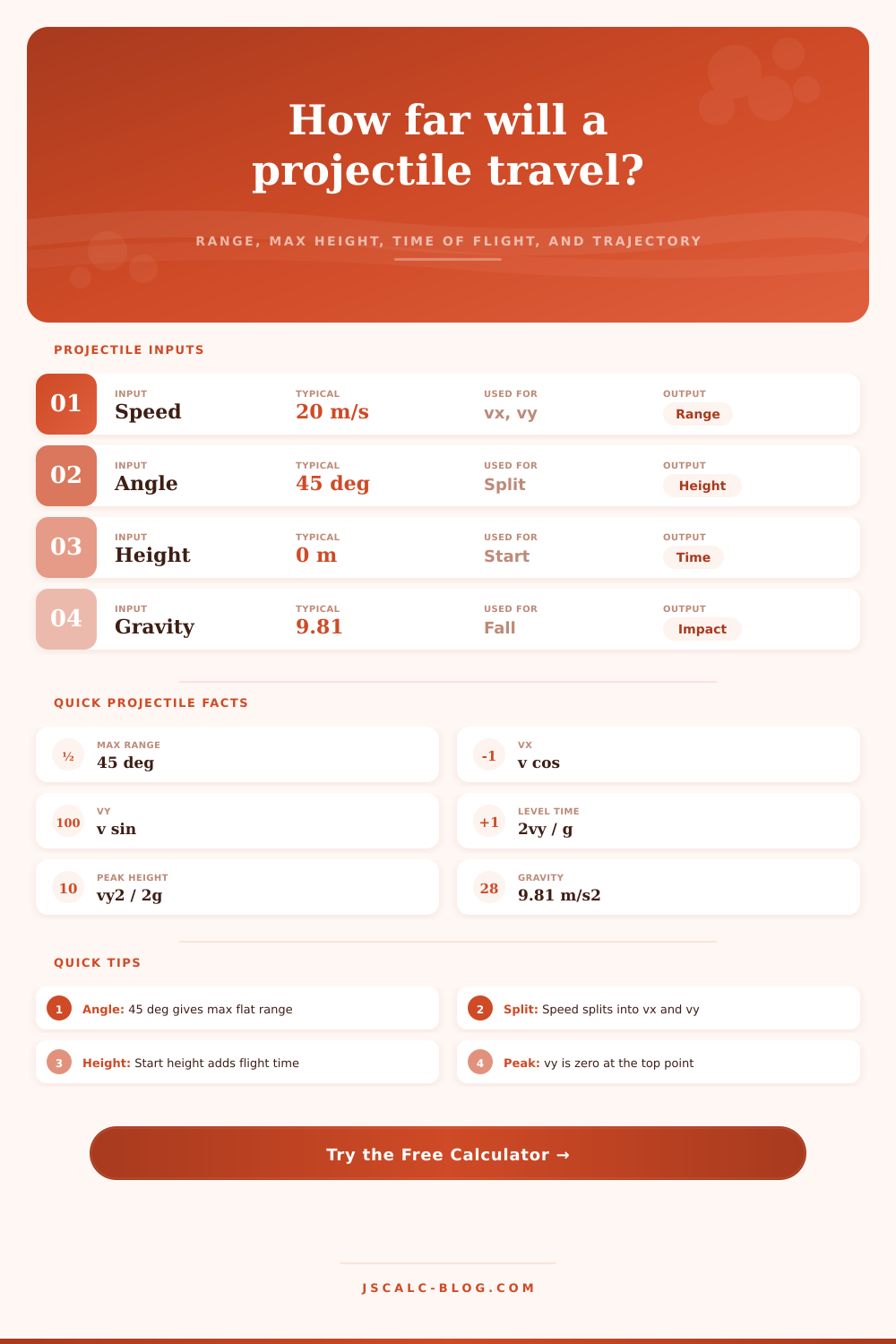
Enter launch speed, launch angle, and start height to find the range, maximum height, time of flight, impact velocity, velocity components, and full trajectory using ideal projectile motion with no air resistance.
🎯Real Launch Presets
📝Launch Inputs
Muzzle or release speed at the instant of launch.
Set to 0 for a launch from level ground.
Used only when gravity setting is Custom.
This tool assumes no drag for clean textbook results.
🔢Formula Snapshot
📊Trajectory Points
| Point | Time (s) | Distance x (m) | Height y (m) | Vert. vel. (m/s) |
|---|---|---|---|---|
| Enter values above to plot the trajectory points. | ||||
📈Range By Launch Angle
| Angle | Range (m) | Max Height (m) | Flight Time (s) | Vs Best |
|---|---|---|---|---|
| The angle sweep appears after calculation. | ||||
🗂Launch Scenario Comparison
| Scenario | Speed | Angle | Height | Range | Peak |
|---|---|---|---|---|---|
| 45° max range | 20 m/s | 45° | 0 m | 40.8 m | 10.2 m |
| Cannonball | 80 m/s | 40° | 0 m | 642 m | 135 m |
| Soccer kick | 25 m/s | 30° | 0 m | 55.2 m | 7.97 m |
| Basketball shot | 8 m/s | 52° | 2.0 m | 7.63 m | 4.03 m |
| From height | 15 m/s | 25° | 30 m | 43.5 m | 32.1 m |
| Arrow shot | 60 m/s | 35° | 1.5 m | 347 m | 61.9 m |
⚙Full Formula Breakdown
📋Velocity Component Reference
| Angle | cosθ (vx share) | sinθ (vy share) | sin(2θ) range factor | Note |
|---|---|---|---|---|
| 15° | 0.966 | 0.259 | 0.500 | Flat and fast forward |
| 30° | 0.866 | 0.500 | 0.866 | Long, low arc |
| 45° | 0.707 | 0.707 | 1.000 | Maximum level range |
| 60° | 0.500 | 0.866 | 0.866 | Same range as 30° |
| 75° | 0.259 | 0.966 | 0.500 | High and steep |
| 90° | 0.000 | 1.000 | 0.000 | Straight up, no range |
💡Practical Projectile Tips
From a soccer player’s chip shot to artillery fire, projectile motion trace out a certain curve. That curve depends on launch angle and initial speed which operate in opposition to gravity. Seeing it unfold is enough to understand it. Enter your values into the calculator above, and it does math for you: converting abstract forces into concrete time and distance. All you have to do is know what to put in.
So velocity are a vector quantity (meaning, it has both direction and magnitude). If you throw something, its initial speed becomes two separate thing: one that keeps going in the same direction as you threw it at constant speed (provided there’s no air resistance) and one that opposes gravity. Gravity pulls the object downward and will slow the object when it’s traveling upward and accelerate it when it’s traveling downward.
Understanding Projectile Motion
In this perfect world, horizontal never changes. That’s the important part. It allows you to multiply constant horizontal speed by total amount of time the object is in the air to determine how far the object traveled. The only thing time-of-flight depends on is the vertical. So if you roll a ball across ground, it will return faster then if you kicked it directly upward. That’s because gravity has had more time to do its job if there’s greater initial vertical velocity. It also matters how high you launch it, because beginning above ground level add more time to the fall. That’s why quadratic equation for position gets adjusted in calculator. If it didn’t get adjusted, then anytime you aren’t launching from flat earth, your range predictions will be off.
It all depends on the angle of launch. For level ground, max horizontal distance comes at a forty-five degree angle. That’s basic physics. But that’s assuming you start and end at the same height. What about if you’re standing on a cliff edge and throwing a rock? Then best angle is less than forty-five degrees, since more forward speed will use the additional time provided by falling off edge first. Or what if your destination is above where you are standing? In that case, make a steeper angle. These adjustments show up in tool.
It has presets for things like cannonballs or basketball shot to show how those shifts apply. A flat trajectory might work better for soccer (speed), whereas a golf drive require a high launch to hit the ball far before it starts to descend. The calculator is based off theoretical conditions: no air resistance. Air resistance have a dramatic effect on actual projectiles. At higher velocities or with lighter projectile, it creates significant drag force. This decreases both the range and the maximum height achieved. By not accounting for drag, this calculator gives you pure theory; i.e., the best possible outcome. It’s the ceiling. Reality won’t match those figures with an actual projectile (ball/arrows). The perfect example establish a baseline for what is lost to drag in practice.
Gravitational environment variations are another thing you can play around with. Switching setting from Earth to Moon demonstrates that, with the same amount of starting force, an object will fly further and remain airborne much longer in weak gravity there. The Moon’s slight downward tug makes it possible for astronauts to throw a baseball incredible distances. A comparable throw on Jupiter would of barely leave your hand before slamming back down. Those comparisons help demonstrate how influential gravity is in dictating trajectory. That’s where this calculator can help you see the trade offs.
Slow down a few mph. See that range increase? Change the angle by a few degrees, see the peak change as the distance remains constant. Thirty and sixty-degree angles are complementary, so they yield equal ranges on flat terrain because sine of double the angle remains identical. The one route is slow-and-high horizontally, the other fast-and-low. They end up at the same place.
There’s more to projectile motion than formulas. There’s also some good old fashioned intuition at work: once you’ve seen that your speed breaks down into components and gravity pulls things along one axis by itself, you understand why things fly the way they do. These principles applies whether you’re trying to understand physics, analyze a sports play, or design a water fountain. If you know something’s going at a certain speed from a certain place, you can predict its arc. That’s the power of breaking motion down into parts.