Depreciation Calculator
Build a full year-by-year depreciation schedule for any asset using straight-line, declining balance, double-declining, sum-of-years-digits, or units of production, with annual expense, accumulated depreciation, and ending book value.
🎯Real Asset Presets
📝Asset Inputs
Purchase price plus setup, freight, and install.
Estimated resale value at end of life.
Used only for declining balance methods.
Units of production method only.
Total output the asset is expected to make.
Which schedule year the result cards show.
🔢Formula Snapshot
📊Year-by-Year Schedule
| Year | Begin Book | Depreciation | Accumulated | End Book |
|---|---|---|---|---|
| Enter values above to build the depreciation schedule. | ||||
⚖Method Comparison (First Year)
| Method | Year 1 | Year 1 Book | Full-Life Total |
|---|---|---|---|
| The method comparison appears after calculation. | |||
🗂Depreciation Method Reference
| Method | Formula | Expense Pattern | Uses Salvage | Typical Assets |
|---|---|---|---|---|
| Straight-line | (C – S) / N | Equal every year | Yes, from day one | Buildings, fixtures |
| 150% declining | Book × 1.5 / N | Front-loaded, gentle | Only as floor | Vehicles, ag equipment |
| Double-declining | Book × 2 / N | Front-loaded, steep | Only as floor | Computers, phones, tech |
| Sum-of-years | (N–k+1)/SYD × base | Front-loaded, smooth | Yes, in the base | Trucks, machinery |
| Units of production | (C–S)/U × units | Follows usage | Yes, in per-unit | Presses, mining rigs |
📅Useful Life Reference
| Asset Class | Common Life | Typical Salvage | Common Method | DDB Rate | Notes |
|---|---|---|---|---|---|
| Computers / laptops | 3 – 5 yr | 5% – 10% | DDB | 40% – 67% | Fast obsolescence |
| Office furniture | 7 – 10 yr | 10% – 20% | Straight-line | 20% – 29% | Slow wear |
| Cars / light trucks | 5 yr | 15% – 30% | SYD or 200% DB | 40% | Heavy early loss |
| Heavy machinery | 7 – 12 yr | 10% – 20% | Units or 150% DB | 13% – 21% | Tie to output |
| Buildings (non-res) | 39 yr | 0% – 5% | Straight-line | 5% | Land not depreciated |
| Servers / networking | 5 yr | 5% | DDB | 40% | Refresh cycles |
| Tools / small equip | 5 – 7 yr | 10% | Straight-line | 29% – 40% | Section 179 option |
| Leasehold improve | 15 yr | 0% | Straight-line | 13% | Over lease term |
⚙Full Formula Breakdown
💡Practical Depreciation Tips
You spend six grand on a piece of machinery, then three years from now you have a stack of metal valued at two thousand dollars on paper but only worth five hundred bucks in real life. That’s not magic, that’s accounting. In particular, it’s called depreciation.
While you might consider it a dull piece of paperwork you hand off to your accountant, it’s actualy a cash-flow management tool. How you spread that loss out over time affect your reported earnings, yet leaves the same amount in your bank account. Once you plug all those numbers into the calculator above, it do the work for you, no need to type out complicated formulas yourself.
What Is Depreciation and Why It Matters
You’ll begin with the depreciable base: The price paid for an asset minus how much you expect to get back at its end-of-life (scraping/selling). For example, let’s say you purchase a delivery van for $50K and expect to sell it for $10K after five years. Your base = $40K. This is the part you’re writing off.
Make sure you get this figure accurate, because overestimating your scrap value mean leaving money on the tax-deduction table. If you underestimate, you risk writing off more than your asset has lost in value, which will make it harder when it is time to sell.
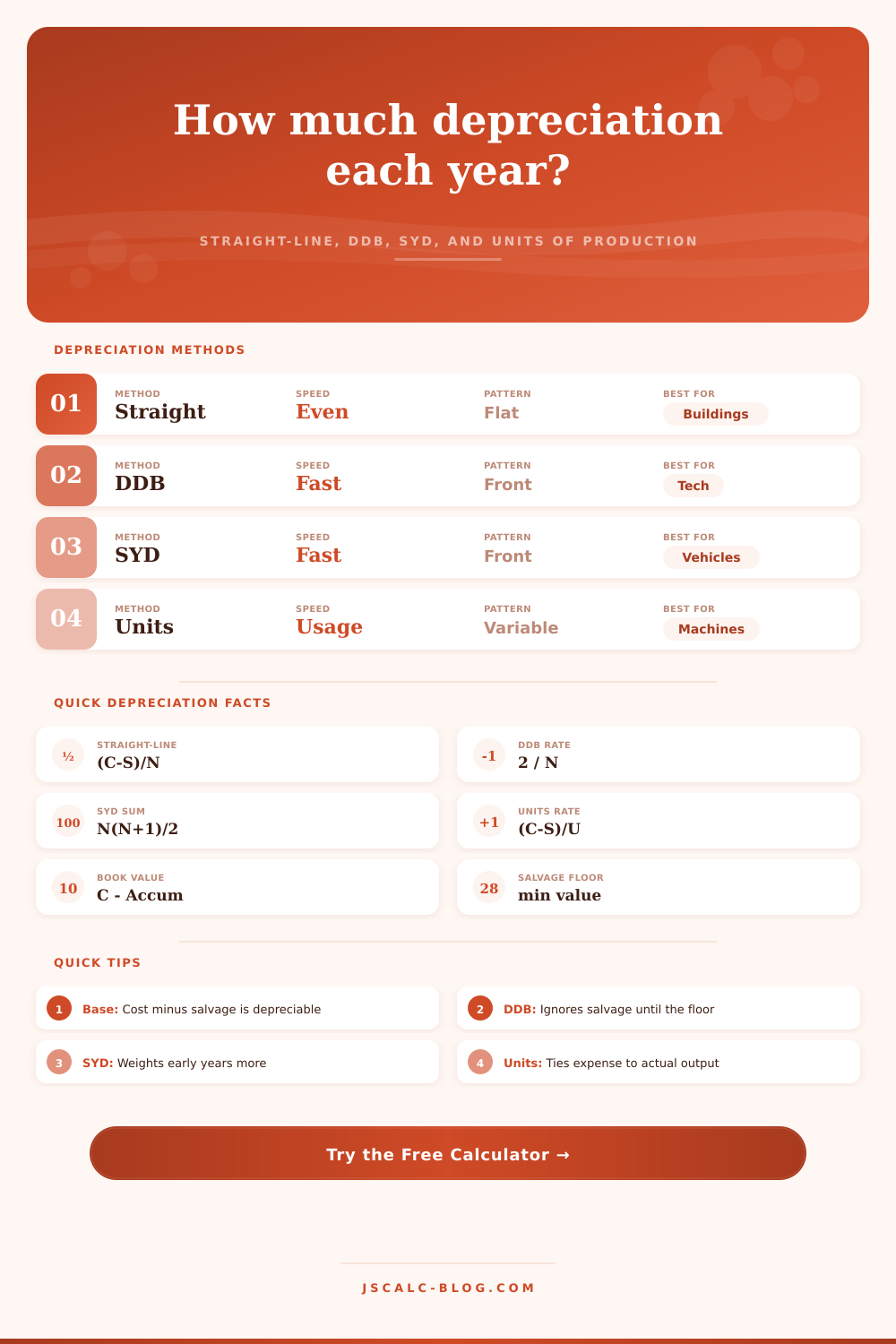
That’s where the confusion sets in: what method do you use? Because straight-line depreciation is easy, most of us does it anyway. The books appear smooth; profits stays constant. That $40,000 base divided by 5 years means you’ll write off $8,000 per year. This works well if you’ve purchased furnitures or a building that wears down gradually over time.
But not all assets behave that way. A computer doesn’t lose half its worth during year three. It loses most of its worth during year one when the new moddern model comes out. Double-declining balance and other accelerated methods do just that: they allows you to put more of the expense at the beginning by writing off more dollars during the first few years.
You can use the reference table on the page for various asset types… It makes it clear what method will fit your situation. If you have vehicles, heavy-use assets, or high-tech equipment, you can take larger deductions earlier in their lives. This results in lower taxable income at the same time you are likely spending the most to buy and maintain them.
Remember, no matter what method you choose, the total amount you’ll be able to depreciate over the asset’s lifetime is always going to be the same. You won’t be able to write off any more than the depreciable base, making this a timing game.
And then there’s units of production/sum-of-years-digits, which is helpful in certain scenarios, but niche enough that I’m only going to mention them here. For example, imagine you own a factory with many machines. A press machine), then making the depreciation dependent on number of widgets produced makes more sense, why would you write off the same amount regardless of whether your machine was sitting idle? You don’t want to waste your dollars, so this makes your expense aligned with your money coming in in a way that straight-line never can. And if your machine runs 24 seven, you’ll write off more.
Here is why: many tax codes let you change your depreciation method from accelerated to straight line as soon as straight line starts yielding a higher deduction. Because that way, you don’t waste any depreciation, and you get full depreciation on the asset by the time it reaches the end of its useful life.) That way, you won’t find yourself stuck with some little remaining book value dragging on for years with tiny write-offs.
So in the end: What’s depreciating got to do with anything? The answer is depreciation = match costs to benefits. You would of liked the cost to go into the same period as the benefit. It produces revenue. Depreciation isn’t a way to game the system for a big tax write-off today; depreciation is about transparency and accuracy when you’re expensing a factory building, a delivery truck or even a laptop.
Pick what truly reflects how an asset loses value over time; don’t pick the one that saves you the most on taxes this year. You’ll thank yourself later, because while the math is hard, the logic is simple. You invested money in order to make more money, now you just have to see where all that money went.