Empirical Formula Calculator
Find the simplest whole-number mole ratio from element masses in grams or percent composition, then derive the molecular formula from a known molar mass using clear, worked stoichiometry.
🧪Real Compound Presets
📝Composition Inputs
Leave 0 for empirical formula only. Enter a value to also get the molecular formula.
Controls how ratios like 1.5, 1.33, and 1.25 are scaled to whole numbers.
🔢Method Snapshot
📊Worked Example Steps
| Element | Input | Atomic Mass | Moles | ÷ Smallest | Subscript |
|---|---|---|---|---|---|
| Enter composition above to see the step-by-step mole calculation. | |||||
⚖Common Atomic Masses
| Element | Symbol | Atomic Mass | Typical Role |
|---|---|---|---|
| Hydrogen | H | 1.008 | Acids, water, organics |
| Carbon | C | 12.011 | Backbone of organics |
| Nitrogen | N | 14.007 | Amines, nitrates |
| Oxygen | O | 15.999 | Oxides, water, acids |
| Sodium | Na | 22.990 | Salts, bases |
| Sulfur | S | 32.06 | Sulfates, sulfides |
| Chlorine | Cl | 35.45 | Chlorides, salts |
| Iron | Fe | 55.845 | Oxides, ores |
🗂Empirical vs Molecular Reference
| Compound | Empirical | Emp Mass | Molar Mass | n | Molecular |
|---|---|---|---|---|---|
| Water | H2O | 18.02 | 18.02 | 1 | H2O |
| Carbon dioxide | CO2 | 44.01 | 44.01 | 1 | CO2 |
| Hydrogen peroxide | HO | 17.01 | 34.01 | 2 | H2O2 |
| Glucose | CH2O | 30.03 | 180.16 | 6 | C6H12O6 |
| Benzene | CH | 13.02 | 78.11 | 6 | C6H6 |
| Acetic acid | CH2O | 30.03 | 60.05 | 2 | C2H4O2 |
| Butane | C2H5 | 29.06 | 58.12 | 2 | C4H10 |
📐Mole-Ratio Rounding Guide
| Decimal Part | Fraction | Multiply All By | Example Ratio | Becomes |
|---|---|---|---|---|
| 0.10 to 0.90 | Near whole | 1 (round) | 1.98 : 1.00 | 2 : 1 |
| ~0.50 | 1/2 | 2 | 2.50 : 1.00 | 5 : 2 |
| ~0.33 or 0.67 | 1/3 or 2/3 | 3 | 1.33 : 1.00 | 4 : 3 |
| ~0.25 or 0.75 | 1/4 or 3/4 | 4 | 1.25 : 1.00 | 5 : 4 |
| ~0.20 or 0.40 | 1/5 group | 5 | 1.40 : 1.00 | 7 : 5 |
| ~0.17 or 0.83 | 1/6 group | 6 | 1.17 : 1.00 | 7 : 6 |
⚙Full Formula Breakdown
💡Practical Formula Tips
The problem is that you get some kind of raw mass data (e.g., “carbon, 24 grams,” “hydrogen, 2 grams,” “oxygen, 16 grams” …) But just those numbers don’t tell you what a molecule look like. To do that, you need something called an empirical formula which tells you the simple, whole-number ratio of atoms making up a given molecule. That tells you its basic skeleton. Knowing how this works will help you keep your rounding errors down.
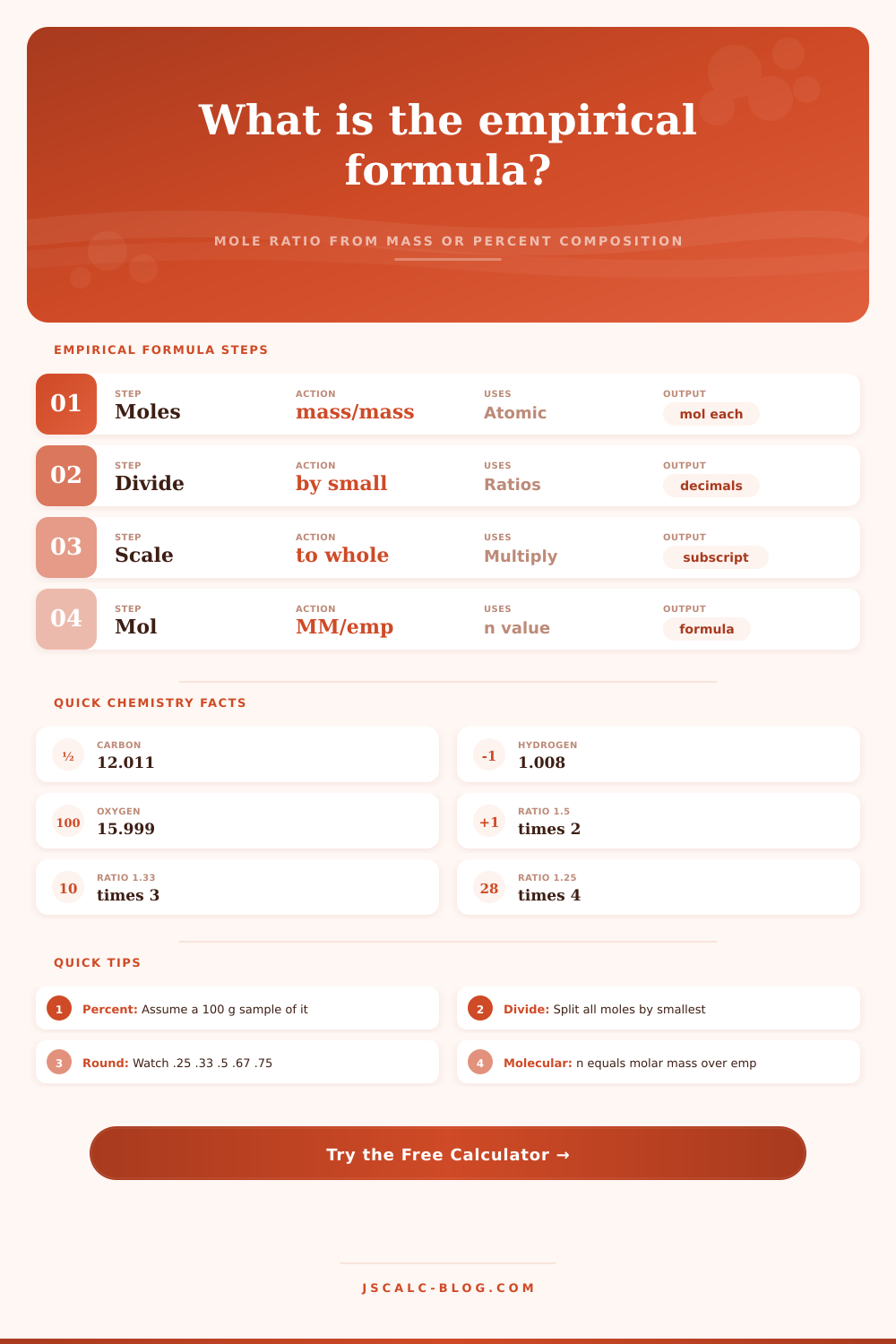
Here is the math, calculated using steps above: First, you convert your masses into moles. Why? Because an atom is not equal in mass to other atoms; a gram of hydrogen contain more atoms than a gram of carbon, for example. To set things on an even level, you takes the mass of each element and divide by its atomic weight. Now you’ve got your mole values, so you divides each value by whatever was the lowest number you found. This establishes the base ratio: the first value is 1, and everything else will be a decimal multiple or fraction of that.
How to Calculate Empirical Formulas
If all these numbers come out as whole numbers, good, you’re finished (but this isn’t exactly how chemistry play out). The problem for most students is that they look at a number such as 1.5 and round down to 2. But rounding only one of the numbers violate the proportional nature of a compound. The trick is to scale up all the numbers together. Double them if you have a ratio close to 0.5. Triple them if it is close to 0.33. Scale them by four if your ratios are close to 0.2 (the table of references will guide you on decimals). It’s just like adjusting the amounts in a recipe; if you add more sugar, you must also add more flour. In this way, you’re maintaining the actual relationships between the components.
Perhaps you have determined the simplest formula, but that’s not the same as knowing the actual molecule. The empirical formula for glucose and formaldehyde is the same (CH2O), yet one is a sugar, the other a preservative. What do you do? Use the molar mass of the real thing to distinguish between different compounds that share the same empirical formula. Divide the molar mass by the empirical mass. This gives you a multiplier value, n, which tell you how many empirical unit are in every molecule. Multiply all your subscripts by this integer to get molecular formula.
Real-world data is often slightly off. Those little deviations could throw off the scale but that’s where this tool’s rounding sensitivity comes into play. If you’re dealing with pretty noisy data, the stricter setting will keep stubborn decimal places around. A less strict tolerance help pull out the rough integer ratio even if there’s some slight error in measurement. It requires a degree of confidence in starting measurements to understand what level of smoothing you should of allow versus what may be an actual change from the norm.
It seems like magic, but it’s very rational: converting imprecise amounts to real numbers (atoms). From determining your chemistry homework to identifying a mysterious organic substance, these same steps apply. Normalize based off the smallest amount, convert to moles, round to whole numbers, and then expand with molar mass if possible. The power in stoichiometry is how it take raw values and converts them into an exact form of matter.