Horsepower Calculator
Find engine horsepower from torque and RPM, estimate power from quarter-mile ET or trap speed and vehicle weight, solve for torque, and convert between HP, kilowatts, and metric PS.
🏎Real Horsepower Presets
🔧Horsepower Inputs
Used by torque/RPM method. Converted from Nm if selected.
Solve mode returns the torque needed at the RPM above.
Used by the kW / PS conversion method.
🔢Formula Constants
⚙Torque, RPM & HP at 5252
| Torque (lb-ft) | HP at 3000 | HP at 5252 | HP at 6500 | HP at 8000 |
|---|---|---|---|---|
| Enter values above to build the torque reference table. | ||||
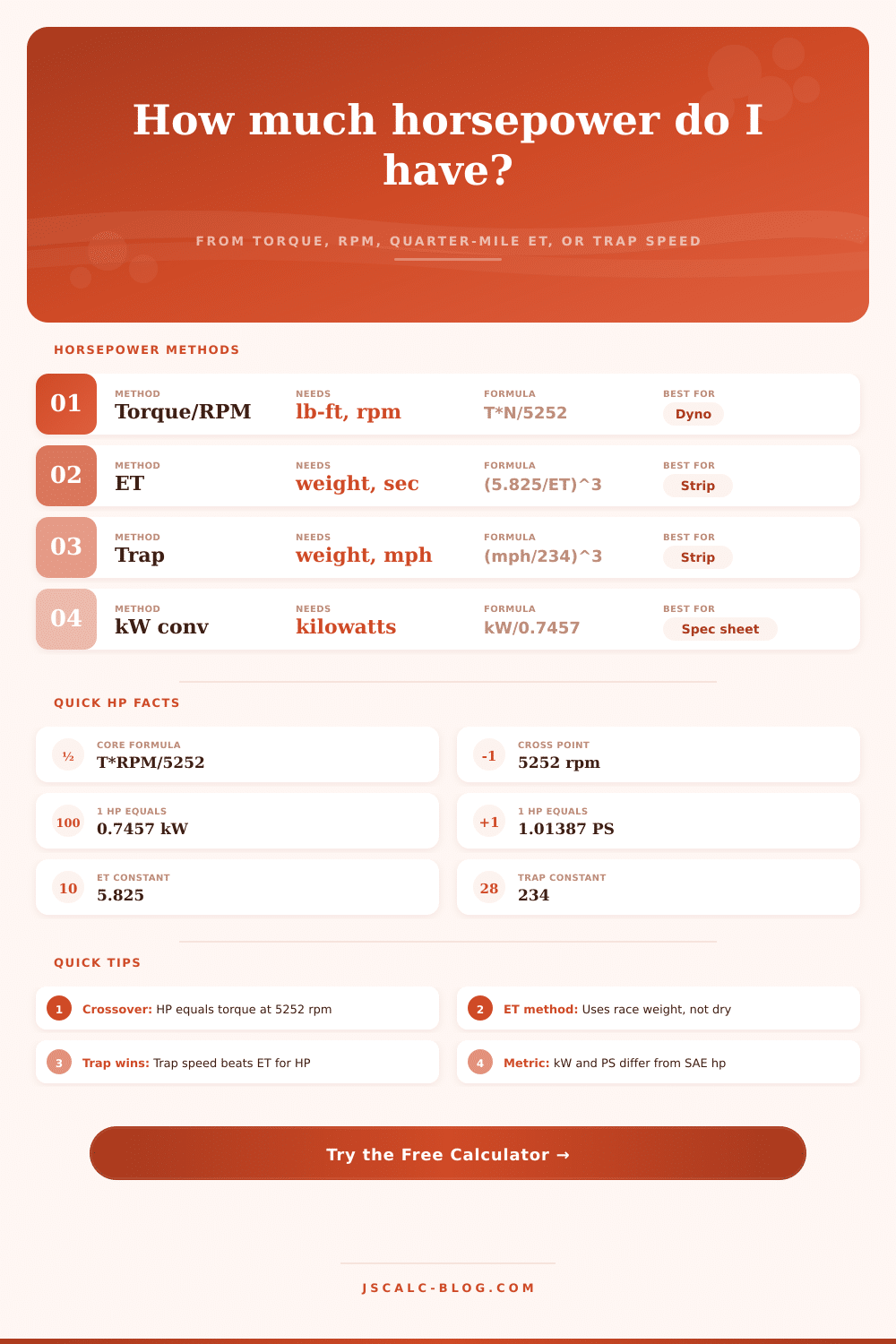
Because HP = torque × RPM / 5252, horsepower and torque are numerically equal only at 5252 RPM. Below it torque leads; above it horsepower leads.
🔄HP, kW & PS Conversion
| Horsepower | Kilowatts (kW) | Metric PS | Torque at 5252 |
|---|---|---|---|
| 50 hp | 37.3 kW | 50.7 PS | 50 lb-ft |
| 100 hp | 74.6 kW | 101.4 PS | 100 lb-ft |
| 200 hp | 149.1 kW | 202.8 PS | 200 lb-ft |
| 300 hp | 223.7 kW | 304.2 PS | 300 lb-ft |
| 400 hp | 298.3 kW | 405.5 PS | 400 lb-ft |
| 500 hp | 372.9 kW | 506.9 PS | 500 lb-ft |
| 707 hp | 527.2 kW | 716.8 PS | 707 lb-ft |
🏁Quarter-Mile ET & Trap to HP
| Vehicle Class | Weight (lb) | ET (sec) | ET HP | Trap (mph) | Trap HP |
|---|---|---|---|---|---|
| Hot hatch | 3000 | 14.5 | 221 | 98 | 220 |
| Muscle sedan | 3600 | 13.2 | 354 | 106 | 335 |
| Sports coupe | 3400 | 12.0 | 389 | 115 | 404 |
| Track special | 3200 | 11.5 | 416 | 120 | 431 |
| Pro street | 3000 | 10.5 | 512 | 128 | 490 |
| Drag build | 2800 | 9.5 | 645 | 140 | 599 |
ET and trap estimates assume good traction and standard air. Trap speed tracks power more reliably than ET because ET is sensitive to launch and 60-foot times.
🚗Engine HP Class Comparison
| Class | Torque | Peak RPM | Crank HP | kW | Typical Use |
|---|---|---|---|---|---|
| Economy 4-cyl | 130 lb-ft | 4400 | 109 hp | 81 kW | Commuter car |
| Turbo 4-cyl | 258 lb-ft | 5000 | 246 hp | 183 kW | Hot hatch |
| Naturally asp. V6 | 270 lb-ft | 6400 | 329 hp | 245 kW | Sports sedan |
| Small-block V8 | 383 lb-ft | 5600 | 408 hp | 304 kW | Muscle car |
| Diesel pickup | 650 lb-ft | 1800 | 223 hp | 166 kW | Heavy tow |
| Supercharged V8 | 650 lb-ft | 6100 | 755 hp | 563 kW | Muscle flagship |
| Superbike inline-4 | 83 lb-ft | 13000 | 205 hp | 153 kW | Liter sportbike |
📐Full Formula Breakdown
📋Method Reference
| Method | Inputs Needed | What It Estimates | Accuracy Notes |
|---|---|---|---|
| Torque & RPM | Peak torque, matching RPM | Crank HP at that point | Exact when both are true dyno values |
| Quarter-mile ET | Race weight, ET seconds | Approx crank HP | Sensitive to traction and launch |
| Trap speed | Race weight, trap mph | Approx crank HP | More stable than ET method |
| Solve torque | Known HP, RPM | Torque in lb-ft | Exact algebra, not an estimate |
| kW / PS | Power in kilowatts | SAE HP and PS | Fixed unit conversion factors |
💡Practical Horsepower Tips
“A lot of times when you see a dyno sheet, there’s this really big curve up to a bunch of horsepower and it falls right back down again. And that all looks great on a piece of paper but doesn’t correlate with pushing the pedal in traffic.”
Horsepower is a measure of work over time, not simply raw force. Understanding how that number are derived changes how you view performance. So your perception of how well something performs change,” you say. “It stops being about chasing numbers on a spec sheet and starts becoming about where that power actualy resides.”
What Horsepower and Torque Really Mean
Horsepower and torque is connected by one unchanging number: 5252. And no, it’s not some random mystical number. One horsepower equal thirty-three-thousand foot pounds per minute divided by two pi. See where the math meet? That’s RPM, which are revolutions per minute. Below five thousand two hundred fifty-two RPM, torque has the advantage numerically; above it, horsepower have the advantage. The curves will always intersect here.
If you’re building an engine to be gruntier around town, like a tow vehicle or diesel truck, you’d prefer peak torque occur far below that intersection. If you run a track day and want to chase top speed, you’ll need horsepower to remains elevated far above it. Once you plug in the numbers from your dyno reading into the calculator, it do all the dividing, and knowing how those curves act can help you understand what you’re feeling and hearing when tuning.
There’s one story told by dyno numbers. There’s another story told by the drag strip. The drag strip measure the car as a system. This include the engine plus all the things that eat away at the horsepower it generate at the crank, such as tires slipping on the pavement, air pushing on body panels, and losses in the driveline.
Generally, trap speed is a better indicator different than elapsed time because trap speed is less affected by launching mistakes. Launching a bit early or late wrecks your ET run so your estimate will be way off, but it still gives a good picture of how fast you ended up going based off what you built up in momentum.
We always use race weight (meaning we include the fuel and driver) because this is closer to reality and if the math doesn’t reflect reality then you’re working with an idealized version of curb weight. That can make a big difference when you try to figure out why the car isn’t performing how you expect down the quarter mile. But it only makes a small adjustment.
Many of us enthusiasts also gets confused with conversions from one unit to another. Kilowatts, metric PS, and SAE horsepower are all labels for the exact same type of physical energy. An SAE horsepower is about 0.75 kilowatts. When you look at a spec sheet of a European sports car next to a brochure from an American muscle car, the differences seems minor until you are actualy comparing them. In fact, a European manufacturer may be quoting their peak output in PS (the ‘base’ unit being kilogram-meters) that’s slightly more than SAE hp. It is not cheating, just a different set of measurement rules. Unless you know what rule the maker plays by, you’re comparing apples to oranges on your group chat.
With this, you’ll see true equality automatically without having to do any mental gymnastics.
Horsepower is often thought of as an absolute characteristic of an engine; it’s not. Horsepower is calculated based on the combination of fuel, air, and timing occurring at any given rate of rotation. That’s why some engines are more linear (naturaly aspirated), while others use turbocharging, which create a lag that push their usable power higher into the rev range. Understanding how this affect the car’s handling allows you to match your driving style to where the actual power is, instead of just focusing on total energy numbers on paper.
Diagnosing real world slip or calculating theoretical limits will help keep false expectations and costly mistakes out of the equation by understanding the basics. It’s far more helpful to have a moderate number that you can flat-out lay down than a large number that only comes into play when conditions line up perfectly, never to be repeated again. The numbers don’t change but the execution makes all the difference.
It could of been better if we knew the numbers earlier.