Percent Yield Calculator
Compare the actual yield you measured against the theoretical yield from stoichiometry to find the percent yield of a chemical reaction, in grams or moles, with molar mass conversion and a quality rating.
⚗Real Reaction Presets
🧪Reaction Yield Inputs
Leave meaningless when you are solving for actual yield.
From the limiting reactant and stoichiometry.
Used when solving for actual or theoretical yield.
Optional. Converts moles to grams for display.
Shown in the results, for example Aspirin.
🔢Formula Snapshot
📊Yield Quality Bands
| Category | Percent Range | What It Means | Typical Cause |
|---|---|---|---|
| Excellent | Above 90% | Very efficient reaction | Clean, well optimized synthesis |
| Good | 70% to 90% | Solid preparative result | Minor losses in transfer |
| Moderate | 50% to 70% | Usable but improvable | Side reactions or workup loss |
| Poor | Below 50% | Low efficiency | Incomplete or competing reactions |
| Over 100% | Above 100% | Physically impossible | Wet, impure, or solvent trapped |
📐Theoretical Yield Method
| Step | Action | Example |
|---|---|---|
| 1. Balance | Write the balanced equation | 2 H2 + O2 → 2 H2O |
| 2. Limiting | Find the limiting reactant in moles | H2 runs out first |
| 3. Mole ratio | Multiply by product-to-reactant ratio | 2 mol H2 → 2 mol H2O |
| 4. To grams | Multiply product moles by molar mass | mol × 18.02 g/mol |
| 5. Compare | Divide measured actual by this value | A / T × 100 |
⚖Grams and Moles Reference
| Compound | Formula | Molar Mass (g/mol) | 1 mol = |
|---|---|---|---|
| Water | H2O | 18.02 | 18.02 g |
| Carbon dioxide | CO2 | 44.01 | 44.01 g |
| Sodium chloride | NaCl | 58.44 | 58.44 g |
| Glucose | C6H12O6 | 180.16 | 180.16 g |
| Aspirin | C9H8O4 | 180.16 | 180.16 g |
| Ethanol | C2H6O | 46.07 | 46.07 g |
🗂Yield Comparison Grid
| Scenario | Actual | Theoretical | Unit | Percent | Category |
|---|---|---|---|---|---|
| Aspirin synthesis | 2.20 | 2.55 | g | 86.3% | Good |
| Ester prep | 7.80 | 10.00 | g | 78.0% | Good |
| Grignard product | 3.10 | 6.90 | g | 44.9% | Poor |
| Precipitation | 0.90 | 1.00 | mol | 90.0% | Excellent |
| Combustion water | 16.50 | 18.02 | g | 91.6% | Excellent |
| Reduction | 4.60 | 7.20 | g | 63.9% | Moderate |
| Wet crude solid | 11.30 | 10.00 | g | 113.0% | Over 100% |
⚙Full Formula Breakdown
📋Common Yield-Loss Causes
| Cause | Where It Happens | Effect on Percent |
|---|---|---|
| Incomplete reaction | Reaction did not finish | Lowers actual yield |
| Side reactions | Competing pathways | Diverts product, lowers yield |
| Transfer loss | Glassware and filtration | Small consistent loss |
| Purification loss | Recrystallization step | Trades purity for yield |
| Impure or wet solid | Not fully dried product | Can push above 100% |
💡Practical Yield Tips
You balance reactions for hours, heat up flasks, filter solids, cross your fingers, and hope the reaction works out. Eventually, you weigh your product and find that it is nowhere near as much as what you calculated in first place. This space between what was expected and what was achieved are called percent yield. Percent yield isn’t simply an A-F on a report card; its a metric of how well your atoms traveled from reactant to product without becoming lost along the way.
The calculator above do all the arithmetic for you, so you can go ahead and interpret what that number really means for your industrial run or experiment.
What Does Your Percent Yield Tell You?
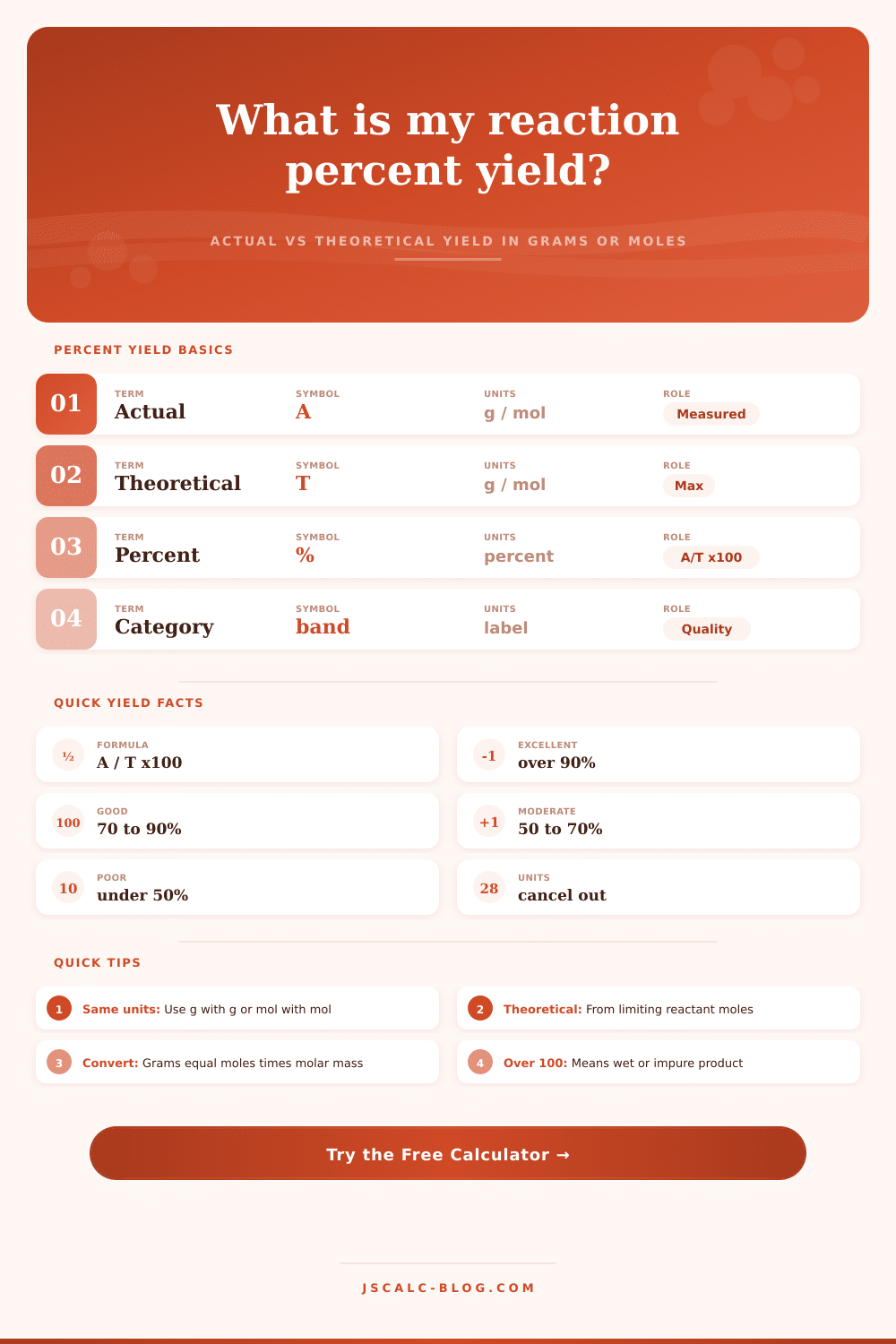
I know it sounds like common sense. You determine actual yield (how much product you obtained) and divide that by theoretical yield (how much product should of been obtained if everything went perfectly). Multiply by 100 and theres your percent yield. It is simple, right? It seems straightforward until you realize how many ways things can go wrong, and you need to understand what happened when something doesn’t go as planned.
A theoretical yield assume a perfect world. In this world, all available molecules of the limiting reagent turns into the product, nothing escapes through evaporation during transfer, and no unwanted side reactions divert precursors. Rarely does real life play along. To understand why your yield didn’t pan out, you have to look at the process from beginning to end, not just the final weigh-in.
Using consistent units can be tricky for many people. How do you know what you measured (actual yield) versus what you calculated (theoretical yield)? Do you have your unit right? Was your actual yield measured in grams and your theoretical yield calculated in moles? The whole equation doesn’t make any sense anymore. We’ve tried to make this as easy as possible by letting you enter numbers in moles OR in grams. We also added a field for the Molar Mass. This allows it to convert back and forth to help you keep your units straight.
The next thing is you need to remember, why does 80% yield mean anything if neither side of fraction represents the same thing physically? Eighty percent of WHAT? You can get a quick idea about how well you did from looking at quality bands in reference section. If you got an excellent yield of more than ninety percent, then you made a really clean compound and optimized your synthesis. That’s not always the case in organic chemistry, but it happens all the time when doing a simple precipitation reaction or combustion.
Getting a good yield of anything between seventy and ninety percent indicates solid preparative work, meaning there were some unavoidable losses associated with transferring or filtering the material, but nothing that should be major. Moderate yields (fifty, seventy percent) tends to match incomplete conversions because of an equilibrium limitation or side reactions competing with your desired reaction pathway. Finally, poor yields (<50%) typically mean something went wrong at the most basic level, your stoichiometry is off, you used the wrong solvent, or maybe your product decompose significantly during purification.
You’ll find that sometimes you calculate a yield greater then 100%. In pure terms, this is impossible… Matter can’t be created out of nothing. If this occurs, it is usually due to leftover unreacted starting material(s), solvent, or water in your sample. These add extra mass to the balance reading. It’s a red flag that tells you product requires additional purification or drying. Avoiding this helps you avoid falsely declaring your chemistry to be very efficient when all along you’re simply weighing wet glassware.
Increasing yields doesn’t comes from tweaking a single parameter. Increasing yields comes from getting conditions just right, using solvents that precipitate the product cleanly; optimizing temperature to favor the forward reaction; and minimizing the number of transfer steps where material sticks to vessel walls. Recrystallization (which reduces purity) is an example of this. Some product dissolves into the mother liquor, which results in loss of yield but improved purity.
Depending on your application, you have to decide if purity or yield is more important to you. For pharmaceutical applications, there’s typically pressure to achieve high purity (e.g., ninety-nine percent), even at the expense of losing half your material. If you’re producing something in bulk for industrial purposes, you might be willing to sacrifice purity to maintain cost efficiency.
That’s the beauty of percent yield. It takes all of the jumbled-up results from an experiment and reduces them down to one number. You can use this number to compare different runs, to runs from last month, or to compare your method different than that of your competitors. Percent yield is the universal language of chemical efficiency, whether you’re making aspirin in a teaching lab or running a polymer production line at scale. It doesn’t matter if you’ve made something; what matters is how much you got, and how much you didn’t get. Because if you know how much you lost, you know exactly where your process can be improved. And every missing gram is a story of a process step that could be improved.