Moon Phase Calculator
Find the Moon's phase, illuminated fraction, moon age in days, and the dates of the next new, first quarter, full, and last quarter Moon for any date using the synodic lunar cycle of 29.53 days.
🌙Quick Date Presets
📅Date & Options
Any date from year 1 onward works; math uses UTC noon.
Flips which side of the disc appears lit.
Adds this many days to the target date.
🔢Cycle Snapshot
🗓Upcoming Principal Phases
| Principal Phase | Projected Date | Days Away | Illumination |
|---|---|---|---|
| Pick a date above to project the next four principal phases. | |||
🌓The Eight Principal Phases
| Phase | Symbol | Moon Age | Illumination | Meaning |
|---|---|---|---|---|
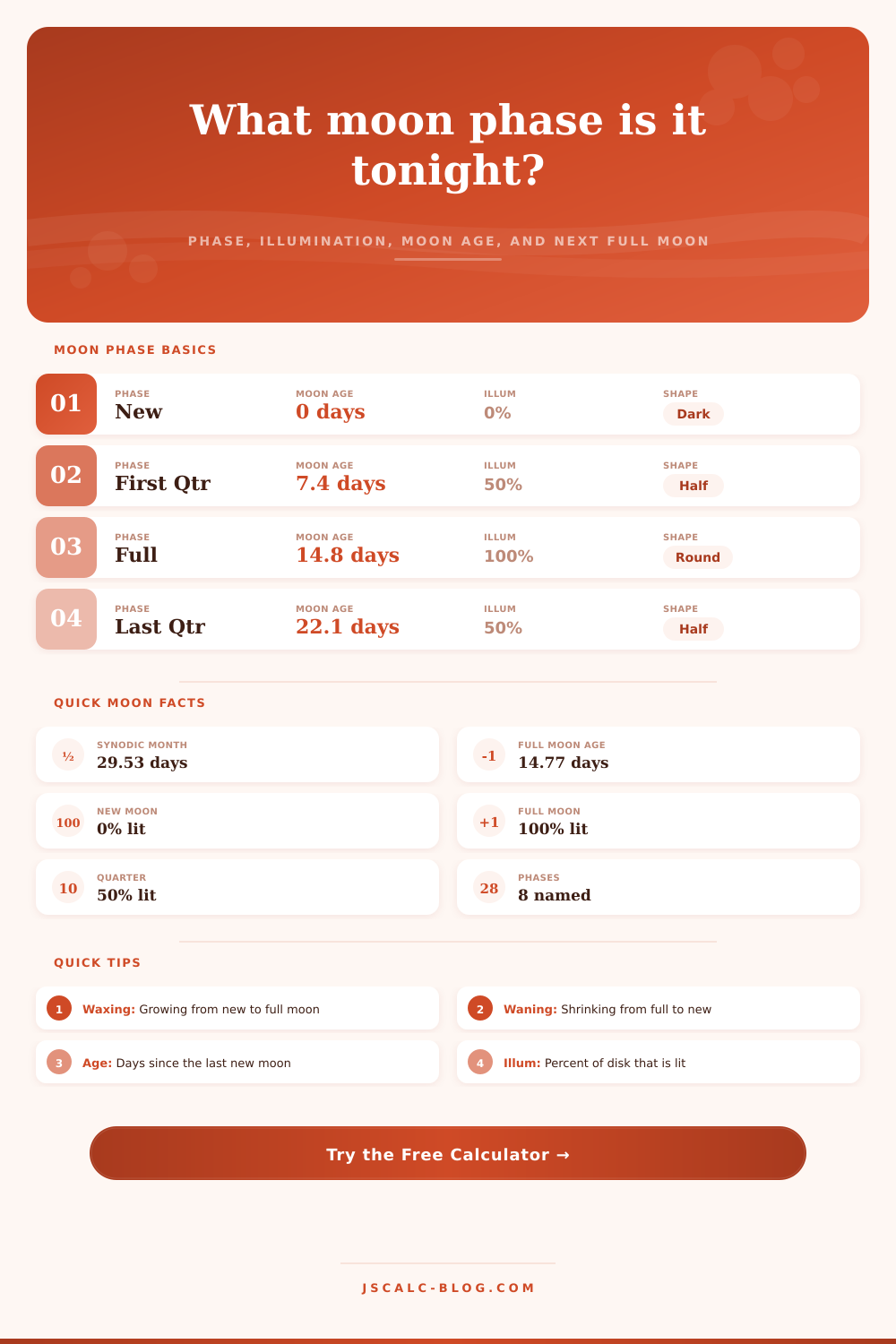
| New Moon | 🌑 | 0.0 days | 0% | Dark disc, Moon between Earth and Sun |
| Waxing Crescent | 🌒 | 1.8 to 5.5 days | 1% to 49% | Sliver growing after new moon |
| First Quarter | 🌓 | ~7.4 days | 50% | Right half lit, quarter of the cycle |
| Waxing Gibbous | 🌔 | 9.2 to 13.0 days | 51% to 99% | More than half and still growing |
| Full Moon | 🌕 | ~14.8 days | 100% | Whole disc lit, Earth between Sun and Moon |
| Waning Gibbous | 🌖 | 16.6 to 20.3 days | 99% to 51% | Past full and shrinking |
| Last Quarter | 🌗 | ~22.1 days | 50% | Left half lit, three quarters through |
| Waning Crescent | 🌘 | 23.9 to 27.7 days | 49% to 1% | Thin sliver fading toward new moon |
📊Illumination Reference Grid
| Moon Age | Phase Fraction | Cosine Term | Illumination | Phase |
|---|---|---|---|---|
| 0.00 days | 0.000 | 1.000 | 0% | New Moon |
| 3.69 days | 0.125 | 0.707 | 15% | Waxing Crescent |
| 7.38 days | 0.250 | 0.000 | 50% | First Quarter |
| 11.07 days | 0.375 | -0.707 | 85% | Waxing Gibbous |
| 14.77 days | 0.500 | -1.000 | 100% | Full Moon |
| 18.46 days | 0.625 | -0.707 | 85% | Waning Gibbous |
| 22.15 days | 0.750 | 0.000 | 50% | Last Quarter |
| 25.84 days | 0.875 | 0.707 | 15% | Waning Crescent |
| 29.53 days | 1.000 | 1.000 | 0% | New Moon |
⚙Full Formula Breakdown
📋Lunar Cycle Reference
| Term | Value | What It Means | Note |
|---|---|---|---|
| Synodic month | 29.53 days | New moon to new moon | Phase cycle used here |
| Sidereal month | 27.32 days | Orbit vs the stars | Shorter than synodic |
| Waxing half | 0 to 14.77 days | New up to full moon | Lit part is growing |
| Waning half | 14.77 to 29.53 days | Full down to new moon | Lit part is shrinking |
| Quarter step | 7.38 days | One quarter of the cycle | 50% lit at quarters |
| Blue moon | ~2.7 years | Second full moon in a month | Extra full moon |
💡How To Read The Moon
The moon changes shape every night… Rapidly, on a schedule most of us are unaware of, except that we think: “Oh, I saw that moon last night, a sliver, and now it’s a sliver again.” It won’t be a sliver again for several nights; the moon races through its roughly 30-day complete cycle from new to waxing crescent to first quarter to gibbous to full to waning gibbous to third quarter and back to the new moon again. Fast! This moon makes it confusing to time anything, from when to photograph it at night to when to plant seeds.
If you choose a date, the calculator up there will do work for you; you don’t have to try to guess at what stage cycle is on. It uses the synodic month (the conventional way of measuring how long it takes the Moon to change phases), which is about twenty-nine point five days. Why does this matter? That’s not a clean twenty-eight, nor is it a nice round thirty. If you go by ballpark figures, the numbers aren’t precise enough to keep your prediction accurate without some leeway. If you’re serious about following the Moon, you want precision.
How to Use the Moon Phase Calculator
The calculator tell you exactly how many days old the Moon is, in days since previous new moon. And note: a Moon can be very young and therefore lit only faintly even as it grows rapidy. Knowing the difference help you see sky properly. How illuminated is it? That’s what the Illumination percent figure indicates; when does the sun shine on what fraction of disk? Half the disk are lit at first quarter but remember: the Moon itself is still a quarter of distance into its cycle at that point. The calculator spells that out for you by showing actual amount and the phase name.
This phase name often surprises beginners because they expect to see a number instead. Knowing that the Moon is 70% illuminated may be just enough contrast to see stars at night if you’re planning an observing session. You can set your rounding preferences in case you want precise numbers for some historical or scientific purpose.
Depending on which hemisphere you select, you’ll get a different view onscreen. A waxing Moon will light up from the left if you’re in Southern Hemisphere, but from the right if you’re in Northern. That’s a small detail, just a flip in shape due to your position relative of Earth and the Sun. But it makes all the difference: When staring down at an app (or even a paper star chart) meant for another latitude, it can keep you from mistakenly identifying the Moon. For those of us in South America and Australia, and anyone else who travels with such tools, there’s a lot of confusion that most generic tools miss.
You can use future phases table to see what is coming up. It helps you schedule your photo shoots by the full moon or know which times of year to expect bright nights so you can avoid viewing faint galaxies. It also takes into account a typical orbital period for its calculations; that works well enough for most purposes except that Moon doesn’t quite obey this model perfectly, having a slight variation in its “speed” at apogee and perigee due to elliptical orbit variations and tidal effects. But usually we don’t notice that much if we’re casual observers.
The stability of these cycles span centuries; historical dates help put them in context. With a click, you’ll find the Moon’s phase on important occasions, such as ancient festivals or a space landing. Orbital mechanics doesn’t change over long time scales, so the math goes both ways: backwards as well as forwards. It’s this predictability that has made the lunar calendar the guide to religion and agriculture for thousands of years.
Don’t assume: A new moon is totally dark, or a full moon will always be bright and full. It’s all relative. Full moons aren’t all equal; they are different sizes because of how far away they are from Earth. Even during a new moon, you might see it as a tiny sliver of a crescent just minutes after sundown if the angle is favorable. The calculator doesn’t display apparent size, but it provides timing accuracy sufficient to match up with other information.
In the end, however, when it comes to knowing the Moon’s phase, it’s all about getting into a rhythm, not remembering names. The sky ticks on a billion-year-old clock; let’s learn how to tell time in night sky. Whatever your nighttime activity. Whether astrophotography or old-fashioned, traditional gardening, the act of syncing up to the lunar calendar give your evenings a sense of purpose.
The Moon doesn’t shift her schedule for us; we must catch up to her. You should of checked sooner.