Power to Weight Ratio Calculator
Turn horsepower, kilowatts, or watts and vehicle or rider weight into hp per ton, hp per pound, watts per kilogram, and the inverse pounds per horsepower, then match the result to a real performance band.
🏎Real Power to Weight Presets
⚙Power and Weight Inputs
Cycling mode leads with watts per kilogram.
In the same unit as base weight. Add fuel too for realism.
Estimates power reaching the wheels for the ratio.
🔢Conversion Constants
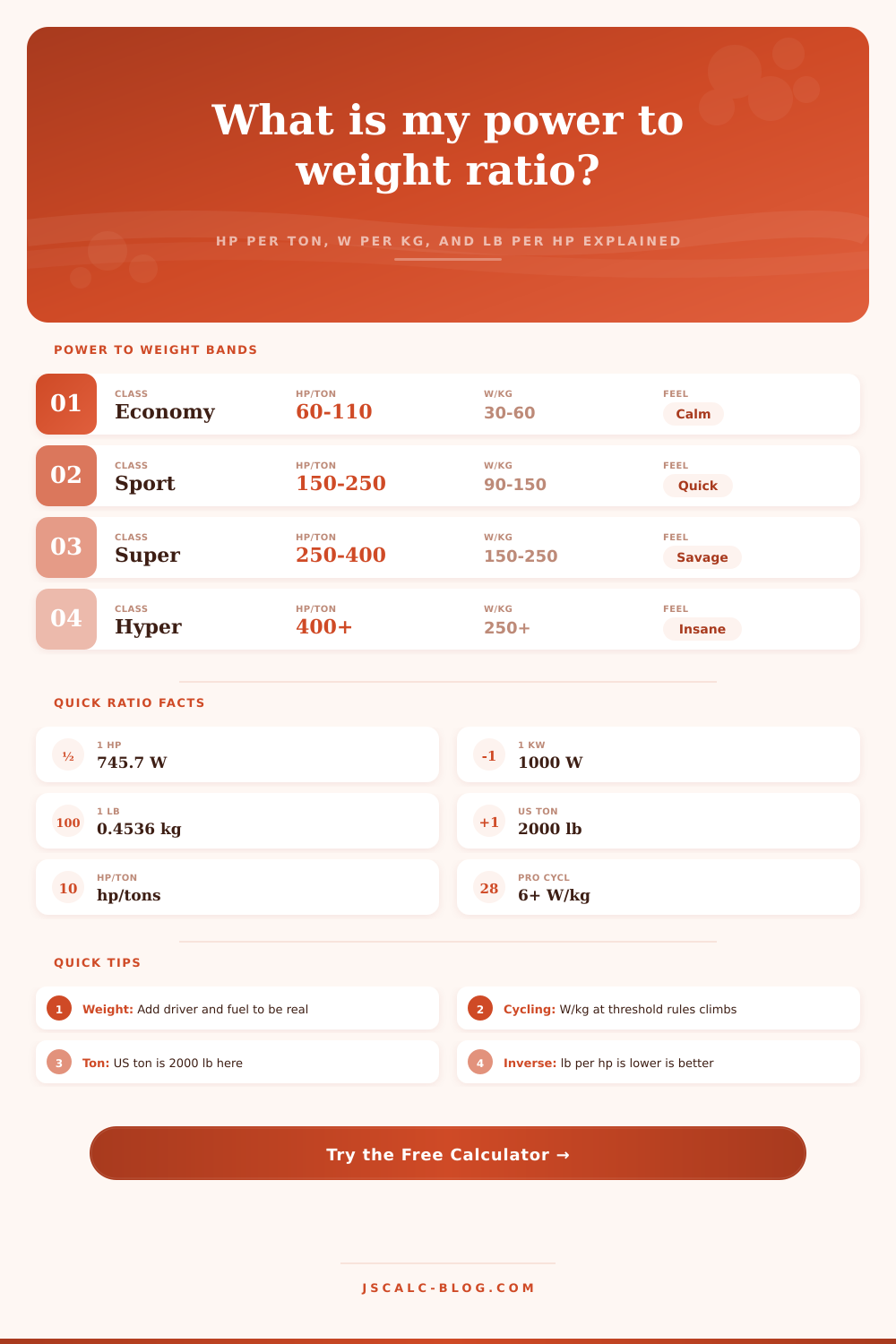
📊Vehicle Performance Bands
| Category | hp per US ton | hp per lb | W per kg | Typical Feel |
|---|---|---|---|---|
| Economy commuter | 60 – 110 | 0.030 – 0.055 | 30 – 60 | Relaxed, efficient cruising |
| Warm / family | 110 – 150 | 0.055 – 0.075 | 60 – 90 | Comfortable overtakes |
| Hot hatch / sport | 150 – 250 | 0.075 – 0.125 | 90 – 150 | Quick, eager, fun |
| Sports car | 250 – 350 | 0.125 – 0.175 | 150 – 215 | Fast, planted, thrilling |
| Supercar | 350 – 450 | 0.175 – 0.225 | 215 – 275 | Savage acceleration |
| Hypercar / race | 450+ | 0.225+ | 275+ | Neck-snapping, extreme |
🚴Cycling W/kg Fitness Bands
| Rider Level | W/kg at threshold | Example (75 kg) | Climbing Note |
|---|---|---|---|
| Novice / recreational | 1.5 – 2.5 | 113 – 188 W | Flat rides, gentle grades |
| Fitness enthusiast | 2.5 – 3.5 | 188 – 263 W | Rolling terrain, group rides |
| Category racer (Cat 3–4) | 3.5 – 4.5 | 263 – 338 W | Competitive club climbs |
| Elite amateur (Cat 1–2) | 4.5 – 5.5 | 338 – 413 W | Strong sustained climbing |
| Domestic pro | 5.5 – 6.0 | 413 – 450 W | Races up serious mountains |
| World tour / grand tour | 6.0+ | 450+ W | Wins summit finishes |
🔄Power and Weight Unit Conversions
| From | Equals | Reverse | Where It Matters |
|---|---|---|---|
| 1 horsepower | 745.7 W = 0.7457 kW | 1 kW = 1.341 hp | US and UK vehicle output |
| 1 metric PS | 735.5 W = 0.9863 hp | 1 hp = 1.0139 PS | European brochure figures |
| 1 kilowatt | 1000 W = 1.341 hp | 1 hp = 0.7457 kW | EV and global ratings |
| 1 pound | 0.453592 kg | 1 kg = 2.2046 lb | Curb weight conversions |
| 1 US ton | 2000 lb = 907.18 kg | 1 tonne = 1.1023 US ton | hp per ton denominator |
| 1 metric tonne | 1000 kg = 2204.6 lb | 1 US ton = 0.9072 t | Metric curb weight |
🗂Reference Vehicle Comparison Grid
| Machine | Power | Weight | hp/ton | W/kg | lb/hp |
|---|---|---|---|---|---|
| Economy sedan | 150 hp | 3100 lb | 97 | 79 | 20.7 |
| Hot hatch | 250 hp | 3100 lb | 161 | 133 | 12.4 |
| Muscle car | 480 hp | 4050 lb | 237 | 195 | 8.4 |
| Sports car | 400 hp | 3200 lb | 250 | 206 | 8.0 |
| Performance EV | 500 hp | 4800 lb | 208 | 171 | 9.6 |
| Litre superbike | 200 hp | 440 lb | 909 | 750 | 2.2 |
| Formula 1 car | 1000 hp | 1760 lb | 1136 | 938 | 1.8 |
| Full-size pickup | 400 hp | 5500 lb | 145 | 120 | 13.8 |
🧮Full Formula Breakdown
📋Reference Ratios and Uses
| Ratio | Formula | Better When | Best Used For |
|---|---|---|---|
| W/kg | watts / kg | Higher | Cycling, cross-unit vehicle comparison |
| hp per ton | hp / (lb / 2000) | Higher | Car spec sheets, magazine comparisons |
| hp per lb | hp / lb | Higher | Precise builds, motorcycles |
| lb per hp | lb / hp | Lower | Drag racing rule of thumb |
| kg per hp | kg / hp | Lower | European tuning discussions |
💡Practical Ratio Tips
You’ve all been there: reading through the spec sheet, and seeing five-hundred horsepower promised in brochures, only to be disappointed by slow takeoff while merging on the highway. Or maybe you’re launched into your seat with alarming force, despite having barely two hundred horsepower in this modest hot hatch. There’s a reason for that dissonance between what you feel and what you read. Horsepower is only half the equation.
While it will tell you how much work your engine can do, it doesn’t say anything about how much total mass that engine has to pushes. For that reason, power-to-weight ratio are the real indicator of acceleration potential, not raw engine size. You can plug your numbers into this calculator above and it’ll crunch the numbers for you, but knowing what the variables is will allow you to make better use of the calculator.
Why Weight Matters More Than Power
The first number most folks plug in is curb weight. Nothing wrong with that if you drive around in a vacuum with an empty vehicle. Life itself is the driver (and perhaps a passenger) along with a fair bit of fuel in the tank. If you add a hundred pounds to your equation, you may be sliding down that scale so much that your ratio becomes more of a commuter than a sport. It is a small deal but it decreases steadily when you add weight and does not change when you add power.
In the case of cyclists, it’s all about watts per kilogram. Unlike an automobile with a gearshift, there’s no way for a road bike’s engine to compensate for added weight during a steep hill climb. Dropping pounds tends to pay bigger dividends than pumping out more raw wattage. This trade-off is made clear with the tool.
So if you’re plateaued at four watts per kilogram, adding 50 watts of fitness will move the needle quite nicely. But so will dropping 12 kilograms off your body weight without pedaling any harder. That’s where many riders gets lost. They seek out power without realizing that every pound they carry is pulling them back as hard.
Drivetrain loss is a point of debate among automotive junkies everywhere. And there is good reason for this. Most of the time when a horsepower figure appears in a brochure, it’s taken from the crankshaft. This energy has not yet passed through transmission, differential, and gears, all of which lose energy as heat. Rear-wheel setups loses less power here than their front-wheel counterparts since there are fewer components between the transmission and wheels to contend with. You can use this calculator to adjust a percentage loss to approximate how much hits your tires. While a 12 percent adjustment to a typical car may seem small, that lost energy accumulates over thousands of miles or in a drag race.
Another problem is that people gets confused about units. Engineers and cyclists use watts per kilogram; the US automotive industry has a love affair with horsepower per ton. Mathematically, they’re equivalent, but psychologically they sound different. Three hundred hp per ton sounds impressive, until you find that means about one hundred fifty watts per kilogram, putting the car squarely into quick-but-not-extreme territory. This page’s reference table matches those different units to performance bands, so you can visually see where your machine lies compared to either an economy sedan or a super car.
So in the end, power-to-weight is all about efficiency of force. If you can take something away that the engine has to lift, then you don’t require any more engine for the task. Whether you’re building a track car, tuning a motorcycle, or attempting a mountain climb on two wheels, we’re after the same thing. We want maximum push with minimal drag.
The numbers tell us where to aim. But the drive tells us it’s true. At the right ratio, the gears seems to draw closer together. The road shortens. The machine immediately answers when you ask it to go. It’s that instant translation of intent into motion that’s the difference between good performance and great performance. You should of known that.