Power & Energy Converter
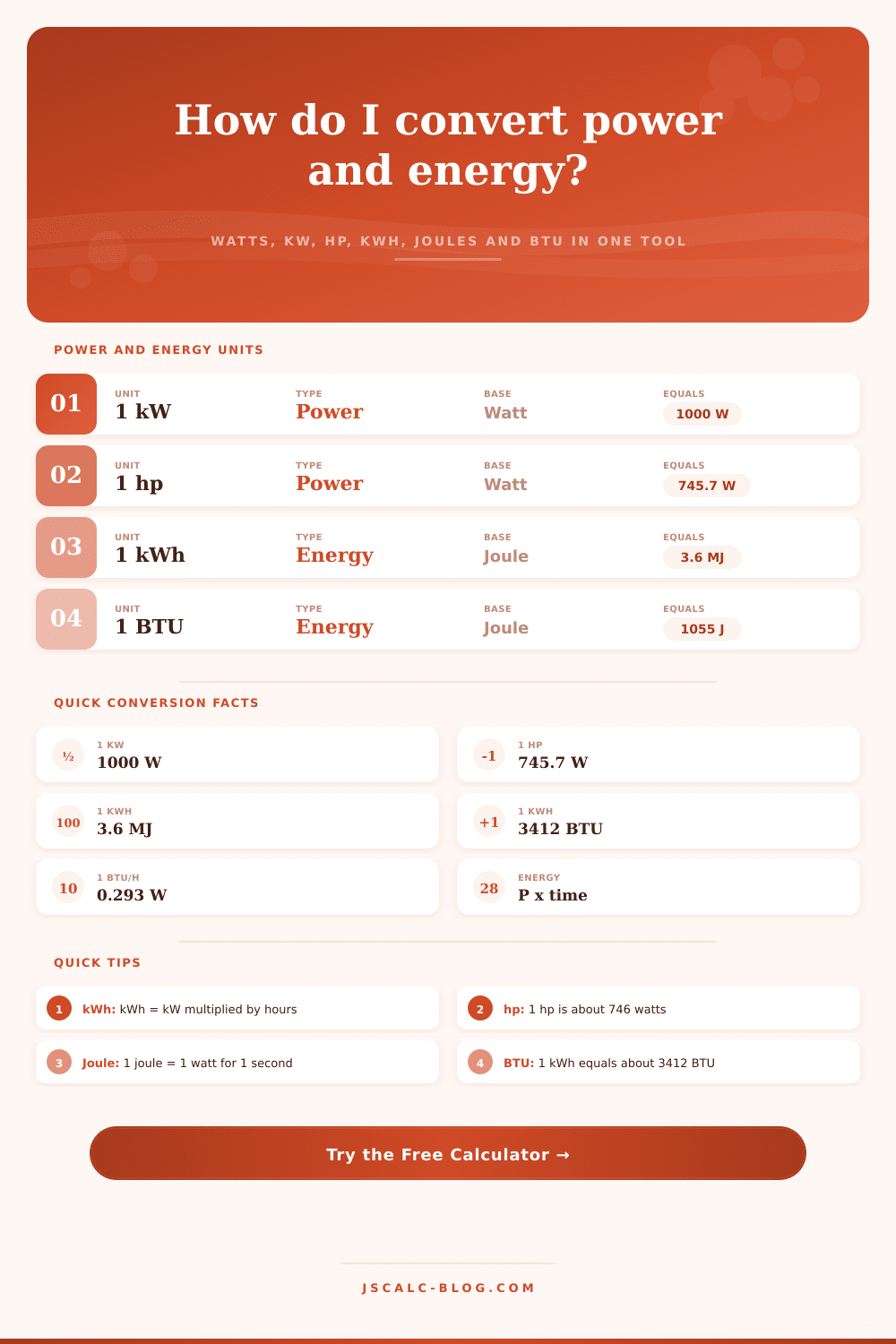
Convert power units like watts, kilowatts, horsepower, and BTU per hour, switch energy units such as joules, kilowatt-hours, and BTU, and link them together with the relation Energy = Power × time.
⚡Real Conversion Presets
🎛Converter Inputs
Pick power-only, energy-only, or link the two with E = P × t.
Used for power modes and as the power side of E = P × t.
Used for energy modes and as the E = P × t result unit.
🔢Base Units & Relation
📊Power Unit Chart (base watt)
| Power Unit | Symbol | Watts (W) | Notes |
|---|---|---|---|
| Watt | W | 1 | SI base unit of power |
| Kilowatt | kW | 1,000 | Common appliance rating |
| Megawatt | MW | 1,000,000 | Power plants and grids |
| Horsepower (mechanical) | hp | 745.7 | Engines and US motors |
| Metric horsepower | PS | 735.5 | European engine spec |
| BTU per hour | BTU/h | 0.293071 | Heating and cooling |
| Foot-pound per second | ft·lb/s | 1.35582 | Imperial mechanical power |
🔋Energy Unit Chart (base joule)
| Energy Unit | Symbol | Joules (J) | Notes |
|---|---|---|---|
| Joule | J | 1 | SI base unit of energy |
| Kilojoule | kJ | 1,000 | Food and physics energy |
| Megajoule | MJ | 1,000,000 | 1 kWh = 3.6 MJ |
| Watt-hour | Wh | 3,600 | Batteries and small loads |
| Kilowatt-hour | kWh | 3,600,000 | Electric meter billing unit |
| British thermal unit | BTU | 1,055.06 | Heating and HVAC energy |
| Calorie | cal | 4.184 | Small thermal energy unit |
| Kilocalorie | kcal | 4,184 | Food Calorie (1 Cal) |
🕑Power × Time Examples
| Load | Power | Time | Energy (kWh) | Energy (J) |
|---|---|---|---|---|
| LED bulb | 10 W | 10 h | 0.1 kWh | 360,000 J |
| Old bulb | 100 W | 10 h | 1 kWh | 3.6 MJ |
| Desktop PC | 500 W | 8 h | 4 kWh | 14.4 MJ |
| Space heater | 2 kW | 3 h | 6 kWh | 21.6 MJ |
| Microwave | 1.2 kW | 0.25 h | 0.3 kWh | 1.08 MJ |
| Split AC | 3.5 kW | 8 h | 28 kWh | 100.8 MJ |
🔌Appliance Power Ratings
| Appliance | Typical Power | In kW | In hp | 1 Hour Energy |
|---|---|---|---|---|
| LED light bulb | 10 W | 0.010 kW | 0.013 hp | 0.01 kWh |
| Laptop charger | 65 W | 0.065 kW | 0.087 hp | 0.065 kWh |
| Refrigerator (run) | 150 W | 0.150 kW | 0.201 hp | 0.15 kWh |
| Desktop computer | 500 W | 0.500 kW | 0.671 hp | 0.5 kWh |
| Microwave oven | 1,200 W | 1.200 kW | 1.609 hp | 1.2 kWh |
| Space heater | 2,000 W | 2.000 kW | 2.682 hp | 2.0 kWh |
| Split air conditioner | 3,500 W | 3.500 kW | 4.694 hp | 3.5 kWh |
| Electric water heater | 4,500 W | 4.500 kW | 6.035 hp | 4.5 kWh |
⚙Full Conversion Breakdown
📋Common Equivalents
| Quantity | Equals | And | Type |
|---|---|---|---|
| 1 hp | 745.7 W | 0.7457 kW | Power |
| 1 kW | 1.341 hp | 3412 BTU/h | Power |
| 1 kWh | 3.6 MJ | 3412 BTU | Energy |
| 1 MJ | 0.2778 kWh | 239 kcal | Energy |
| 1 BTU | 1055.06 J | 0.000293 kWh | Energy |
| 1 kcal | 4184 J | 0.001163 kWh | Energy |
💡Practical Conversion Tips
If you’ve ever looked at your electric bill, I’m sure you’ve noticed the numbers there and pondered their relationship to devices in your home. Despite what its name implies, the kilowatt-hour is not a measurement of power. It’s actualy a measurement of energy, that is, it takes into account not just strength (power) but duration (time). Power is the equivalent of speed; energy is the equivalent of distance. While you might travel fast, you don’t cover very far if you’re going only for a minute. Getting this right will help you control your home’s energy footprint without a PhD in engineering.
What does that mean? Power measure how fast energy is produced or consumed. A two-kilowatt space heater sucks up power fast, while a ten-watt LED bulb sips it slowly. So how much will my particular load consume for a certain amount of time? The calculator do that math for you. Simply input your own number and the tool figures out the rest, no more trying to figure out what each unit means and converting between them.
Power vs Energy: What Is the Difference?
They are all talking about the same thing, but their units comes from different eras and sometimes different countries. HVAC technicians tend to communicate in BTUs/hour; mechanics say “horsepower,” and electricians refers to kilowatts. But they’re still all measuring the exact same underlying physical quantity. There’s an easy equation for how power relates to energy. Power times time equals energy. Running a one-kilowatt heater for three hours use up three kilowatt-hours of energy.
Most folks don’t understand this… They look at the wattage rating on the plug, and think that’s how much energy it uses. False. You aren’t charged for just the rating; you’re charged for amount of work you’ve done (over time). So a device with a large power rating used for only a short period may be cheaper than another with a small power rating left running all day. This same logic apply to both reducing your monthly utility bill and properly sizing a battery bank for a cabin.
There is also the issue of horsepower, which make sense for engines but not as much for electricity. A mechanical horsepower is about seven hundred forty-six watts. It is a holdover from when we bought our tools and cars rated by horsepower. It persists because we continue to do just that. Converting between kW and hp is easy; getting confused mixing them with units of energy is where things go wrong. Power is instantaneous, while energy is cumulative, and horsepower alone will not tell you how many joules your engine produced unless you also know how long it operated. Confusing the two lead to expensive errors in planning a project.
Another stumbling block is British thermal units, particularly as they apply to heating and cooling system. A BTU is a tiny unit of energy. It is the amount of energy required to increase temperature of one pound of water by one degree Fahrenheit. Air conditioners rated in BTUs per hour aren’t telling you how much energy they use; they’re giving you their power rating: how quickly they will pull heat from the room. But that’s not the same thing as knowing the total energy consumed. This is explained clearly in reference table on the page, which spells out how these units compare to the basic SI units such as joules and watts. If you look at them together, you’ll immediately see why scales differ, and why some folks get tripped up.
In Physics, all things speak the same language: Joules. Whether it’s boiling water or picking up a rock or pushing a car down the road, the unit is joules. Unfortunatly, for electric power, they’re far too tiny. For an average house, there are millions of joules consumed each day. To make life easy, we package those joules into units called kilowatt-hours (which contain thirty-six hundred thousand joules). Three million six hundred thousand joules sound like a nice round number. That also happens to match our utility meter ticks. Understanding this conversion will let you compare apples to apples between any two energy sources, such as electricity stored in your home battery compared to gasoline pumped into your vehicle.
In practice: keep tabs on how you use things. Which ones are always running? What consumes hundreds of watts? (your computer?) But what’s on for eight hours a day? (your computer) What has a lower wattage? A refrigerator have a lower wattage but is never turned off. Those little dials that tick away constantly can add up to more total than big appliances that only turn on for a few minutes. Smart choices come from knowing what use electricity and when.
Ultimately though, converting from one unit to another requires less math then mindset. Joule, watt, or horsepower, they’re all different lenses for looking at the flow of energy. The bottom line doesn’t change, only the number does. Energy is the coin of the realm these days. You should of learned to count it and you’ll be in charge.