Electrical Energy Converter
Convert electricity energy between kilowatt-hours, watt-hours, joules, megajoules, BTU, therms, and kilocalories, or turn appliance watts × hours into kWh used per day and per month.
⚡Real Energy Presets
📝Energy Inputs
Used when mode is convert a unit.
All units are shown; this one is featured.
Used in appliance mode. 1 kW = 1000 W.
Multiplies daily kWh for a monthly or run total.
🔢Base Unit Snapshot
📐Energy Unit Conversion Chart
| Unit | In Joules | In kWh | In MJ | In BTU | In kcal |
|---|---|---|---|---|---|
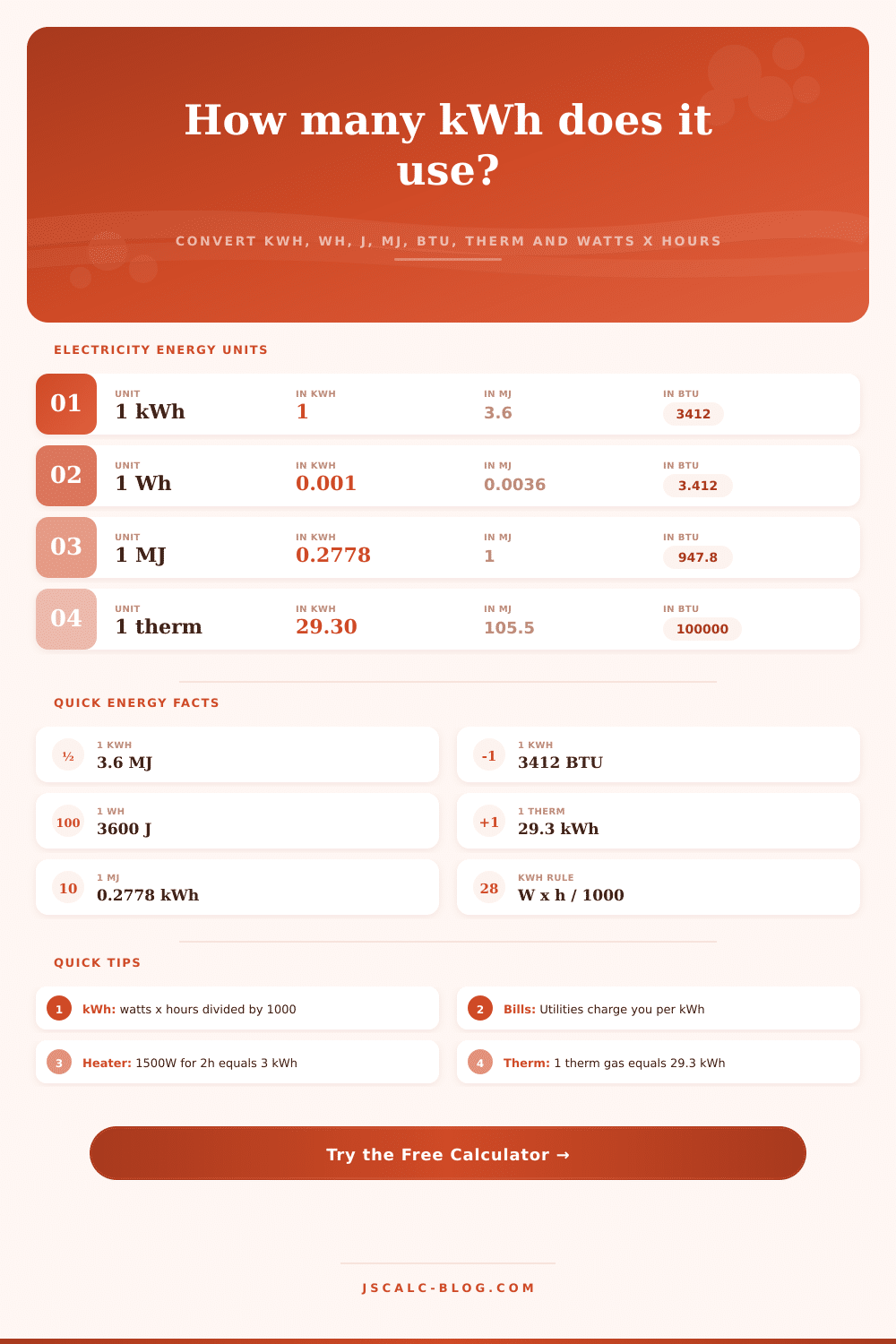
| 1 kWh | 3,600,000 | 1 | 3.6 | 3,412.14 | 859.845 |
| 1 Wh | 3,600 | 0.001 | 0.0036 | 3.41214 | 0.859845 |
| 1 J | 1 | 0.000000278 | 0.000001 | 0.000947817 | 0.000238846 |
| 1 MJ | 1,000,000 | 0.277778 | 1 | 947.817 | 238.846 |
| 1 BTU | 1,055.06 | 0.000293071 | 0.00105506 | 1 | 0.251996 |
| 1 therm | 105,505,585 | 29.3001 | 105.506 | 100,000 | 25,199.6 |
| 1 kcal | 4,186.8 | 0.00116300 | 0.0041868 | 3.96832 | 1 |
🔌Appliance kWh Per Use
| Appliance | Watts | Hours | kWh Per Use | MJ Per Use | BTU Per Use |
|---|---|---|---|---|---|
| LED bulb | 10 W | 5 h | 0.050 | 0.18 | 171 |
| Laptop | 60 W | 4 h | 0.240 | 0.86 | 819 |
| Refrigerator | 150 W | 24 h | 3.600 | 12.96 | 12,284 |
| Washing machine | 500 W | 1 h | 0.500 | 1.80 | 1,706 |
| Space heater | 1,500 W | 2 h | 3.000 | 10.80 | 10,236 |
| Clothes dryer | 3,000 W | 1 h | 3.000 | 10.80 | 10,236 |
| Air conditioner | 3,000 W | 8 h | 24.000 | 86.40 | 81,891 |
| EV charge | 7,200 W | 8 h | 57.600 | 207.36 | 196,539 |
🗂Daily and Monthly kWh Examples
| Appliance | Watts | Hours/Day | kWh/Day | kWh/Month | MJ/Month |
|---|---|---|---|---|---|
| LED bulb | 10 W | 5 h | 0.05 | 1.5 | 5.4 |
| Wi-Fi router | 12 W | 24 h | 0.29 | 8.6 | 31.1 |
| Laptop | 60 W | 6 h | 0.36 | 10.8 | 38.9 |
| Refrigerator | 150 W | 24 h | 3.60 | 108.0 | 388.8 |
| Television | 120 W | 5 h | 0.60 | 18.0 | 64.8 |
| Space heater | 1,500 W | 4 h | 6.00 | 180.0 | 648.0 |
| Air conditioner | 3,000 W | 8 h | 24.00 | 720.0 | 2,592 |
| Electric oven | 2,400 W | 1 h | 2.40 | 72.0 | 259.2 |
⚙Full Formula Breakdown
📋kWh, MJ and BTU Quick Reference
| kWh | MJ | BTU | Wh |
|---|---|---|---|
| 0.5 | 1.8 | 1,706 | 500 |
| 1 | 3.6 | 3,412 | 1,000 |
| 2 | 7.2 | 6,824 | 2,000 |
| 5 | 18.0 | 17,061 | 5,000 |
| 10 | 36.0 | 34,121 | 10,000 |
| 29.3001 | 105.506 | 100,000 | 29,300 |
| 60 | 216.0 | 204,728 | 60,000 |
💡Practical Energy Tips
When you look at your electric bill, it’s just some arbitery number on a piece of paper; until you try to calculate it yourself. Then you realize there’s something off: the number from the utility company (charged by the kilowatt-hour) doesn’t seem to match what you read on the wattage label on your heater. Somewhere along the line, something change from watts to something else. Where? What? Why? That’s where people get confused.
But once you understand how electricity converts between different measure, everything changes; it becomes straightforward math. No more magic; no more mystery.
How to Calculate Your Electricity Bill
The problem is: We don’t count things the same way with energy (or power) as we do other stuff (like weight and distance). Like “speed” is the rate something travels, watts are the rate your device consume electricity. Just as miles measure the total distance traveled, kilowatt-hours measures the total energy consumed over time. Running a one-kilowatt heater for two hours equals using two kilowatt-hours of energy. Why does it matter? You pay by the distance, not the speed.
The calculation above takes care of the math so that you can figure out just what your daily choices add up to each month. No need to get lost in units. But those scales are foreign to many people, until they’re lined up next to each other in another industry. If your energy comes from natural gas or heating oil, for example, it’s quoted in unit called million BTUs or therms. These sound like something only aliens would measure with unless you’ve seen an electrical meter. In fact, about 29 kilowatt-hours of electricity equals one therm, so that’s a hefty block of home electricity. Knowing this equivalence lets you convert heating methods for fair comparisons. Instead of guessing which fuel seems cheapest based off the numbers shown, you can compare them directy.
The cross-system conversion chart below on the page spells all that out plainly and takes the guess-work out of comparing electric versus gas estimates.
Finally, people who estimate their usage often ignore one important factor: appliance efficiency. Does your fridge use as much electricity as your toaster oven? Maybe not! Because fridges are appliances which cycle on/off according to internal temperature controls, whereas toasters run at maximum wattage all the time. If you leave both plugged in for eight hours, don’t assume they’ll both “use” the same amount of electricity. Your fridge may actualy only run its compressor for an hour during those eight hours, whereas the heater will pull full force every minute. This is a detail which can make or break the accuracy of your own budgeting calculations.
The other thing that changes with the seasons is that it shifts the entire landscape. When you run an air conditioner eight hours a day during summer months, it’s a load much larger then everything else in your house combined. And when those twenty-four kilowatt-hours are spread out across a whole thirty days in a given month, they can easily double your electricity bill (depending where you live). Convert that number back to BTUs or megajoules, and you get some perspective on just how much physical effort it takes to cool a structure against the ambient temperature outdoors. This is a reminder of how precious and hard-to-move energy realy is.
There’s no need for an engineer’s degree here… As long as you can keep tabs on the wattage of devices and their duration of use, you’ll be in good shape. You should of known it was that simple.
Boiling water? Are you drying laundry? Charging your car? It all adds up the same way. Power X time / 1000 = your consumption baseline. If you memorize that cadence, energy management shifts from panic mode into something you can predict and plan around. Costs become real choices you can make and those big scary numbers shrink until they make sense.