Angle to Degrees Converter
Convert radians, gradians (gon), turns, NATO mils, and degrees-minutes-seconds into decimal degrees. See the exact multiplier used, plus radian, gradian, and DMS equivalents for any angle.
📌Common Angle Presets
📝Angle Input
Used for every unit except DMS. Negative values are allowed.
Degrees (°)
Minutes (’)
Seconds (″)
🔢Whole-Circle Reference
📐Radians to Degrees Chart
| Radians | Pi Form | Degrees | Turn Fraction |
|---|---|---|---|
| 0.2618 | π/12 | 15° | 1/24 |
| 0.5236 | π/6 | 30° | 1/12 |
| 0.7854 | π/4 | 45° | 1/8 |
| 1.0472 | π/3 | 60° | 1/6 |
| 1.5708 | π/2 | 90° | 1/4 |
| 3.1416 | π | 180° | 1/2 |
| 4.7124 | 3π/2 | 270° | 3/4 |
| 6.2832 | 2π | 360° | 1 full |
🌐Common Angles in All Units
| Degrees | Radians | Gradians | Turns | NATO Mils |
|---|---|---|---|---|
| 0° | 0 | 0 | 0 | 0 |
| 30° | 0.5236 | 33.333 | 0.0833 | 533.33 |
| 45° | 0.7854 | 50 | 0.125 | 800 |
| 60° | 1.0472 | 66.667 | 0.1667 | 1066.67 |
| 90° | 1.5708 | 100 | 0.25 | 1600 |
| 180° | 3.1416 | 200 | 0.5 | 3200 |
| 270° | 4.7124 | 300 | 0.75 | 4800 |
| 360° | 6.2832 | 400 | 1 | 6400 |
🎯Gradian and Mil Quick Reference
| Unit | One Unit in Degrees | Full Circle | Typical Use |
|---|---|---|---|
| Gradian (gon) | 0.9° | 400 gon | Surveying, geodesy |
| NATO mil | 0.05625° | 6400 mils | Artillery, optics |
| Warsaw Pact mil | 0.06° | 6000 mils | Older military kit |
| Milliradian | 0.057296° | 6283.2 mrad | Rifle scope turrets |
| Turn | 360° | 1 turn | Rotations, revolutions |
| Radian | 57.29578° | 2π rad | Math, physics |
🧭DMS Conversion Examples
| Decimal Degrees | Degrees | Minutes | Seconds | DMS |
|---|---|---|---|---|
| 45.5° | 45 | 30 | 00 | 45°30’00″ |
| 12.25° | 12 | 15 | 00 | 12°15’00″ |
| 30.5083° | 30 | 30 | 30 | 30°30’30″ |
| 100.1° | 100 | 06 | 00 | 100°06’00″ |
| 57.2958° | 57 | 17 | 45 | 57°17’45″ |
| 0.5° | 0 | 30 | 00 | 0°30’00″ |
⚙Full Formula Breakdown
💡Angle Conversion Tips
There are angles all around and they’re not always easy to work with. If you want to measure a piece of pie, you intuitively know what “degrees” mean. But if you’re programming a robot arm (or aiming a rifle), you’d rather work in “radians”. Degrees seem clunky there which is why it’s important to convert back and forth. It isn’t just math class, it’s knowing how to speak the appropriate language for the job at hand.
The calculator above will do the math for you on the fly but being able to explain *why* these languages exist makes numbers easier to believe. In our day-to-day lives, degrees make sense. There are 360 of them in a circle. That number comes from ancient astronomy because it divides nicely into several fractions.
Why We Use Different Angle Units
Engineers and mathematicians tend to use another unit: radians. That sounds backwards at first, especially if seeing 1.57 instead of 90 feels strange. But it’s actualy more simple: it links the angle directly with radius. An arc length equal to the radius itself is one radian. It’s a natural unit of measure for rotation and motion.
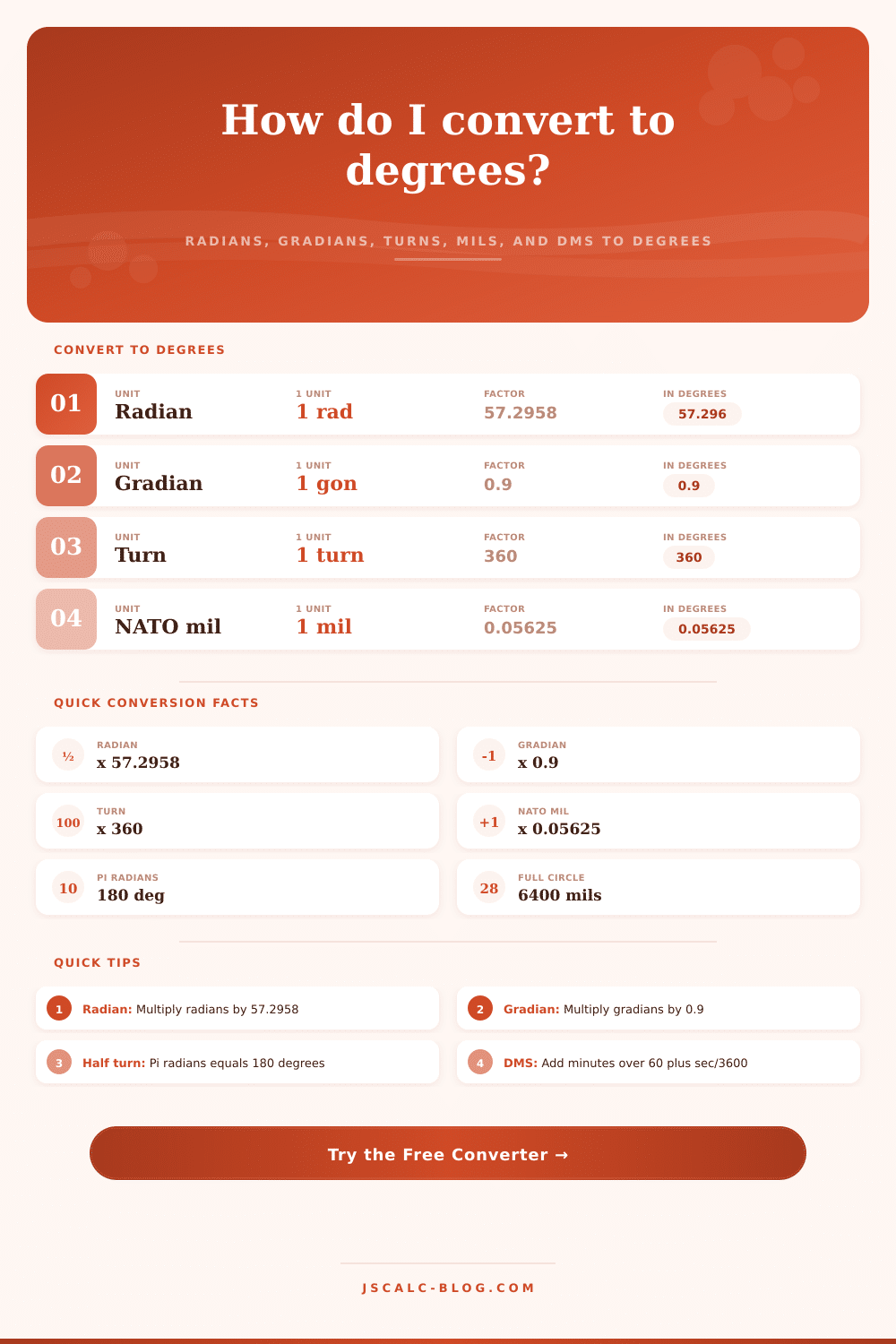
Converting between radians and degrees turns geometric measurements back into units that are easy for people to use. The calculator does that math for you. To cross over the gap, multiply by about 57.3.
Less typical angles are also possible. There is 400 right angles in a circle (gradians). That seems like a nightmare for mental arithmetic but it means that converting to decimals is tidy. Exactly 100 gradians equals a right angle. Surveyors employed this so they didn’t have to deal with fractions.
An even more obscure system is NATO mils, which has 6400 tiny slivers of a circle. This gives an enormus amount of detail that’s needed when snipers or artillery spotters wants to adjust position by very small amounts without getting lost in a chain of decimal places.
The key thing to know is which one you are using. You can’t mix degrees and radians when doing trigonometry. Try it with a physics problem and see what weird result you get, it happens all the time.
And then there’s the complication of degrees, minutes, and seconds. Geography and navigation systems has been using this base-60 system since the beginning, and even though we have decimal places now, it’s precise enough not to need them (at least until they became easier to read!). To convert DMS to one decimal number, simply divide the minutes by sixty and seconds by three thousand six hundred. It is tedious if done by hand but handy when you are done. This way, decimal degrees can be entered directly into mapping programs and GPS devices.
On the page are the reference tables which clearly indicate how 45.5 degrees breaks down into 45 degrees and 30 minutes. Also note the range normalizations available with these converters. Mathematically, an angle of 450 degrees is perfectly fine. But physically, that’s only 90 degrees with one full additional rotation added on. If you’re drawing a simple triangle or trying to track wheel rotations, then that makes a difference.
Visualizing direction as wrapping around from zero to 360 degrees or centered at -180 to +180 changes things. Not a big deal. But can help avoid navigation mistakes in everything from aviation to video game development.
So how do you master these conversions? You don’t do it by memorizing any formulas. It is not really about formulas at all, it’s all about recognizing the context. If you’re looking at a map, stick with degrees. If you’re programming a motor controller, think in radians. If you’re fiddling with optics, use mils. The geometry remains the same, it’s just viewed through a different lens.
Once you know what each unit represents, the numbers stop feeling arbitrary. They become part of a clear story about direction and rotation. You switch back and forth easy, without even thinking about it. What was once confusing becomes precise control.