Power Consumption Calculator
Turn any appliance wattage and daily runtime into kilowatt-hours per day, month, and year, add optional standby draw, and see the electricity cost at your own utility rate.
🔌Real Appliance Presets
📝Appliance Inputs
Check the nameplate, label, or power brick for rated watts.
Fewer than 7 days scales the monthly and yearly totals down.
Power drawn during the idle hours the device is not in active use.
🔢Formula Snapshot
📋Appliance Wattage Reference
| Appliance | Typical Watts | Typical Hours/Day | kWh/Day | Est. Cost/Month |
|---|---|---|---|---|
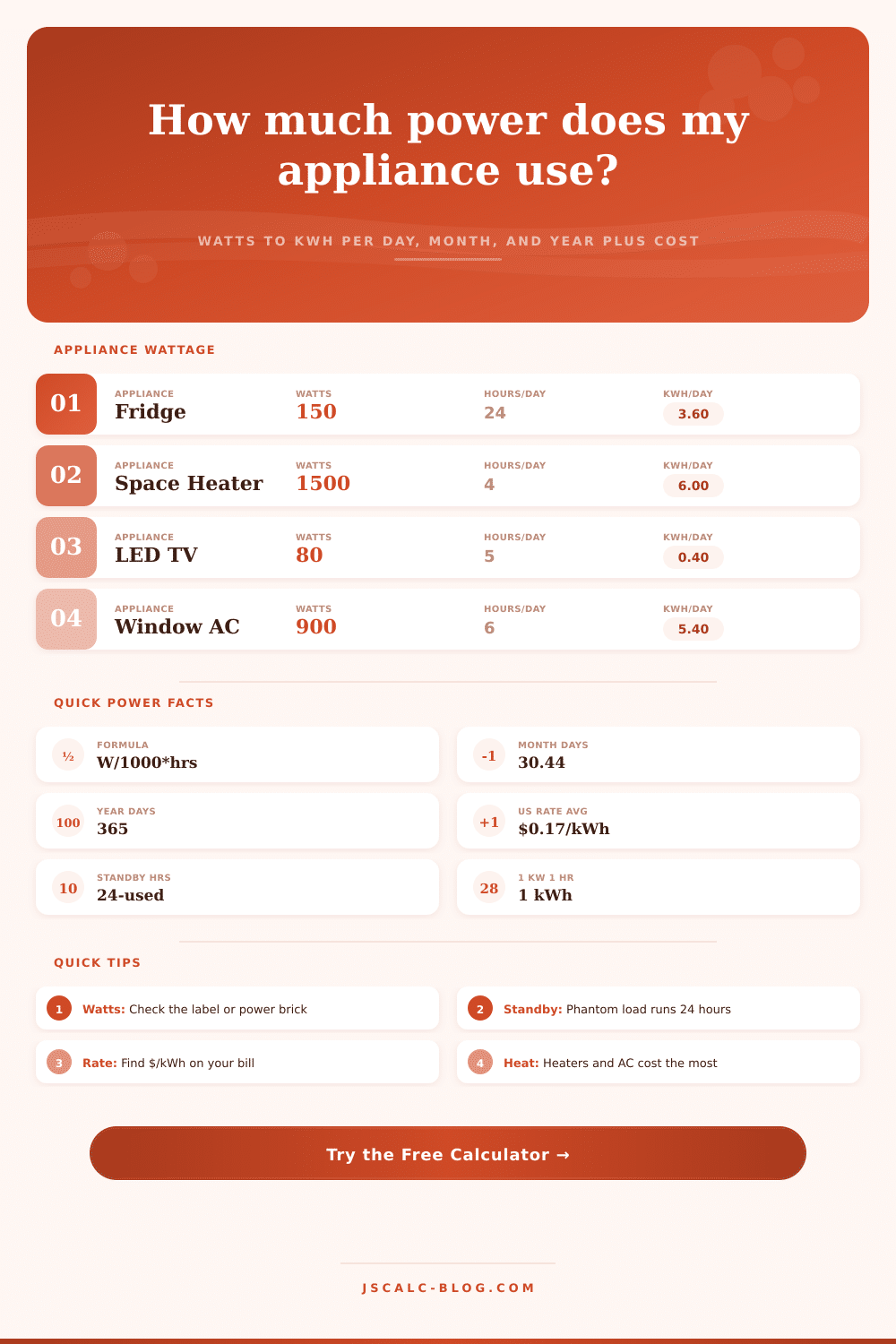
| Refrigerator | 150 W | 24 (cycling) | 3.60 | $18.62 |
| Chest Freezer | 200 W | 24 (cycling) | 4.80 | $24.83 |
| Space Heater | 1,500 W | 4 | 6.00 | $31.04 |
| Window AC Unit | 900 W | 6 | 5.40 | $27.93 |
| Central AC | 3,500 W | 6 | 21.00 | $108.62 |
| LED TV 55 in | 80 W | 5 | 0.40 | $2.07 |
| Gaming PC | 450 W | 4 | 1.80 | $9.31 |
| Clothes Dryer | 3,000 W | 1 | 3.00 | $15.52 |
| Electric Water Heater | 4,000 W | 3 | 12.00 | $62.07 |
| LED Light Bulb | 10 W | 6 | 0.06 | $0.31 |
🔋Standby & Phantom Load Reference
| Device | Standby Watts | Idle Hours/Day | kWh/Year | Cost/Year |
|---|---|---|---|---|
| Cable / satellite box | 18 W | 20 | 131.4 | $22.34 |
| Game console (rest mode) | 10 W | 22 | 80.3 | $13.65 |
| Desktop PC (sleep) | 5 W | 18 | 32.9 | $5.59 |
| TV (off but plugged) | 3 W | 19 | 20.8 | $3.54 |
| Phone charger (no phone) | 1 W | 20 | 7.3 | $1.24 |
| Microwave clock | 3 W | 23 | 25.2 | $4.28 |
| Coffee maker display | 2 W | 23 | 16.8 | $2.86 |
💰Cost by Electricity Rate
| Appliance | kWh/Month | $0.12/kWh | $0.17/kWh | $0.22/kWh | $0.30/kWh |
|---|---|---|---|---|---|
| Space Heater 4 h/day | 182.6 | $21.92 | $31.05 | $40.18 | $54.79 |
| Refrigerator 24 h | 109.6 | $13.15 | $18.63 | $24.11 | $32.87 |
| Window AC 6 h/day | 164.4 | $19.72 | $27.94 | $36.16 | $49.31 |
| LED TV 5 h/day | 12.2 | $1.46 | $2.07 | $2.68 | $3.65 |
| Gaming PC 4 h/day | 54.8 | $6.57 | $9.31 | $12.05 | $16.43 |
| Water Heater 3 h/day | 365.3 | $43.83 | $62.10 | $80.36 | $109.58 |
| Ceiling Fan 8 h/day | 18.3 | $2.19 | $3.10 | $4.02 | $5.48 |
| Always-On (50 W) | 36.5 | $4.38 | $6.21 | $8.04 | $10.96 |
⚙Full Formula Breakdown
💡Practical Energy-Saving Tips
You’re always plugging things into outlets, but electric bill still comes as a bit of a shocker. While it’s easy to feel that something isn’t adding up, that there’s no connection between what you do during the day and how much your bill is for, utility arithmetic don’t work like that. Plug in runtime and wattage values, and let the calculator do its thing. No need for guesses about conversions or coefficients; just hours to see how many dollars they add up to.
Here’s how it works: The physics are easy; the units are baffling. Utilities don’t charge based solely on hours or even watts, but instead charges per kilowatt-hour. Watts describe instantaneous power (like a speedometer in a car). Kilowatt-hours describes total energy consumption over time (like a car’s mile-age, measured on an odometer). One kilowatt-hour equals running something at 100 watts for ten hours. That distinction is important because high-wattage things used for short times may be cheaper than low-wattage thing left running all the time. People pay attention to the former (power rating) but not the latter (duration), then get shocked by their bill.
How to Calculate Your Electric Bill Costs
To begin, locate the rated watts of your devices. They’re typically listed in tiny print on the device’s nameplate or label; look inside the door to the compartment where the plug cord plugs in. If you can’t locate a label, most manufacturers’ websites will has the spec info for popular products. Plug that into the calculator (along with how many hours per day you really operate the item).
If it’s a space heater, for instance, you’ll enter the rated watts. You must realize that while it may be rated for non-stop use, you might only run it in the morning and evening in winter. Be truthful about the hours. The tool will project from there to tell you what the daily use translates to over months and years, helping you think about total cost, not just peaky expense.
For the most part, it’s heating/cooling systems that skew these numbers. Because it takes a lot of work to move thermal energy around, things like resistive heaters (and air conditioners) gobble up a ton of electricity. For example: Four hours on a 1500 watt heater is equivalent to one kWh, which is also how much you’d use by having a 150 watt fridge cycle on/off throughout the day. This is illustrated nicely in the calculator; where lowering your usage on high-power items results in greater savings than messing with little gadgets. Sure, replace that lightbulb with an LED. But run that window unit an extra three hours and your gains are gone.
There’s also what I call phantom loads: the silent tax of convenience. Even if you turn your devices off, they may be drawing power sitting there, waiting for a signal (from a remote) or refreshing their firmware. Smart TVs, cable boxes and gaming consoles all adds to this standby drain. While you won’t notice any outages, it piles up month after month. See how much it adds up by checking the typical idle draw of common electronics on the reference table.
To avoid wasting electricity by letting it leak out unused components, group them together on a switched power strip and simply cut its power when you aren’t using it. This is a little change of habit that saves some electricity.
To get accurate results, be sure to input your electricity price (cost per kilowatt-hour), that number differs wildly by location. While there are national average prices as a guide, they’ll also be twice as high (or more!) in certain regions at peak times, such as summertime and wintertime. Do you have time-of-use electricity? Are there specific times of day that you do your largest loads? For instance, moving your laundry to occur off-peak might not reduce your overall energy usage, but it can drastically decrease how much money this costs you. Knowing your electric rate will help you read the calculator’s result, translating statistics into useful ways to budget.
Saving energy is about more than just saving money. It’s also about being aware. Awareness leads to seeing what costs how much when it’s running. That makes you notice which gadgets deserves to be on your energy bill. Running a heater is expensive; a ceiling fan isn’t. One generates heat; one blows around cool air. And you don’t have to be an engineer to know this difference. No degrees are necessary; you don’t need to memorize formulas; you don’t have to monitor spreadsheets by hand. The key is to have visibility into power use.
Even if you don’t see them, those hidden costs still add up on your bill. As soon as you put a dollar sign on it, then all those hidden costs become visible. Measure the money-watts-time relationship and you’re back in control of this abstract monthly bill. The numbers cease to be scary and begin to show you exactly what’s eating up your dollars. Because that’s not about turning off the lights, that’s about having them on when and how you want them, but at a minimum cost.