Kinetic Energy Calculator
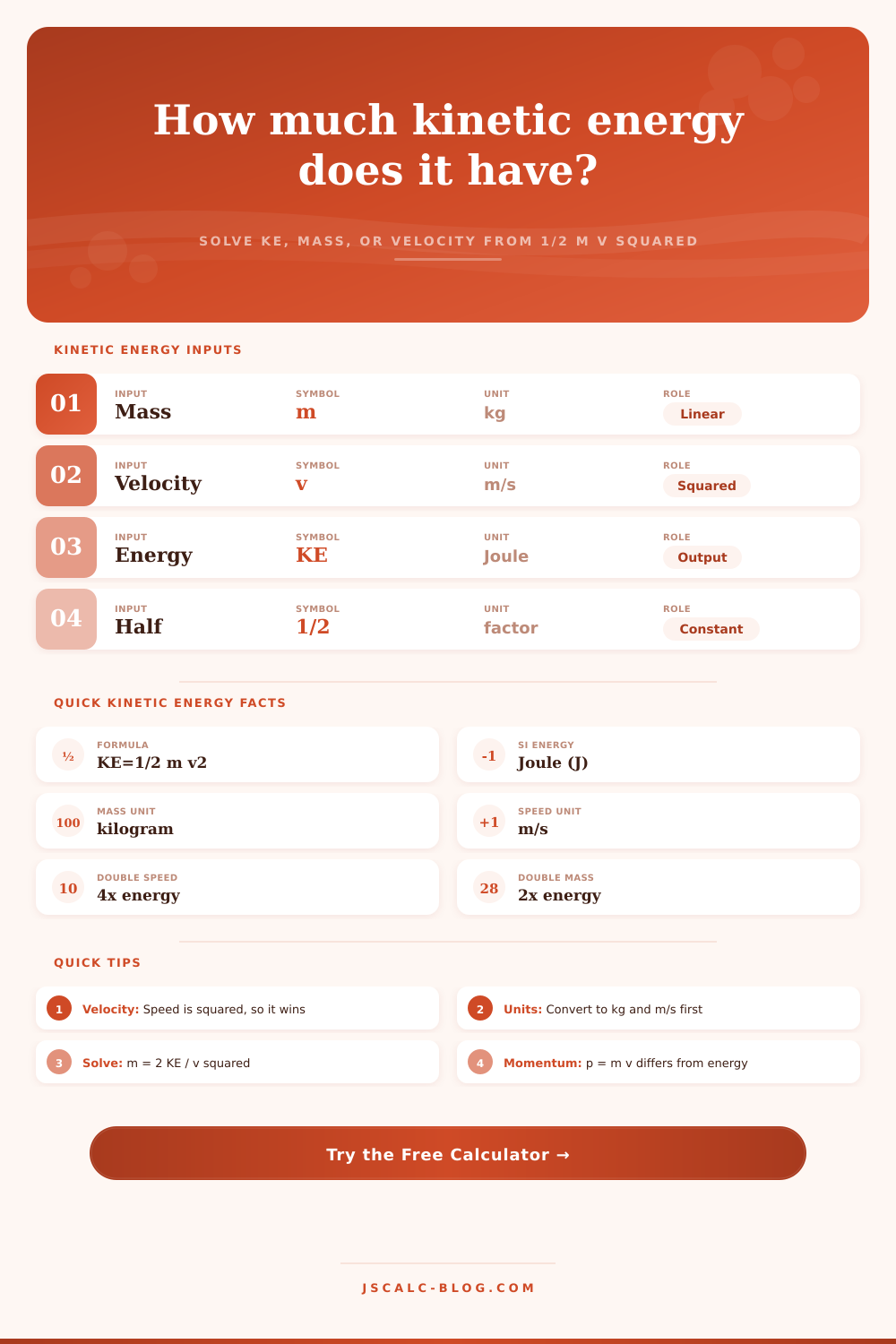
Solve the translational kinetic energy equation KE = 1/2 m v² for energy, mass, or velocity. Mix kilograms, grams, and pounds with meters per second, km/h, and mph, then read Joules, kilojoules, calories, foot-pounds, and momentum.
⚡Real Kinetic Energy Presets
📝Motion Inputs
The unknown field is hidden and filled by the result.
🔢Formula Snapshot
🔄Energy Unit Conversion
| Unit | Symbol | Joules Each | Your Result |
|---|---|---|---|
| Enter values above to see the energy conversion table. | |||
🏃Velocity Unit Conversion
| Unit | Symbol | m/s Each | Your Speed |
|---|---|---|---|
| The velocity conversion table appears after calculation. | |||
📊Kinetic Energy of Common Objects
| Object | Mass | Speed | Speed (m/s) | Kinetic Energy |
|---|---|---|---|---|
| Rifle bullet | 10 g | 400 m/s | 400 | 800 J |
| Baseball pitch | 145 g | 40 m/s | 40 | 116 J |
| Sprinting runner | 70 kg | 5 m/s | 5 | 875 J |
| Cyclist and bike | 90 kg | 8 m/s | 8 | 2,880 J |
| Highway car | 1,500 kg | 108 km/h | 30 | 675,000 J |
| Loaded truck | 18,000 kg | 90 km/h | 25 | 5,625,000 J |
| Dropped rock (2 s fall) | 2 kg | 19.6 m/s | 19.6 | 384 J |
| Free electron | 9.11e-31 kg | 2.19e6 m/s | 2.19e6 | 2.18e-18 J |
🗂Speed vs Energy Comparison Grid
| Speed | m/s | KE at 1 kg | KE at 10 kg | KE at 100 kg | vs 10 m/s |
|---|---|---|---|---|---|
| 18 km/h | 5 | 12.5 J | 125 J | 1,250 J | 0.25x |
| 36 km/h | 10 | 50 J | 500 J | 5,000 J | 1x |
| 54 km/h | 15 | 112.5 J | 1,125 J | 11,250 J | 2.25x |
| 72 km/h | 20 | 200 J | 2,000 J | 20,000 J | 4x |
| 108 km/h | 30 | 450 J | 4,500 J | 45,000 J | 9x |
| 144 km/h | 40 | 800 J | 8,000 J | 80,000 J | 16x |
⚙Full Formula Breakdown
📋SI Reference Values
| Quantity | SI Unit | Symbol | Handy Conversions |
|---|---|---|---|
| Mass | kilogram | kg | 1 g = 0.001 kg, 1 lb = 0.453592 kg |
| Velocity | meter/second | m/s | 1 km/h = 0.277778 m/s, 1 mph = 0.44704 m/s |
| Energy | Joule | J | 1 kJ = 1000 J, 1 cal = 4.184 J |
| Energy (imperial) | foot-pound | ft-lb | 1 ft-lb = 1.35582 J |
| Energy (electric) | kilowatt-hour | kWh | 1 kWh = 3,600,000 J |
| Momentum | kg meter/second | kg m/s | p = m × v, a separate quantity |
💡Practical Kinetic Energy Tips
The concept of kinetic energy becomes intuitive as soon as you encounter it. Intuitively, we know a fast ping pong ball might just sting, while a slow bowling ball hurt. Momentum = mass x velocity. That’s all there is to it. Being both heavy and fast isn’t the point. It’s the combination of those two thing.
Once you put your numbers into the calculator (above), it do the math for you. No need to stumble around making square errors while converting units yourself. That equation, KE = 1/2 mv squared, is core equation. Notice the exponent on the velocity term? It makes all the difference. Since speed are squared, it dominates the equation.
Why Speed Matters More Than Weight
Mass can do this: Doubling mass doubles kinetic energy. A one-ton car moving at the same speed as a two-ton car has half the kinetic energy. That’s linear. It is predictable. But doubling speed quadruples the kinetic energy. A sixty-mile-per-hour car is four times more destructive than a thirty-mile-per-hour car.
That’s what most folks don’t see with performance cars. Safety is also an issue. Speed doesn’t merely add energy to the mix, it increases energy quickly. That’s why braking distance doesn’t scale in a straight line. It is not linear at all. Because when you’re trying to slow something down, there’s work to be done; and that work require the loss of kinetic energy via friction into heat.
If the energy increase by a factor of four, that means the distance necessary to remove it likewise increases. Every time you drive on snowy or rainy pavement, you witness that phenomenon. Because the grip of your tires is reduced, they can’t burn off the energy as rapidy. The physics of the situation say that the car won’t stop, at least not for some time. Your reaction time isn’t changed. However, your underlying energy budget has increased, which causes distance to stretch out.
When using a tool like this pay close attention to units. In its purest form the formula want meters per second and kilograms. Most people operate on miles per hour or pounds. This calculator handles those conversions for you. But knowing how it operates underneath the hood let you know why you should of trust the result. You can’t go feeding grams into a formula where kilos are required and expect to get anything other than a number off by a factor of a thousand. It’s such an easy mistake to rush while making an estimate or doing homework and forget to adjust.
Always leave the conversion factors up to the tool. Knowing you did it right starts with knowing you put the right thing in the right kind of tool. Many students struggle to understand the difference between kinetic energy and momentum. The former is different than the latter: mass × velocity. If it’s a vector quantity (momentum), then it’s telling you about the difficulty of stopping an object along a straight-line path. A scalar (kinetic energy) tell you how damaging it’ll be, irrespective of direction.
Mass and speed make very different ratio combinations, so two objects could have identical momenta but wildly different kinetic energies. Even though they would deliver equal punch as far as getting your attention, the fast-moving lightweight versus the slow-moving heavyweight would both crumple sheet metal quite differently, which is what makes the distinction important when designing anything from space craft shields to car bumpers.
Consider the cases listed in the reference tables. In one case, a rifle bullet may have great speed but tiny mass which pack an awful lot of energy into a little package. Another case might be that of a semi-truck with huge mass moving at a more moddern speed. This is a different type of threat. Both are dangerous for different reasons but the numbers appear quite different.
With this tool, you’re able to switch between those cases without much fuss. And you’re also able to plug in whatever variables you don’t know and solve backwards from there. Want to know mass if you know the speed and the impact energy? You got it. That flexibility allows for looking at the relationships among various physical properties.
The bottom line: Kinetic energy is simply stored motion waiting to be released. A satellite falling back into the Earth’s atmosphere is no different from a person sprinting on a running track. The same rules apply. And speed matters more then you think. Mass creates the base, but velocity make the difference. Remember that squared term whenever you’re changing your cruise control. Small change at the wheel, big change to the physics of your trip.