Amp to Horsepower Calculator
Convert electrical current in amps to mechanical horsepower for DC, single-phase, and three-phase motors. Enter voltage, current, efficiency, and power factor to get shaft HP, electrical input in kilowatts, output watts, and the reverse current needed to hit a target horsepower.
⚡Choose a Mode
🎯Real Motor Presets
📝Motor Inputs
DC uses no power factor; AC single-phase and three-phase do.
Line-to-line volts for three-phase, supply volts otherwise.
Motor full-load or measured running amps per line.
Desired shaft HP; the tool solves for the amps needed.
Motor efficiency, typically 80 to 96 percent.
AC only, usually 0.8 to 0.9; ignored for DC.
Controls rounding on every result card.
🔢Formula Snapshot
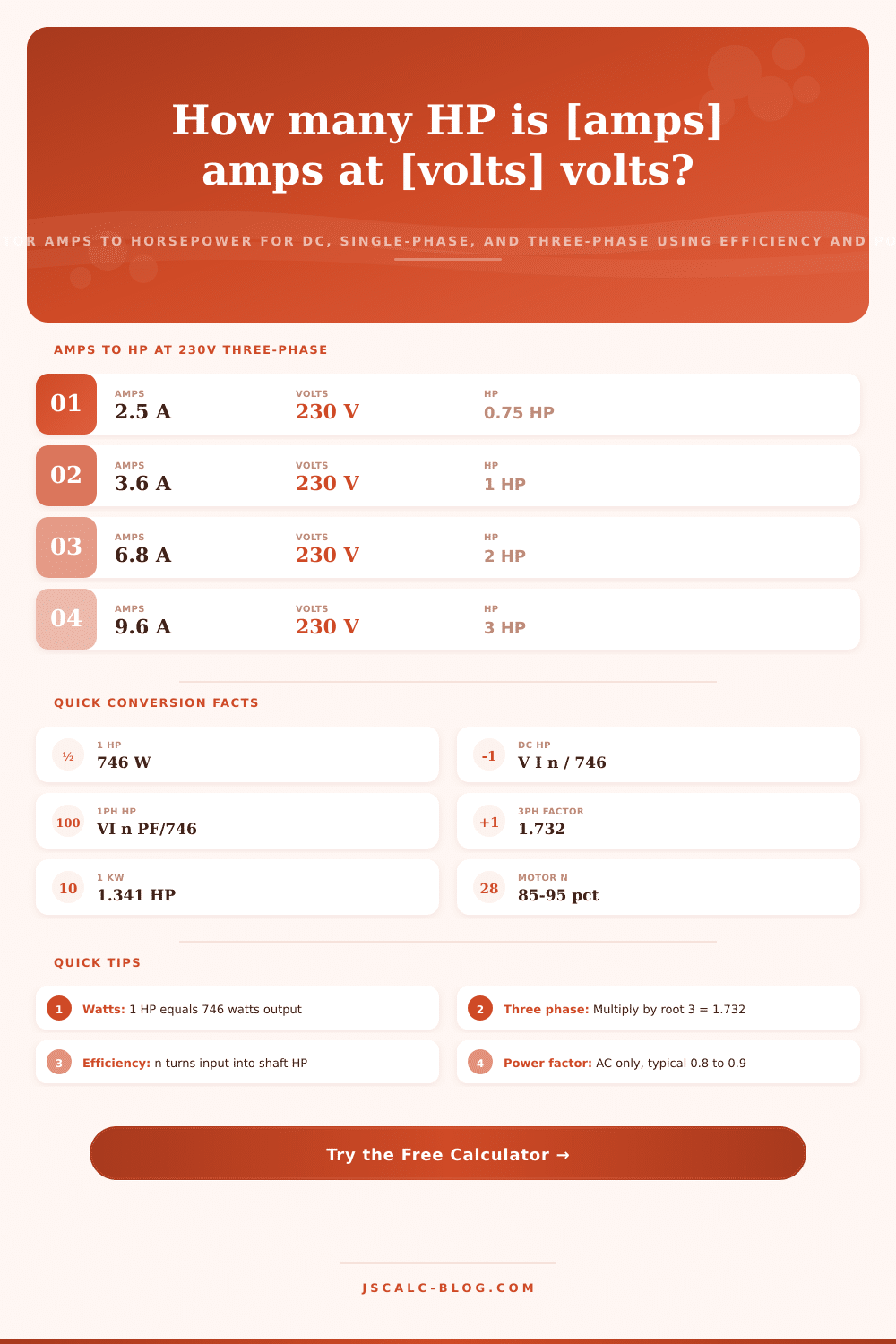
📋Amps to HP at 230V Three-Phase
| Full-Load Amps | Voltage | Approx HP | Reads As |
|---|---|---|---|
| 2.5 A | 230 V | 0.75 HP | Three quarter |
| 3.6 A | 230 V | 1 HP | One horse |
| 6.8 A | 230 V | 2 HP | Two horse |
| 9.6 A | 230 V | 3 HP | Three horse |
| 15.2 A | 230 V | 5 HP | Five horse |
| 22 A | 230 V | 7.5 HP | Seven and half |
| 28 A | 230 V | 10 HP | Ten horse |
| 42 A | 230 V | 15 HP | Fifteen horse |
📊NEMA Motor Full-Load Amps by HP
| Motor HP | 230V 3-Phase FLA | 460V 3-Phase FLA | Output Watts | Notes |
|---|---|---|---|---|
| 1 HP | 3.6 A | 1.8 A | 746 W | Small fan or pump |
| 2 HP | 6.8 A | 3.4 A | 1492 W | Blower duty |
| 3 HP | 9.6 A | 4.8 A | 2238 W | Compressor |
| 5 HP | 15.2 A | 7.6 A | 3730 W | Conveyor drive |
| 7.5 HP | 22 A | 11 A | 5595 W | Machine tool |
| 10 HP | 28 A | 14 A | 7460 W | Pump station |
| 15 HP | 42 A | 21 A | 11190 W | Large blower |
| 25 HP | 68 A | 34 A | 18650 W | Heavy compressor |
🧬Typical Efficiency and Power Factor Ranges
| Motor Type | Efficiency Range | Power Factor | Best Use |
|---|---|---|---|
| Small AC under 1 HP | 72 to 82 pct | 0.70 to 0.80 | Fans, small pumps |
| Standard AC 1 to 10 HP | 84 to 90 pct | 0.80 to 0.86 | General industry |
| Premium AC over 10 HP | 91 to 96 pct | 0.85 to 0.90 | Continuous duty |
| DC brushed | 75 to 85 pct | 1.00 (n/a) | Winches, tools |
| DC brushless (BLDC) | 85 to 93 pct | 1.00 (n/a) | EV, drones |
| Universal motor | 60 to 75 pct | 0.90 to 0.95 | Power hand tools |
📏Horsepower, Kilowatt, and Watt Conversions
| From | Equals | In Watts | Note |
|---|---|---|---|
| 1 HP | 0.746 kW | 746 W | Electrical horsepower |
| 1 kW | 1.341 HP | 1000 W | Kilowatt to HP |
| 0.5 HP | 0.373 kW | 373 W | Half horse |
| 2 HP | 1.492 kW | 1492 W | Two horse |
| 5 HP | 3.730 kW | 3730 W | Five horse |
| 10 HP | 7.460 kW | 7460 W | Ten horse |
🗃Amps vs Horsepower Comparison Grid
| Current | DC 90V | 1ph 120V | 1ph 240V | 3ph 230V | 3ph 460V |
|---|---|---|---|---|---|
| 5 A | 0.53 HP | 0.60 HP | 1.20 HP | 2.07 HP | 4.14 HP |
| 10 A | 1.06 HP | 1.20 HP | 2.39 HP | 4.14 HP | 8.28 HP |
| 15 A | 1.59 HP | 1.79 HP | 3.59 HP | 6.20 HP | 12.4 HP |
| 20 A | 2.12 HP | 2.39 HP | 4.78 HP | 8.28 HP | 16.6 HP |
| 25 A | 2.66 HP | 2.99 HP | 5.98 HP | 10.3 HP | 20.7 HP |
| 30 A | 3.19 HP | 3.59 HP | 7.17 HP | 12.4 HP | 24.8 HP |
| 40 A | 4.25 HP | 4.78 HP | 9.56 HP | 16.6 HP | 33.1 HP |
| 50 A | 5.31 HP | 5.98 HP | 12.0 HP | 20.7 HP | 41.4 HP |
⚙Formula Breakdown
💡Motor Sizing Tips
Let’s say you pull out your motor nameplate and it says 10 amps. But what does that mean? Alone, the value mean nothing. Because you need voltage too, and without it, there’s little idea as to just how hard the electricity is working mechanically.
To further complicate things, you’re typically running on alternating current, which means not all of the electrical energy are pushing the shaft forward; some portion of the electricity is sloshing back and forth within magnetic field and producing heat but no motion. In short, turning amps into HP isn’t quite as easy than multiplying them together. There is more going on than that, including power factor, system type, and efficiency losses.
How to Change Amps into Horsepower
That’s why we created the calculator above; it performs equations so you don’t have to derive a formula from scratch each time you want to size a circuit or troubleshoot a pump.
Here’s the catch: Horsepower is an output; electricity is an input. The motor are somewhere in-between, converting electricity into rotation (with varying levels of success). By definition, no engine can converts all the electricity it uses into motion; some must be lost as friction in the engine bearings or wasted as heat in the windings. We refer to this as efficiency.
Failure to account for it will cause you to underestimate your motor’s horsepower. You might conclude that you have enough horsepower to haul that big load. You may then discover that you’ve overestimated the motor’s power by ten percent and the motor stall. This is an expensive error on job site.
The equation for a direct current motor is easy. Just take volts times amps times efficiency then divide by seven hundred and forty-six (which defines one electric horsepower). It is simple and clean if your DC supply (battery) are stable.
Current gets complicated when it alternates. If you use single-phase power, you have to account for its power factor (a number from zero to one that describes how well the current is doing its job). If you pull straight back, all your effort moves the load forward, but if you pull at an angle, some force go into dragging sideways. In the same way, low power factor make your wires heat up and strain your supply, as you need to pull more amps to get the same amount done.
On top of this, there’s the additional problem of three phases, multiplied by about 1.732 times. That’s a geometric constant that lets three-phase motors draws substantially fewer amperes for equivalent output, saving factories money on copper wire and avoiding voltage drop over long distances.
With your own data entered, it spits out four different results: The shaft horsepower, or the true mechanical power of whatever is hooked up to the motor on the other end; the electrical input, or kilowatt power that shows you the power going into your machine and the breaker box; the total harmonic distortion (THD), measuring the degree to which electricity are being lost to heat during use; and then finally, a reverse calculation mode. Use this when you want to know how much amp draw your circuit will require. For example, say you’re looking for a motor to run a conveyor belt; you know the belt requires five horsepower, so put that in as the goal, and it’ll tell you exactly how many amps your circuit needs to supply. Essentialy, it turns an educated guess into a plan.
The correct power factor and efficiency selection makes a bigger difference than many folks think. A new premium efficiency motor may be operating at ninety-five percent efficiency with a strong power factor while that ancient worn out machine in the grimy factory may be at just eighty percent. While generic defaults are great for rough estimates, when you’re trying to calculate the cost of running something or determining overload protection, those few percentage points makes a big difference in both heat generated and performance.
The page has some reference tables showing normal full-load amps for popular sizes of motors so that you can sanity check your results. You plug in your number and it says a ten-horsepower motor will pull only five amps at four hundred sixty volts. But the table indicate it should of draw twenty-eight. Odds are good you flipped up the single- and three-phase input switches and made a wild guess at your results.
In the end, knowing about power and current lets you avoid two big mistakes. Oversizing means money is wasted on underused equipment that operates with a light load. Undersizing cause overheated motors and tripped breakers. Respecting the variables and constants makes the switch from guesswork to engineering. Converting electricity into mechanical force keep your project running smoothly. This applies to everything from designing an industrial drive system to troubleshooting your home water pump.
The next time you’re looking at an amp rating, think twice, it’s only half the story. Complete the picture with voltage, phase, and efficiency.