Points to Percentage Grade Calculator
Convert earned points into a percent, letter grade, weighted category contribution, and point margin using JSCalc-Blog.com grade scale options.
Formula Breakdown
| Scale | Top grade cutoff | Middle cutoff | Passing cutoff | Best used for |
|---|---|---|---|---|
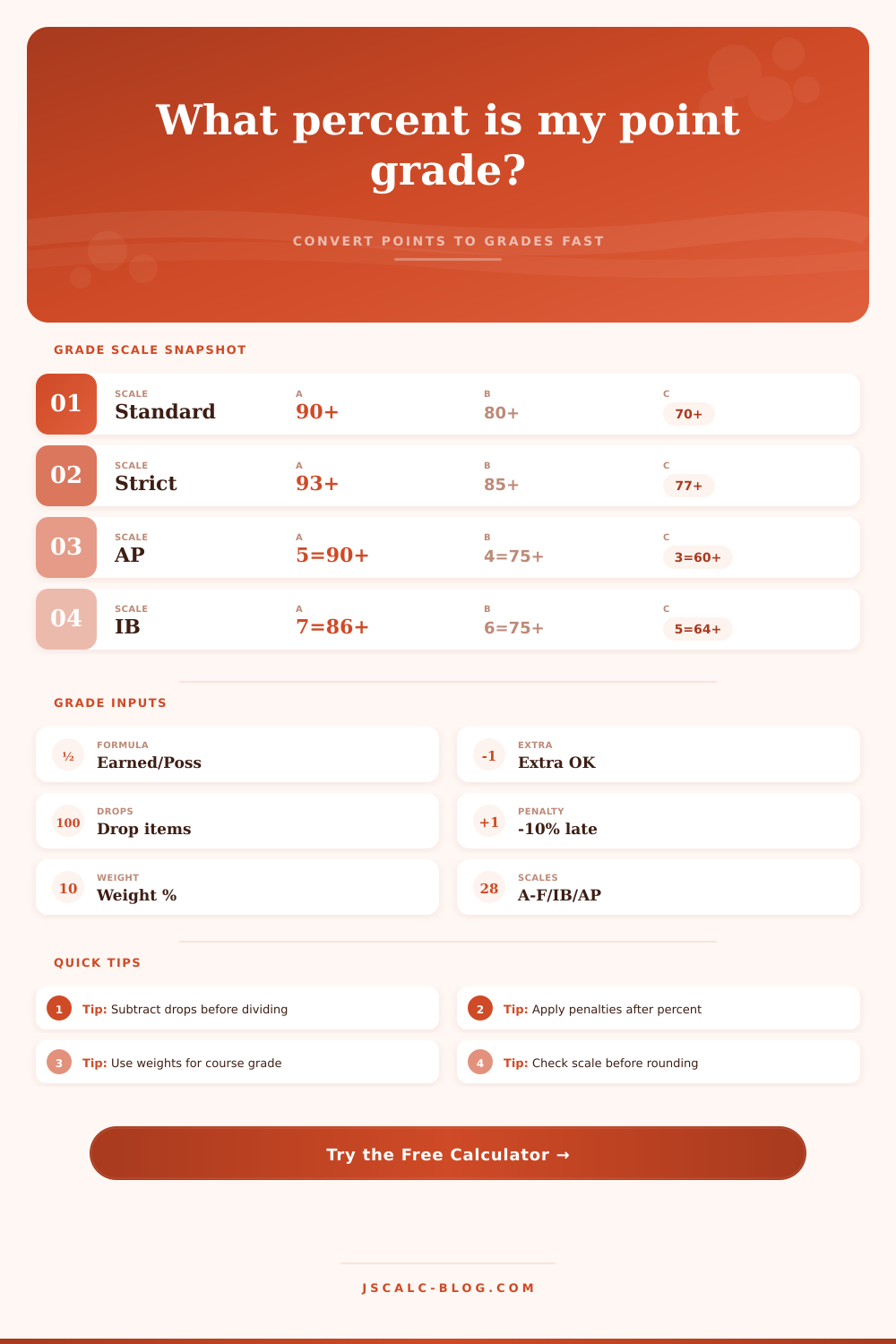
| Standard 10-point | A at 90% | C at 70% | D at 60% | Common US classroom grading |
| College plus/minus | A at 93%, A- at 90% | C at 73%, C- at 70% | D- at 60% | Transcript-style course grades |
| Strict honors | A at 93% | C at 77% | D at 70% | Advanced or departmental scales |
| AP-style 5 point | 5 at 90% | 3 at 60% | 2 at 45% | Practice exams and review sets |
| IB-style 7 point | 7 at 86% | 5 at 64% | 4 at 50% | IB rubric or internal assessment checks |
| Mastery level | Exceeds at 90% | Developing at 60% | Approaching at 40% | Standards-based rubrics |
| Scenario | Earned / possible | Extra credit | Dropped points | Penalty | Weight | Final percent | Mapped grade |
|---|---|---|---|---|---|---|---|
| Quick quiz | 18 / 20 | 0 | 0 / 0 | 0% | 5% | 90.00% | A on standard scale |
| Unit exam | 83 / 100 | 0 | 0 / 0 | 0% | 25% | 83.00% | B on standard scale |
| Rubric project | 42 / 48 | 0 | 0 / 0 | 0% | 15% | 87.50% | B on standard scale |
| AP practice | 73 / 90 | 0 | 0 / 0 | 0% | 30% | 81.11% | 4 on AP-style scale |
| IB assessment | 29 / 34 | 0 | 0 / 0 | 0% | 20% | 85.29% | 6 on IB-style scale |
| Lab practical | 37 / 45 | 2 | 0 / 0 | 0% | 18% | 86.67% | B on standard scale |
| Late essay | 86 / 100 | 0 | 0 / 0 | 10% | 12% | 77.40% | C on standard scale |
| Drop lowest set | 142 / 160 | 0 | 8 / 10 | 0% | 10% | 89.33% | B on standard scale |
| Points possible | 1 point missed | 2 points missed | 5 points missed | 10 points missed |
|---|---|---|---|---|
| 10 | 90% | 80% | 50% | 0% |
| 20 | 95% | 90% | 75% | 50% |
| 25 | 96% | 92% | 80% | 60% |
| 50 | 98% | 96% | 90% | 80% |
| 75 | 98.67% | 97.33% | 93.33% | 86.67% |
| 100 | 99% | 98% | 95% | 90% |
| Adjustment | When it is applied | Formula effect | Example | Use carefully when |
|---|---|---|---|---|
| Extra credit | Before division | Adds to earned points | (94 + 8) / 100 = 102% | The syllabus caps grades at 100% |
| Dropped item | Before division | Removes earned and possible points | (142 - 8) / (160 - 10) | Only possible points are dropped by policy |
| Late penalty | After percent | Multiplies percent by remaining credit | 86% with 10% penalty = 77.4% | The teacher subtracts points instead |
| Category weight | After final percent | Final percent × weight / 100 | 83% × 25% = 20.75 grade points | Weights do not total 100% |
| Rounded whole percent | Before grade lookup only | Changes cutoff comparison | 89.5% rounds to 90% | The class uses exact decimals |
| Floor rounding | Before grade lookup only | Drops decimals | 89.99% maps as 89% | The policy says standard rounding |
There are red marks on the paper. Eighty-three out of one hundred? Is that a B or a B minus? You don’t know. And that’s the anxiety: you don’t know how those raw points translate into a letter grade. It is translation problem.
That’s where this calculator comes in. Knowing how it works let you make your next move with less panic, because you understand how it functions.
How to Understand Your Grades
Extra credit isn’t magic, it’s arithmetic with a bonus. If your teacher allow it, you add to the numerator without changing denominator, which means it can be more than 100%. So that’s a pretty powerful tool, but it won’t feel like much. Typically, base is big enough that a five-percent increase from adding, say, ten points of extra credit doesn’t feel like much if your base was two hundred points. Sure, it helps, but it alone almost never saves a failing grade.
The true impact will show once you consider how much weight the assignment carry. In the other direction, there’s the dropped assignment. A lot of syllabi will include something about dropping lowest quiz, which sounds nice, but you have to be careful with the math.
For example, suppose I score seven out of ten and I drop that quiz. I’d take away the seven (good), but I’d also take away the ten (bad). That keeps the ratio honest. Not adjusting the denominator is a classic mistake, and it artificialy inflates grades.
The tool on the page does this for you, automatically, so whatever your final percentage ends up being comes from an actual pool of points. A little thing, yes, but it makes all the difference when you’re right at the cutoff.
The math becomes punitive in penalties, and a “late fee” doesn’t mean that ten points are taken away. We take away ten percent of what you earned. If you earned an eighty five percent on a paper submitted late, then you aren’t going to wind up with seventy five percent. Instead, you’re going to wind up with seventy seven point four percent. This is important, because it doesn’t punish you for trying, but instead keeps grade in proportion to the quality of the work.
And yes: The reduction occurs after the division, as standard academic practice require; that’s how calculators work. But not all As are alike. Some schools have really high bars for getting an A (think: ninety-percent being an A minus in some of their stricter honors classes), while in others, a ninety percent is a solid A.
So you can’t get an idea of what grade you’re looking at unless you know how it matches that reference table on the page. If your teacher gives pluses and minuses, then there’s no point stressing over whether you scored an eighty eight or an eighty nine, they may fall into same letter bucket. Check your scale first… It’ll save you from despairing to early or celebrating too soon.
Weighted categories add another level of complexity. For example, your final exam might be worth 50% and your homework might be worth 20%. In other words, a perfect score on homework isn’t as cool as it sounds. It’s still only one slice of the pie.
With this thing, you enter in those category weights so you can see what one assignment does towards your total average. That’s where things get strategic, you know how many points you have to make up on a major test if you had a crummy week of quizzes.
The truth is that grades are nothing more than signaling systems, and the number tells you where you are and the context tells you why. Know how points equate to percentages, whether you’re looking for an A or simply passing the class. Understand how it works and you have control; no longer will you guess but calculate.
What needs to be done becomes crystal clear: hope for the best vs. You will know what needs to be done.
Your initial view of the test might mislead you, but never the math. You should of checked the numbers first.