Path of Exile 2 DPS Calculator
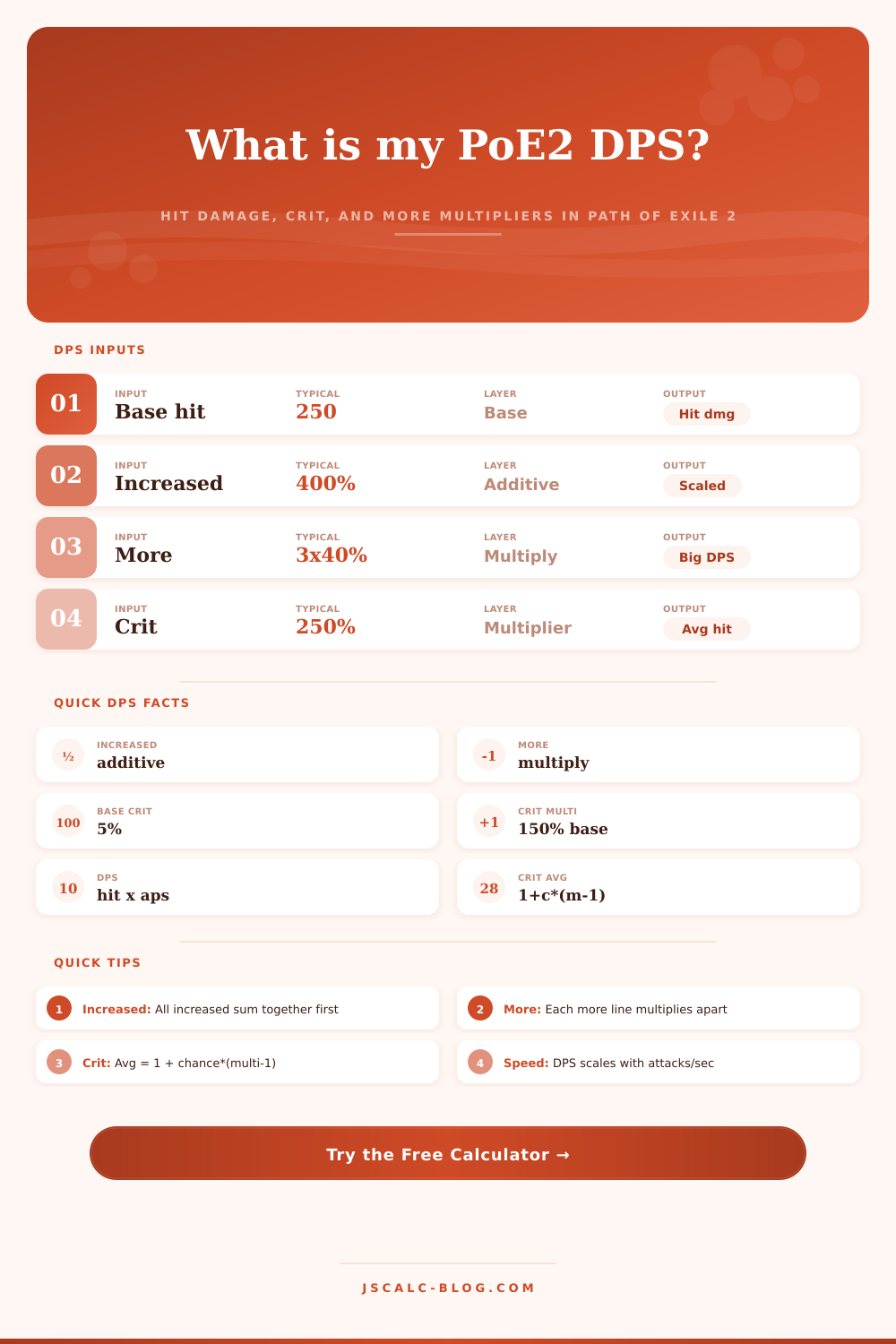
Estimate hit damage per second in PoE2 from base hit, added flat, additive increased damage, up to three more multipliers, attack or cast speed, and critical strike chance and multiplier.
🎯Build Presets
📝Damage Inputs
Average of the skill or weapon min-max before modifiers.
Sum of every increased and reduced modifier added together.
Support gem or keystone, e.g. a 39% more line.
Total multiplier, 250% means a crit deals 2.5x hit damage.
Set higher for multi-projectile or repeat-hit skills.
🔢Formula Snapshot
⚖Increased vs More Damage
| Modifier Type | How It Stacks | Example | Effect on Hit |
|---|---|---|---|
| Increased damage | All sources add together first | 100% + 100% = 200% | Total multiplier ×3.00 vs base |
| Reduced damage | Subtracts from the increased sum | 200% – 30% = 170% | Multiplier drops to ×2.70 |
| More damage | Each line multiplies separately | 40% more × 40% more | ×1.40 × ×1.40 = ×1.96 |
| Less damage | Multiplies as a penalty | 30% less | ×0.70 on the running total |
| Added flat | Adds before increased scales | 250 + 80 = 330 | Then scaled by increased and more |
| Stacking rule | Base, then additive, then multiply | PoE2 damage pipeline | More lines are the strongest layer |
🎲Crit Contribution
| Crit Chance | Crit Multi 200% | Crit Multi 250% | Crit Multi 300% | Notes |
|---|---|---|---|---|
| 5% (base) | ×1.050 | ×1.075 | ×1.100 | Unscaled starting point |
| 20% | ×1.200 | ×1.300 | ×1.400 | Light crit investment |
| 40% | ×1.400 | ×1.600 | ×1.800 | Mid crit build |
| 60% | ×1.600 | ×1.900 | ×2.200 | Heavy crit scaling |
| 80% | ×1.800 | ×2.200 | ×2.600 | Near capped chance |
| 100% | ×2.000 | ×2.500 | ×3.000 | Every hit is a crit |
⚡Attack Speed Reference
| Weapon / Skill | Base Speed | +40% Increased | +80% Increased | Feel |
|---|---|---|---|---|
| Two-handed mace | 1.10 / sec | 1.54 / sec | 1.98 / sec | Slow, big hits |
| One-handed sword | 1.40 / sec | 1.96 / sec | 2.52 / sec | Balanced |
| Claw / dagger | 1.60 / sec | 2.24 / sec | 2.88 / sec | Fast, crit-friendly |
| Bow | 1.20 / sec | 1.68 / sec | 2.16 / sec | Ranged, projectiles |
| Typical spell cast | 1.00 / sec | 1.40 / sec | 1.80 / sec | Scales with cast speed |
| Fast spell cast | 1.50 / sec | 2.10 / sec | 2.70 / sec | High cast investment |
🗂Build DPS Comparison Grid
| Build | Base + Added | Increased | More Lines | Speed | Crit | Style |
|---|---|---|---|---|---|---|
| Attack Build | 250 + 80 | 350% | 39%, 25% | 1.55 | 45% / 250% | Melee sustained |
| Spell Caster | 420 + 40 | 300% | 30%, 20% | 1.30 | 35% / 230% | Elemental spell |
| Crit Stacker | 300 + 60 | 250% | 20% | 1.65 | 78% / 320% | High crit hits |
| More Multipliers | 280 + 70 | 200% | 44%, 39%, 30% | 1.45 | 40% / 260% | Multiplicative |
| Bow Build | 210 + 90 | 320% | 35%, 25% | 1.80 | 55% / 270% | Projectiles |
| Boss DPS | 360 + 120 | 450% | 50%, 40%, 30% | 1.60 | 70% / 340% | Single target |
⚙Full Formula Breakdown
📋Damage Layer Reference
| Layer | Common Source | How It Is Used | DPS Effect |
|---|---|---|---|
| Added flat | Rings, gems, weapon rolls | Adds to base before scaling | Strong early, diluted late |
| Increased % | Passive tree, gear affixes | All summed then applied once | Weakens as the sum grows |
| More % | Support gems, keystones | Each multiplies separately | Consistent, best late scaling |
| Crit chance | Crit mods, gems, tree | Feeds the crit average term | Pairs with crit multiplier |
| Crit multiplier | Gear, ascendancy, gems | Sets bonus on critical hits | Weak alone, strong with chance |
| Attack speed | Weapon, tree, buffs | Sets hits per second | Direct linear DPS gain |
💡Practical DPS Tips
The problem is when you stand before a boss monster and see damage numbers explode across your screen, but dont know how efficient it’s being done. Whether that spell is visually pleasing or actualy good at killing things. This is the traditional Path of Exile conundrum: Real performance lurk in the math while raw numbers mislead. Enter our calculator, which does the arithmetic for you after you enter in your gear stats. No more manually keeping track of additive vs. Multiplicative layers! It calculate your actual hit damage per second. It bundles your base value, flat additions, percentage increase, and critical strike mechanics into a single steady number.
Your total DPS number is what kills stuff in maps, not the occasional critical hit that flashes on screen every ten seconds. This means that new players falls into the core trap of assuming that all percentage bonuses are alike. They aren’t. The game very clearly differentiates between more damage and increased damage; mixing these up will cost you a lot in terms of output.
How the Damage Calculator Works
Additive increases stack: Each 100 percent bonus to damage adds to the previous ones until you’re wearing down their effectiveness. Multiplicative increases dont stack: Instead, each unique source of increased damage multiply whatever number you already have by another value. 80. That is the difference between standing still and feeling powerful. Ideally, you want several different sources of unique multipliers instead of a huge lump of additive percent bonus.
Now the way that flat damage addition work depends on where you put it. Early on, adding flat value to your skill pool or base weapon is extremely effective, giving you a solid floor to scale off. However, once you start getting into the hundreds with your percentage bonuses, those flats will increasingly lose their impact compared to everything else. Late-game you may wind up rolling for larger flat numbers simply because you need something else to add onto your build, when in fact you’d be better served by going after a stat like critical chance or raw damage. This change is reflected in the calculator, which track how much each stat matter compared to the others as you enter increasing total numbers.
On top of all that, there’s another wrinkle: Critical strikes dont scale linearly in damage. Your end result are multiplied by a given number instead, so any additional bonuses on your sheet apply to that too. That’s what creates such a powerful synergy in crit builds. Having a high multiplier (e.g. 250 percent) but only a low chance to land a crit (e.g. Five percent), means your average damage barely moves. Before youll see a large contribution to your total output from those huge multipliers, you’re going to want to increase the chance substantialy. 250 percent) and having a good chance of getting a crit on each attack (e.g. A five percent chance gives you a lot more than just a few big hits. Before youll see significant contribution to your total output from those huge multipliers, you’re going to want to increase the chance substantialy.
So how does this work? Since there’s always some non-crit damage, the tool combines that with its critical counterparts to show your sustained performance, not just the one-in-a-million shot luck gave you at that single moment. While it dont feel quite as glamorous as big damage spikes do, attack/cast speed is often undervalued. Every single other source of damage you’ve acquired scales directly off of speed. Even a small increase in your attack speed make all your other modifiers work better and grow faster. It might seem like you’re losing out by picking up a weapon with slightly lower base damage. However, the speed bonus will almost always beat the static numbers on face value. This turns a slow heavy hitter into a rapid stream of efficient damage that activates your life recovery mechanics and cooldowns more often.
To use them well, however, you need to consider your character as a whole. You can’t get the most out of one statistic without taking into account its relationship to other parts of your build. To find out what’s limiting you, you can adjust specific fields in the calculator and see if the numbers change. If they do, then that stat is probably a bottleneck for you. Multiplicative damage? Critical hit damage? Doesn’t matter; it’s all math. Once you know how things relate to each other, it takes something completely random (number generation) and turns it into something you deliberate choose (design). Rather than guesswork, it becomes an act of engineering, where random explosions on the screen become a reliable engine of destruction.