Pass or Fail Threshold Calculator
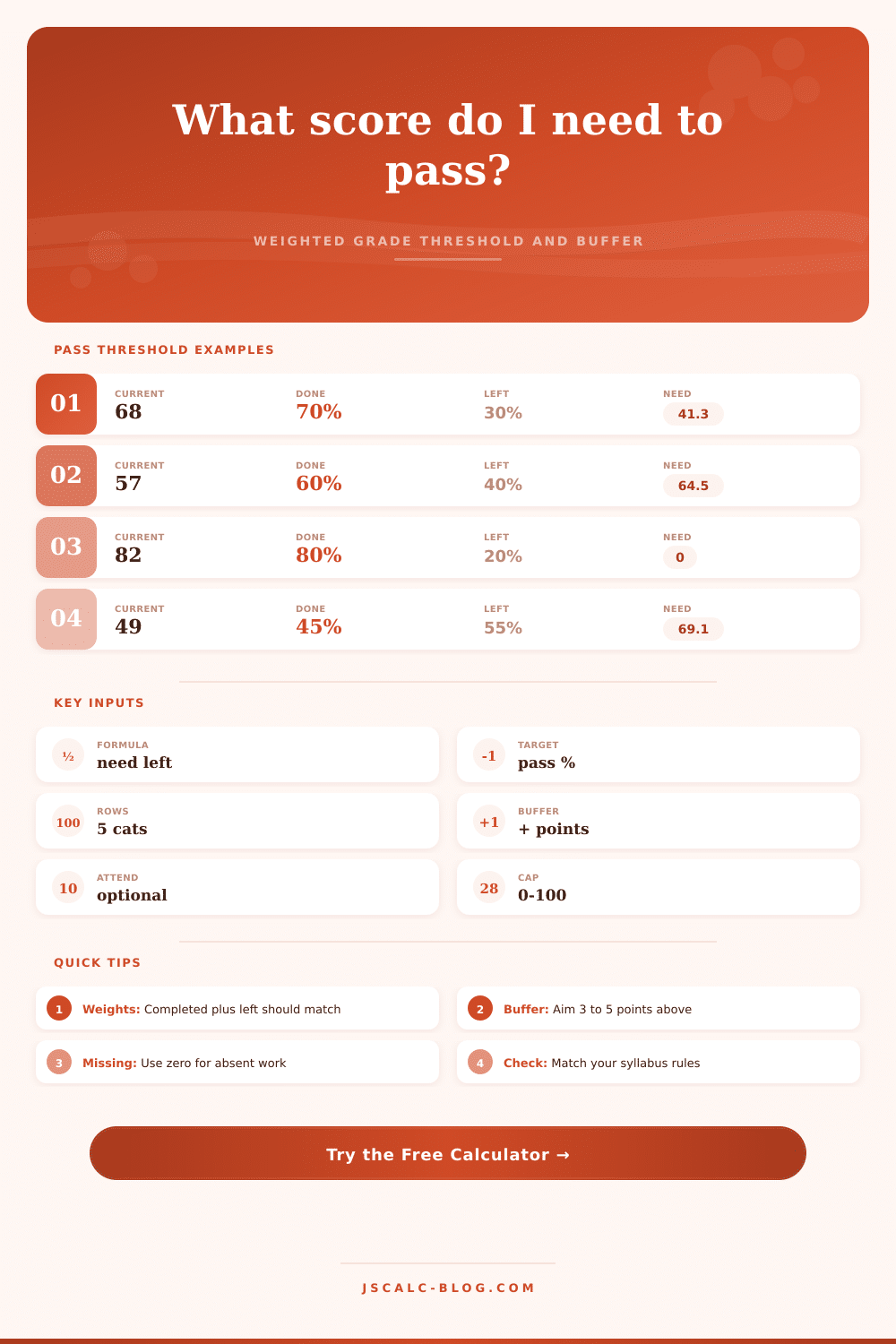
Plan the remaining score needed to pass using weighted categories, current earned credit, attendance or participation credit, score caps, and a practical safety buffer for JSCalc-Blog.com.
Enter your course weights, completed scores, and pass threshold, then calculate.
| Category | Weight % | Score % | Status | Open weight | Earned contribution |
|---|---|---|---|---|---|
| 0.0% | 16.4 | ||||
| 0.0% | 11.4 | ||||
| 0.0% | 17.0 | ||||
| 20.0% | 0.0 | ||||
| 10.0% | 0.0 | ||||
| 0.0% | 4.8 | ||||
| 0.0% | 4.4 |
| Situation | Completed weight | Current average | Remaining weight | Need to pass 60% |
|---|---|---|---|---|
| Comfortable position | 70% | 78% | 30% | 18.0% |
| Typical midterm point | 50% | 68% | 50% | 52.0% |
| Borderline after exam | 60% | 57% | 40% | 64.5% |
| Late recovery path | 75% | 52% | 25% | 84.0% |
| Already mathematically safe | 85% | 76% | 15% | 0.0% |
| Impossible without extra credit | 80% | 45% | 20% | 120.0% |
| Common threshold | Typical use | Risk buffer | Rounding caution | Planning target |
|---|---|---|---|---|
| 50% | Pass/fail minimum | 3 points | Exact cutoff common | 53% |
| 60% | US D or pass mark | 3 to 5 points | Check 59.5 rule | 63% to 65% |
| 65% | Department minimum | 4 points | Lab rules may differ | 69% |
| 70% | C or competency | 5 points | Many do not round | 75% |
| 75% | Clinical pass | 5 points | Failed component may override | 80% |
| 80% | Mastery pass | 5 to 7 points | Retake rules matter | 85% to 87% |
| Category status | How score is used | Contributes to earned? | Contributes to open weight? | Best for |
|---|---|---|---|---|
| Completed | Score x weight | Yes | No | Locked grades |
| Remaining required | Solved by calculator | No | Yes | Final exam, open tests |
| Remaining planned | Score x weight in projection | No | No | Known upcoming project goal |
| Ignore row | Excluded from all totals | No | No | Unused category |
| Attendance checkbox off | Attendance row ignored | No | No | Courses without attendance grade |
| Participation checkbox off | Participation row ignored | No | No | Courses without discussion grade |
| Formula step | Calculation | Meaning | Example |
|---|---|---|---|
| Earned contribution | Weight x score / 100 | Points already locked | 20 x 82% = 16.4 |
| Planned contribution | Open planned weight x planned score | Projected but not solved | 15 x 80% = 12.0 |
| Needed points | Target - earned - planned - extra | Gap to pass | 63 - 45.0 = 18.0 |
| Needed average | Needed points / required open weight | Average score on unsolved work | 18 / 30 = 60% |
| Projected final | Earned + planned + required open score | Expected final course percent | 45 + 12 + 18 = 75 |
It’s 3 a.m., and you’re awake because you think you flunked a test and have destroyed your entire semester. It’s a disaster, except it isn’t. Usually, it’s math. If you understand what the math tells you, then math is friendlier than your imagination makes it out to be.
Most people interpret their gradebook as some sort of mystery novel. They calculate their standing, not by calculating but by guessing. And that’s where the stress lies. The trick, then, that saves you, are weighted grades.
How to Stop Worrying About Your Grades
If your final exam is thirty percent of your grade, it doesn’t knock your overall grade down by thirty points. Your overall grade gets pulled towards whatever score you got on the final, but by only a fraction of that. And getting that fraction right, instead of simply thinking “Oh my God I’m screwed,” makes all the difference.
All you has to do to get through is score above the weighted average of what you have already missed. The rest of your work can be mediocre. The rest of your work can even be shit. Just don’t make it too shitty.
The calculator will take care of the algebra for you. You won’t have to divide anything in your head while half-asleep. You will simply see exactly how much ground you’re going to have to make up. Those inputs also causes you to confront reality. What’s doable? What’s not? What’s finished? What remains undone?
That’s the question that forces us to separate what is useful from what is not. It is settled law. Homework average: done. Quiz score: done. Can’t alter those scores. They’re in the books. Those are your completed scores. The rest is the variable.
Some students include planned scores for future projects they haven’t even begun working on. Wrong! That’s a fantasy budget. Looks nice on paper. But it crumbles under pressure. Planned scores should of been treated like bonus points, not the basis of your foundation.
That’s why this tool separates out those categories so you can see what you’ve got vs. What you still must get. It’s easy to lose sight of attendance and participation points. They’re not glamorous. They don’t get the flashy numbers next to their name. Their contributions are minor percentages that builds up gradually. And five percent here and there doesn’t seem like much.
But that’s a cushion for when you have a bad day. Those points are already in your back pocket if you’ve been showing up and participating. They raise the floor. Forgetting about them only makes that score you need appear larger then it really is. Accounting for them puts you on solid ground with a realistic understanding of how much wiggle room you have.
You might think, “Ok, I know how many I need to get an A. I’ll just do that.” This is dangerous. Rounding rules, grading discretion, and human error exist. When you try to scrape together a marginal passing grade, you have zero wiggle room if your rubric ends up being stricter than expected, or if there’s even a slight curve in favor of lower grades.
If you want some breathing room, add a couple points to your target score. This gives you a cushion, turning a borderline pass into a secure one. With the calculator, you can create that buffer zone. You move the goalpost upward just enough so that you are not right on the edge between success and failure.
And that’s where the reference tables on the page comes into play. In plain English, they lay it out. How does a sixty percent pass mark look compared to an eighty percent mastery requirement? Same math, different effort. Different pressure. And knowing which game you’re playing is half the battle.
It’s all about control. The unknown breeds panic. When you take out the mystery by calculating where you sit, you turn that dread into data. You go from wondering if you’re screwed to knowing what it takes to get through. And while it’s not magic, it sure as hell feels like relief.
Seeing those numbers clear as day makes that ceiling no longer feel like a threat. It feels like a target.