Pace From Time and Distance Calculator
Convert a finishing time and distance into min per mile, min per kilometer, speed, race projections, split checkpoints, and target pace difference.
🏁Descriptive Presets
⚙Time, Distance, and Options
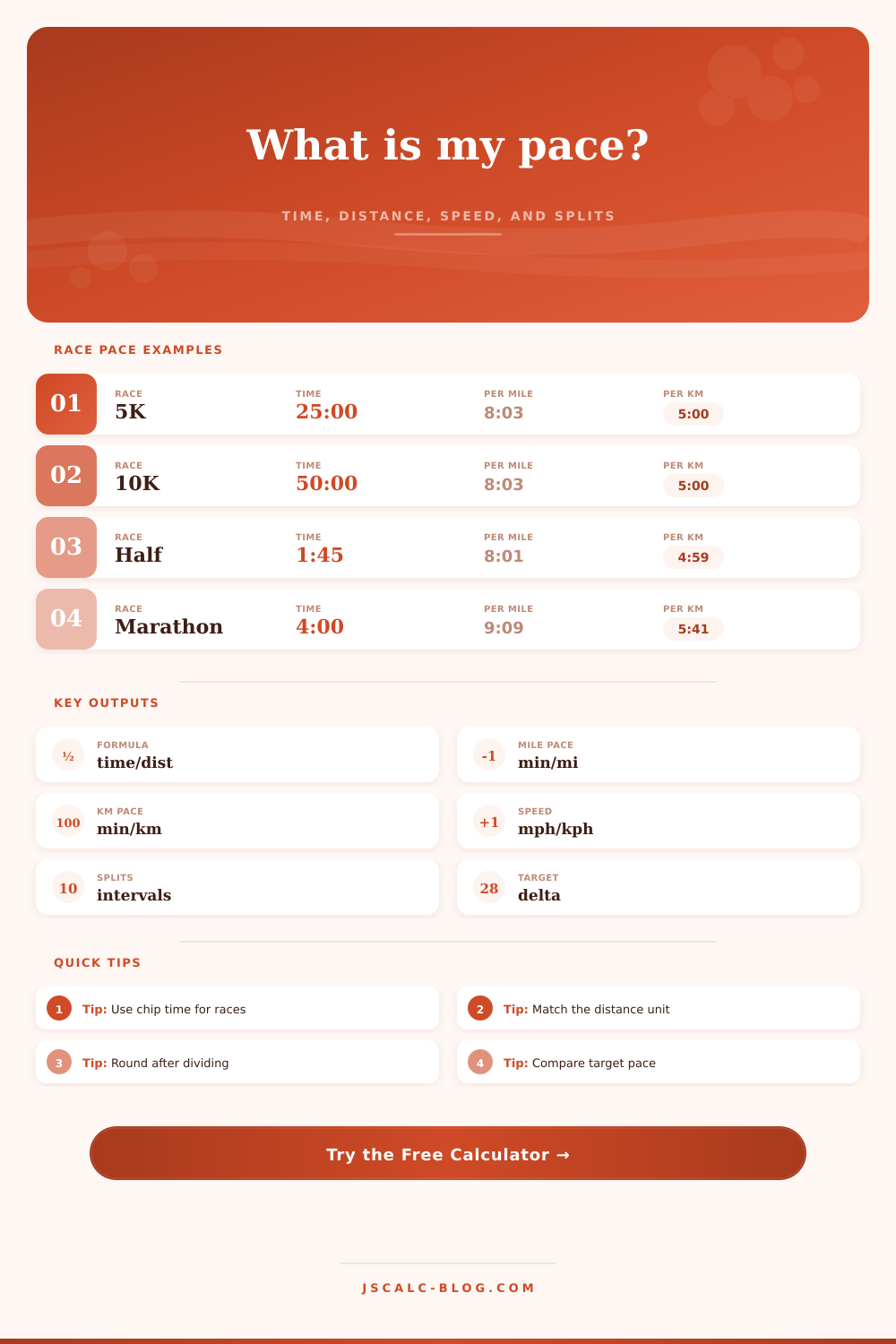
The core formula is pace = total time / distance.
Enter hours, minutes, and seconds from a race result, GPS file, or planned workout.
Use 1 for mile/km splits, 0.5 for half-mile, or 5 for 5K chunks.
Pace Results
📊Common Race Distance Grid
📋Split Projection Table
| Checkpoint | Cumulative Distance | Projected Time | Split Length | Split Time |
|---|---|---|---|---|
| 1 | 1.000 mi | 8:03 | 1.000 mi | 8:03 |
🗂Race Finish Comparison Grid
| Race Distance | At Your Pace | At Target Pace | Difference | Distance Used |
|---|---|---|---|---|
| 5K | 25:00 | 24:51 | 0:09 slower | 3.107 mi |
📘Race Distance Reference Table
| Distance | Miles | Kilometers | Common Split | Best Use |
|---|---|---|---|---|
| 1 mile | 1.000 | 1.609 | 400 m or 0.25 mi | Track tests and short time trials |
| 5K | 3.107 | 5.000 | 1 km or 1 mi | Park runs, beginner races, speed checks |
| 10K | 6.214 | 10.000 | 1 km or 1 mi | Threshold pacing and road races |
| 10 mile | 10.000 | 16.093 | 1 mi | Longer aerobic race prep |
| Half marathon | 13.109 | 21.098 | 1 mi or 5 km | Endurance pace planning |
| Marathon | 26.219 | 42.195 | 1 mi or 5 km | Race-day pacing and checkpoint bands |
| 50K | 31.069 | 50.000 | 5 km or 5 mi | Ultra pacing and run-walk planning |
🔢Pace Conversion Quick Table
| Pace Per Mile | Pace Per Km | Speed MPH | Speed KM/H | Marathon Time |
|---|---|---|---|---|
| 6:00 | 3:44 | 10.00 | 16.09 | 2:37:19 |
| 7:00 | 4:21 | 8.57 | 13.79 | 3:03:32 |
| 8:00 | 4:58 | 7.50 | 12.07 | 3:29:45 |
| 9:00 | 5:36 | 6.67 | 10.73 | 3:55:58 |
| 10:00 | 6:13 | 6.00 | 9.66 | 4:22:11 |
| 11:00 | 6:50 | 5.45 | 8.78 | 4:48:24 |
📐Formula and Method Breakdown
| Metric | Formula | Unit | What It Answers |
|---|---|---|---|
| Pace | total time / distance | min per mile or km | How long each distance unit takes |
| Speed | distance / time | mph or km/h | How much distance is covered per hour |
| Projected finish | pace x race distance | hh:mm:ss | Expected time at the same pace |
| Split time | pace x split interval | hh:mm:ss | Checkpoint time for repeated segments |
| Target delta | actual pace - target pace | seconds per unit | How far ahead or behind the target pace is |
JSCalc-Blog.com: This pace from time and distance calculator uses pace = total time / distance and speed = distance / time, then converts the result into min per mile, min per kilometer, miles per hour, kilometers per hour, race projections, and split checkpoints. Webhook row marker: index 1371, gid 1393155561.
You go out and do a run. Your watch tell you how long it took, but maybe you don’t really know what that number will mean when it comes to running another race. Maybe you went 5 kilometers in 25 minutes. How should that performance translate to a ten kilometer race? Or to a half marathon? To a ten kilometer race? It’s all too tempting to get lost in the numbers, you might lose sight of the math behind them.
That’s where this calculator comes in. It converts what you’ve done into what you’ll do. And it does more than divide by two. It provides a guide from which you can expect next month’s performance.
Why You Should Use a Running Pace Calculator
And most of us has an idea of our own base pace. Maybe we run an eight-minute mile? The problem is that human memory is terrible at precision. We know what it feels like to run fast, but we don’t remember exactly how fast we were going.
Once you enter your distance and time into the tool, it calculates all sorts of stuff for you. It’ll tell you how fast you was running in miles per hour. It’ll show you your pace per kilometer and your pace per mile. All these different measurements comes from one basic math equation: time divided by distance = pace.
The equation itself is beautiful. But people makes a mistake when thinking about this equation. In endurance events, people focus on speed but what they should of consider is pace. Speed indicates your rate of progress per hour. Pace indicates how long you have to sustain some effort to travel some distance. That shifts the mental approach to the race. It’s no longer about the time because now it’s about the price paid for every mile.
The calculator will provide you with both pace and speed. Use pace so you can actualy use it. Use speed for comparison.
Wherever there’s a mile or kilometer marker, it has its own projected split. There’s no more guessing how you’re doing in the race. Feeling good doesn’t mean surging in mile one. At each point, you know whether you’re on track. The table sets out your checkpoints and tells you what you need to hit. It turns this chaotic event into manageable task. You aren’t running a half marathon as one block. You’re running thirteen one-mile segment. That’s a smaller mental hurdle to clear.
When you’re used to racing in kilometers and running in miles, it can get a little tricky since they’re different distance units. But the converter has got you covered. So if you’re running an eight-minute mile, it’s going to convert that correctly into kilometer pace. It’ll adjust the math for you so you’re looking at equivalent data points. That way you don’t have to convert units based off your head.
The target pace function help with planning. Perhaps you desire to complete a sub-three hour marathon? Plug in your desired time and the calculator will display what pace that would require of you. What is the gap between your capabilities now versus your goal? It might be ten seconds per mile. Ten seconds per mile doesn’t sound like much, but when multiplied over 26 miles it equals an extra 20 minutes. Small amounts makes big differences over long distances; context matters.
The other factor is surface type. That’s different than trails versus roads. And hills factor into it as well. You can input what kind of course you’ll be running (road vs. Trail) on the calculator. This way you know how to adjust your expectations. Perhaps you’re running a hilly road race. Maybe you would of run faster on a flat track. By knowing the difference ahead of time, you avoid burning yourself out. You can account for reality, rather than an ideal world.
You can’t improve upon what you don’t measure. You need to know, and this tool turns your messy run into clean, actionable facts. It removes the emotion from the finish line. What remains is cold hard fact. Fact doesn’t care if you’re exhausted, only where you were.
Carry that clarity around in your pocket like a coach. It’s just math and the results can be pretty darn strong. There’s always another run coming right up.