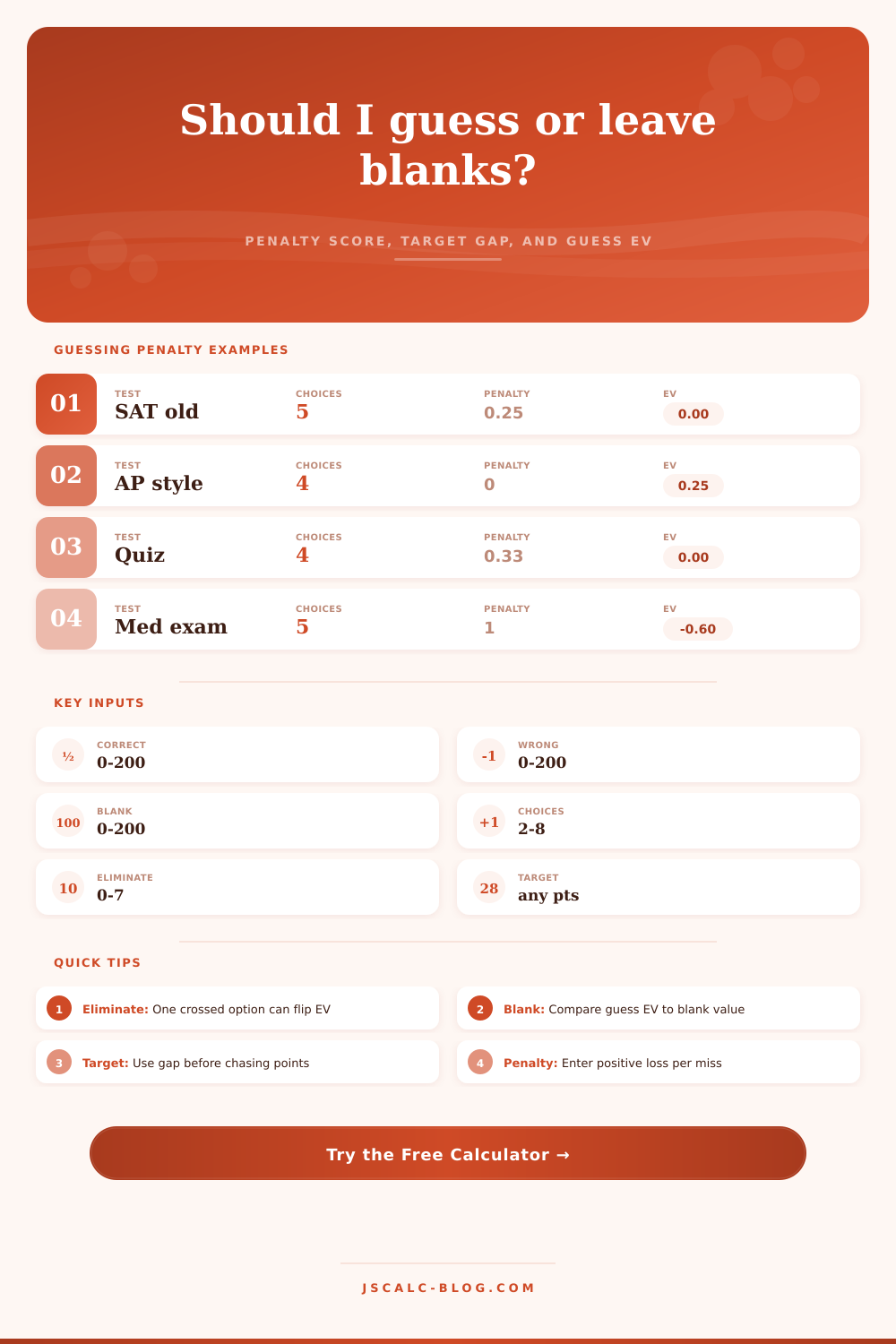
Guessing Penalty Score Calculator
Estimate score, expected guessing value, target gap, and risk threshold before deciding whether unanswered multiple-choice questions should be guessed or left blank on JSCalc-Blog.com.
Load a scoring rule and answer pattern, then adjust the exact counts from your exam or practice set.
Score components
Guessing model
| Rule style | Correct | Wrong penalty | Blank | Natural breakeven |
|---|---|---|---|---|
| No penalty classroom quiz | +1 | 0 | 0 | Guess any item |
| Old SAT five-choice style | +1 | 0.25 | 0 | Needs one elimination |
| Four-choice correction | +1 | 0.33 | 0 | Random is near zero EV |
| Three-choice correction | +1 | 0.50 | 0 | Random is near zero EV |
| Olympiad blank reward | +4 | 1 | 1 | Guess only with confidence |
| High-stakes penalty | +1 | 1 | 0 | Needs strong elimination |
| Choices | Eliminated | Remaining | p(correct) | EV with +1 / -0.25 | EV with +1 / -1 |
|---|---|---|---|---|---|
| 5 | 0 | 5 | 20.0% | 0.000 | -0.600 |
| 5 | 1 | 4 | 25.0% | 0.063 | -0.500 |
| 5 | 2 | 3 | 33.3% | 0.167 | -0.333 |
| 5 | 3 | 2 | 50.0% | 0.375 | 0.000 |
| 4 | 0 | 4 | 25.0% | 0.063 | -0.500 |
| 4 | 1 | 3 | 33.3% | 0.167 | -0.333 |
| 4 | 2 | 2 | 50.0% | 0.375 | 0.000 |
| 3 | 0 | 3 | 33.3% | 0.167 | -0.333 |
| 3 | 1 | 2 | 50.0% | 0.375 | 0.000 |
| 2 | 0 | 2 | 50.0% | 0.375 | 0.000 |
| Strategy | Best when | Score pressure | Risk threshold | Typical action |
|---|---|---|---|---|
| Leave all blanks | Blank value beats EV | Low | Any | Protect current score |
| Guess narrowed only | Some options eliminated | Medium | 0.05 to 0.20 | Attempt selected items |
| Guess all no-penalty | Wrong penalty is zero | Any | 0 or above | Fill every blank |
| Target-chase | Below pass line | High | Lower than usual | Accept more variance |
| Bank-safe | Already above target | Low | Higher than usual | Guess only clear EV |
| Blank-reward contest | Blank points are positive | Medium | Above blank value | Skip uncertain items |
| Planned guesses | p(correct) | Expected correct | Expected wrong | Use this check |
|---|---|---|---|---|
| 5 | 20% | 1.0 | 4.0 | Random five-choice |
| 5 | 25% | 1.25 | 3.75 | One elimination |
| 5 | 33.3% | 1.67 | 3.33 | Two remain removed |
| 10 | 25% | 2.5 | 7.5 | Four-choice random |
| 10 | 50% | 5.0 | 5.0 | Two choices left |
| 20 | 33.3% | 6.67 | 13.33 | Large uncertain block |
You’re sitting in a quiet exam hall with ten minutes left on the clock and twelve questions you have no idea how to answer. Panic sets in. How do you know whether it’s better to just guess the answer and risk sinking your grade? Or should you leave it blank and hope for the best?
This is pretty simple math based off some real-life panic. If you can eliminate incorrect answers, whether it’s better to take an educated guess depends on how much you are penalized for guessing wrong. Most student simply don’t want to leave any question blank so they end up taking a wild stab in the dark. Don’t be that guy.
When to Guess in Exams
This calculator takes rules of the test (how many points per right answer, and the penalty for a wrong one) and puts them into a formula that tells you if it is better to guess or not. Type point values for each answer. How many points is a correct answer worth? What is the penalty for a wrong answer? Some don’t penalize you at all; others may even reward blanked questions! That matters for this equation, too.
If there is no penalty for wrong answers, then it’s a free lottery ticket. Guess away. A heavily-penalized test is a trap because the penalty outweighs the value of skipping.
So consider the odds: Out of five options and with random guesswork, your odds are one in five or twenty percent. Add a quarter-point penalty and it all evens out. Mathematically, the expected value is zero. There’s no benefit to wild guessing. However, when you’re able to rule out one incorrect answer, the odds change. Your chances improve to twenty-five percent. That slight change is enough for the expected value to become positive. It is enough to make taking that risk worth it.
This is where page comes into play. The reference table makes it clear. When you remove even one answer choice, the outcome shifts from breaking even to winning. Many people miss this detail.
A lot of students considers any unanswered question as equal. They don’t distinguish between the questions they’ve whittled down and the ones where they’re completely clueless. These are two distinct cases, so run that calculation independently. For one, there are only two options left. For another, there are five. It’s different than guess at a question where you have two options than when you have five.
That’s what the calculator lets you visualize. It computes what your score would be if you guessed everything vs. This happens if you didn’t answer anything. And it provides a target gap number, how far away are you from reaching your goal?
Sometimes it’s not about the number. It’s also about the context. When you’re way under the pass line, what do you have to lose? Guess all of the time. Sure, variance will screw you but your upside is higher.
When you’re over the pass line, be conservative. Don’t blow out your score. Make a guess only if the expected value is extremely positive. With this strategy, you stay above the line and don’t expose yourself to risk of additional penalty.
Your greatest weapon is elimination. Cross off obviously wrong answers. If you don’t know what’s right, dont burn energy figuring that out. With each elimination, your chances of being correct improve. That goes from negative expected value to positive expected value.
Why does practice matter? Because you learn to spot distractors. You’re more efficient at whittling down options. The penalty isn’t that scary. Don’t get caught up in it. It’s simply a number, the price of your mistake. It is a fee. Every time you’re wrong, you pay the fee. The higher the fee, the less likely you should of pay it. The lower the fee, the more risks you can take.
That’s what the calculator does: it reveals the risk margin. It lets you know whether the reward is worth the penalty. Ultimately, it comes down to control. You don’t have any control over the test questions. You do have control over how you react to unknowns.
Luck is blind guessing. Math is strategic guessing. Let the tool take out the emotion and let the numbers make the decision. Take the shot if the expected value is positive. Walk away if it’s negative. Your score depends on making the right call in pressure situations.
Sure, the point isn’t just to get the question right. It’s to get as many points as possible given the information at hand. Don’t leave points on the table, but also don’t give away points either. That balance is what makes a good score into a great score.