BMX Gear Ratio Calculator
Find your BMX gear ratio, gear inches, and rollout distance per crank revolution from any chainring and cog combo, then match a target ratio and compare equivalent sprocket and driver setups.
🎯Real BMX Gear Presets
🔧Drivetrain Inputs
Modern BMX drivers run 9 to 10 teeth; freewheels run 13 to 16.
Used only when wheel size is set to custom.
Adds tire height to rim for effective rolling diameter.
Used in find cog and find chainring modes.
Used in match target rollout mode.
Crank rpm used to estimate a matching speed.
🔢Formula Snapshot
🚲Common BMX Gear Combos
| Setup | Chainring | Cog | Ratio | Gear Inches (20") | Rollout |
|---|---|---|---|---|---|
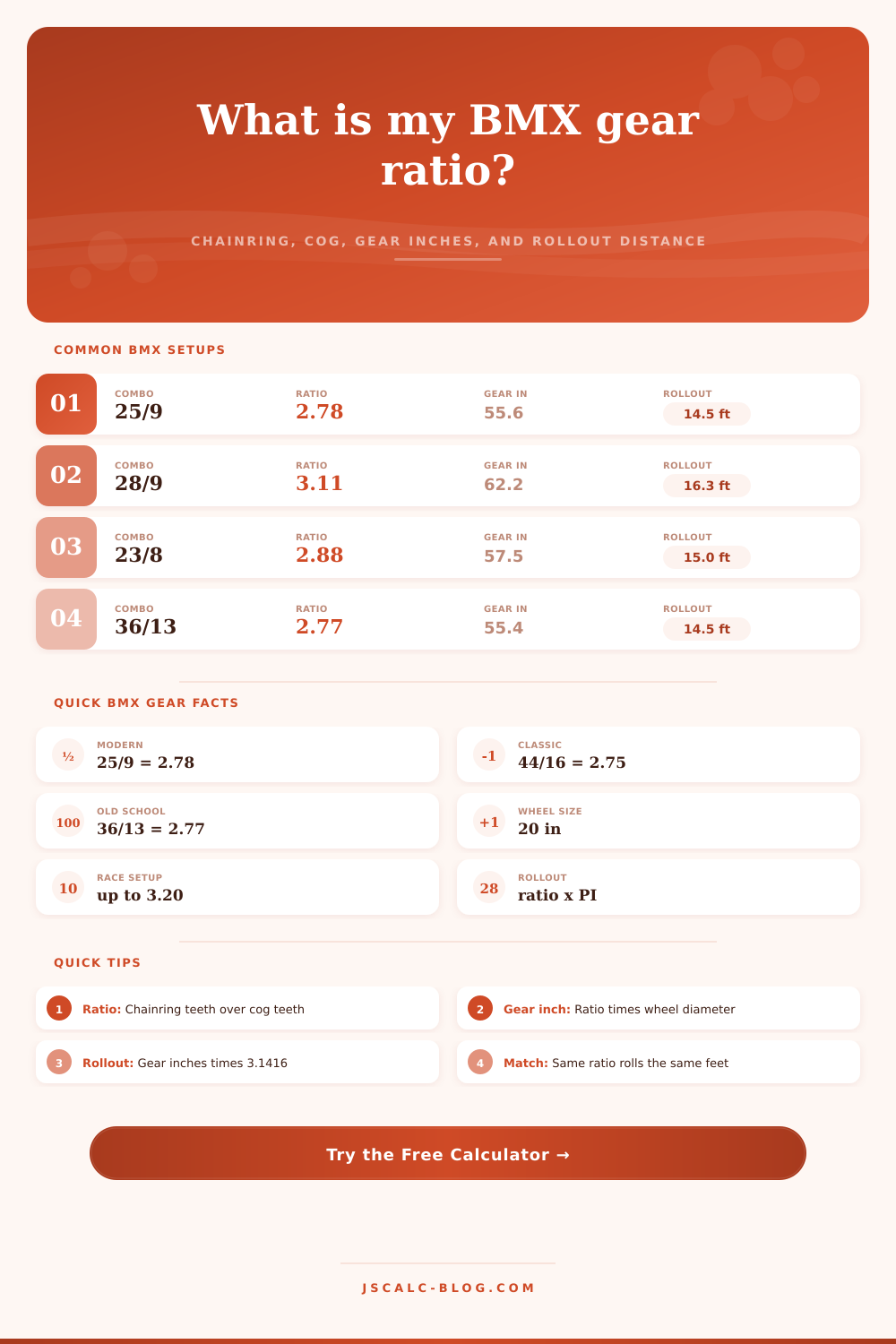
| Micro driver | 23 | 8 | 2.88 | 57.5 | 15.0 ft |
| Modern standard | 25 | 9 | 2.78 | 55.6 | 14.5 ft |
| Common street | 28 | 9 | 3.11 | 62.2 | 16.3 ft |
| Tall street | 28 | 10 | 2.80 | 56.0 | 14.7 ft |
| Old-school 1.75 | 44 | 16 | 2.75 | 55.0 | 14.4 ft |
| Old-school hi | 36 | 13 | 2.77 | 55.4 | 14.5 ft |
| Race push | 44 | 15 | 2.93 | 58.7 | 15.4 ft |
| Tall race | 45 | 14 | 3.21 | 64.3 | 16.8 ft |
📏Gear Inches & Rollout Reference
| Ratio | Gear In (20") | Rollout (ft) | Rollout (in) | Development (m) | Feel |
|---|---|---|---|---|---|
| 2.50 | 50.0 | 13.1 | 157.1 | 3.99 | Spinny / light |
| 2.75 | 55.0 | 14.4 | 172.8 | 4.39 | Balanced classic |
| 2.88 | 57.5 | 15.0 | 180.6 | 4.59 | Modern balanced |
| 3.00 | 60.0 | 15.7 | 188.5 | 4.79 | Slightly tall |
| 3.11 | 62.2 | 16.3 | 195.4 | 4.96 | Street tall |
| 3.25 | 65.0 | 17.0 | 204.2 | 5.19 | Race tall / heavy |
🔃Equivalent Ratio Combos
| Ratio | Micro (t=8) | Driver (t=9) | Tall (t=10) | Freewheel (t=13) | Old (t=16) | Gear In |
|---|---|---|---|---|---|---|
| 2.75 | 22 / 8 | ~25 / 9 | ~27 / 10 | 36 / 13 | 44 / 16 | 55.0 |
| 2.78 | ~22 / 8 | 25 / 9 | ~28 / 10 | ~36 / 13 | ~45 / 16 | 55.6 |
| 2.88 | 23 / 8 | ~26 / 9 | ~29 / 10 | ~37 / 13 | 46 / 16 | 57.5 |
| 3.00 | 24 / 8 | 27 / 9 | 30 / 10 | 39 / 13 | 48 / 16 | 60.0 |
| 3.11 | ~25 / 8 | 28 / 9 | ~31 / 10 | ~40 / 13 | ~50 / 16 | 62.2 |
| 3.25 | 26 / 8 | ~29 / 9 | ~33 / 10 | ~42 / 13 | 52 / 16 | 65.0 |
⚙Full Formula Breakdown
📋Setup Selection Guide
| Riding Style | Typical Ratio | Example Combo | Why |
|---|---|---|---|
| Street / park | 2.75 to 2.90 | 25 / 9 | Balanced pop and cruising ease |
| Flatland | 2.60 to 2.80 | 23 / 8 or 25 / 9 | Lighter gear for control moves |
| Trails / dirt | 2.80 to 3.10 | 28 / 9 | Taller gear holds speed on jumps |
| BMX race | 2.90 to 3.30 | 44 / 15 or 45 / 14 | High top speed off the gate |
| Cruiser (24 in) | 2.70 to 2.90 | 25 / 9 | Bigger wheel already adds rollout |
💡Practical BMX Gearing Tips
Using this calculator allows you to see how the choices you make with your equipment impact your ride. I’ve talked to folks who talk about riding in higher gears but don’t know what that will do to their legs on a climb. It sounds like magic, doesn’t it? It sounds like bigger numbers automatically make you faster, but it’s actualy just a function of simple leveraged geometry. The size of the cog or even the size of chainring isn’t as important as their relationship to each other. That ratio give you the number of rotations the wheel makes relative to how many times your crank spins.
Small details matter when you’re trying to get out of corner or clear the gap. Instead of guessing if your new drivetrain will be too light or too heavy, you simply input your drivers and sprockets’ tooth counts and go from there. First you type in your rear cog and front chainring’s number of teeth. That’s the raw gear ratio. But that raw number doesn’t make much sense without linking it to your wheel size. Sure, a 25-tooth ring paired with a 9-tooth driver has some mechanical advantage, but that mechanical advantage means different distances when riding a large cruiser wheel than say a standard 20-inch rim.
How to Use the Gear Calculator
The tool will translate that leverage into both gear inches and your rollout distance (how far the bike moves forward per pedal stroke), giving you an exact figure for how many feet the bike move per pedal stroke. When I say “gear inches,” I am not referring to anything measured in actual inches; rather, it’s the size (diameter) of an imaginary direct-drive wheel that would carry you down road at the same rate with each turn of the pedals. High-gear inches means that imaginary wheel is enormous and makes big steps. Low-gear inches mean its steps are tiny and fast.
The circumference of that imaginary step is called the rollout, which indicates how far you’ll travel on the road between required pedal strokes. Rhythm riding depends heavily on this because it determines when your feet hit in relation to transitions/obstacles in the stroke. Ideally, your cadence should match the bike’s rollout. Otherwise, you’re struggling against machine’s momentum.
The other thing that many riders don’t realize: Identical performance can result from different combinations of teeth. An old-school setup featuring a 16-tooth freewheel and a 44-tooth ring will feel almost exactly like a moddern micro-drive set-up featuring an 8-tooth driver and a 23-tooth ring. The ratio between the two sets of numbers is almost the same. The math just works out to be about equal. That’s what all the tables on the page do is make clear: Different parts can have the exact same rollout.
This is why it was really only aesthetics and compatibility driving people to swap hardware back in the day, as opposed to any sort of change in feel when they got on their bike. This also explains how even those old bikes with huge chainrings weren’t necessarily geared any different than compact gearsets are today.
The other thing people neglect to include in this equation is tire width. If you increase the width of your tire on an otherwise identical wheel, you’ll effectively raise your gear inches and rollout because the larger tire also has a larger effective rolling diameter. So while the tooth counts stays the same, that knobby trail tire-equipped bike can feel a bit taller than the same bike set up with slick street tires in any given gear. This calculator also factors in tire width, since you can enter it into the system (and have the wheel diameter adjusted appropriately). It’s a subtle difference, but one worth knowing about when trying to dial in the feeling of a bike for a certain discipline.
For street riders: A ratio in the 2.75 to 2.90 range is nice because it has enough pop but also spins out easily from tight maneuvers. On race tracks: The demands are greater and some go beyond 3.0 so they can get up to speed as fast as possible on long straight-aways where top speed is important and low end torque isn’t as much of a factor. There is no single right answer, just what works with your riding style and fitness level.
It’s less about getting the biggest number and more about setting yourself up into a groove where you’re comfortabley pedaling and in control. After you wrap your head around how the tooth count translates into how far the bike goes, selecting your gear becomes second nature and not a guessing game at all. With each turn of the leg crank you’ll have a clear idea of how many feet it will covers.