Bicycle Gear Ratio Calculator
Enter your chainring, rear cog, wheel size and cadence to get the gear ratio, gear inches, development in metres per pedal stroke, and your speed. Gear inches var you compare a road bike, a mountain bike and a BMX on one honest scale, so you can dial in a setup for sprinting, climbing or cruising.
🏁Real Bike Gearing Presets
⚙Drivetrain and Wheel Inputs
Tooth count of the front chainring you are riding.
Tooth count of the rear sprocket you are in.
Picks a base wheel; tire width below fine-tunes it.
Adds twice the tire height to the rim diameter.
Pedal strokes per minute; road riders sit near 90.
Used for the gain ratio, gear inches per crank radius.
Sets the unit on the speed result card.
Reports skid patches = cog divided by the gcd.
🔢Formula Snapshot
📏Gear Inches by Chainring and Cog (700c)
| Chainring \ Cog | 11T | 15T | 19T | 23T | 28T |
|---|---|---|---|---|---|
| 53T | 126.7 | 92.9 | 73.4 | 60.6 | 49.8 |
| 50T | 119.5 | 87.7 | 69.2 | 57.2 | 47.0 |
| 48T | 114.8 | 84.2 | 66.4 | 54.9 | 45.1 |
| 42T | 100.4 | 73.6 | 58.1 | 48.0 | 39.5 |
| 39T | 93.2 | 68.4 | 54.0 | 44.6 | 36.6 |
| 34T | 81.3 | 59.6 | 47.1 | 38.9 | 31.9 |
🛑Wheel Size to Diameter and Circumference
| Wheel Name | ISO / Bead | Diameter (in) | Circumference (in) | Roll-out (m) |
|---|---|---|---|---|
| 700c road (25mm) | 622 mm | 26.3 | 82.6 | 2.10 |
| 650b / 27.5in | 584 mm | 27.5 | 86.4 | 2.19 |
| 26in MTB | 559 mm | 26.0 | 81.7 | 2.07 |
| 29er trail | 622 mm | 28.5 | 89.5 | 2.27 |
| 20in BMX | 406 mm | 20.0 | 62.8 | 1.60 |
| 24in cruiser | 507 mm | 24.0 | 75.4 | 1.92 |
💨Speed at 90 rpm by Gear Ratio (700c)
| Gear Ratio | Gear Inches | Dev (m/rev) | Speed mph | Speed km/h |
|---|---|---|---|---|
| 1.50 : 1 | 39.5 | 3.15 | 10.6 | 17.0 |
| 2.00 : 1 | 52.6 | 4.20 | 14.1 | 22.7 |
| 2.50 : 1 | 65.8 | 5.24 | 17.6 | 28.3 |
| 3.00 : 1 | 78.9 | 6.29 | 21.1 | 34.0 |
| 3.50 : 1 | 92.1 | 7.34 | 24.6 | 39.7 |
| 4.00 : 1 | 105.2 | 8.39 | 28.2 | 45.3 |
| 4.50 : 1 | 118.4 | 9.44 | 31.7 | 51.0 |
| 5.00 : 1 | 131.5 | 10.49 | 35.2 | 56.7 |
📊Real Gear Combo Comparison Grid
| Chainring / Cog | Ratio | Gear In | Dev m | mph @90 | km/h @90 |
|---|---|---|---|---|---|
| 53 / 11 road | 4.82 | 126.7 | 10.11 | 33.9 | 54.6 |
| 55 / 11 TT | 5.00 | 131.5 | 10.49 | 35.2 | 56.7 |
| 50 / 15 road | 3.33 | 87.7 | 7.00 | 23.5 | 37.8 |
| 48 / 18 commuter | 2.67 | 70.1 | 5.60 | 18.8 | 30.2 |
| 46 / 16 track | 2.88 | 75.6 | 6.03 | 20.2 | 32.6 |
| 42 / 16 single | 2.63 | 69.0 | 5.51 | 18.5 | 29.7 |
| 39 / 25 climb | 1.56 | 41.0 | 3.27 | 11.0 | 17.7 |
| 40 / 42 gravel | 0.95 | 26.2 | 2.09 | 7.0 | 11.3 |
| 32 / 50 MTB 29er | 0.64 | 18.2 | 1.46 | 4.9 | 7.9 |
| 36 / 16 BMX 20in | 2.25 | 45.0 | 3.59 | 12.0 | 19.4 |
✅Formula Breakdown
💡Bike Gearing Setup Tips
Have you ever looked at a set of chainrings and asked yourself: Which one should I use? The short answer isn’t just in the tooth count, as it also depends on how that interacts with your wheel size, tire pressure, and leg speed. But that’s not always the case. It realy depends on what size wheels you have, how wide your tires are, how fast your legs can spin, and what the tooth count is. That all adds up to four numbers that define exactly how a bike rides.
Those numbers is called gear inches, development, raw ratio, and expected speed. They connect the dots between theoretical mechanics and what you’ll actualy feel when you pedal hard up a hill or stand to sprint for home. Knowing about them helps you avoid guessing when you buy equipment.
How to Choose the Right Gears for Your Bike
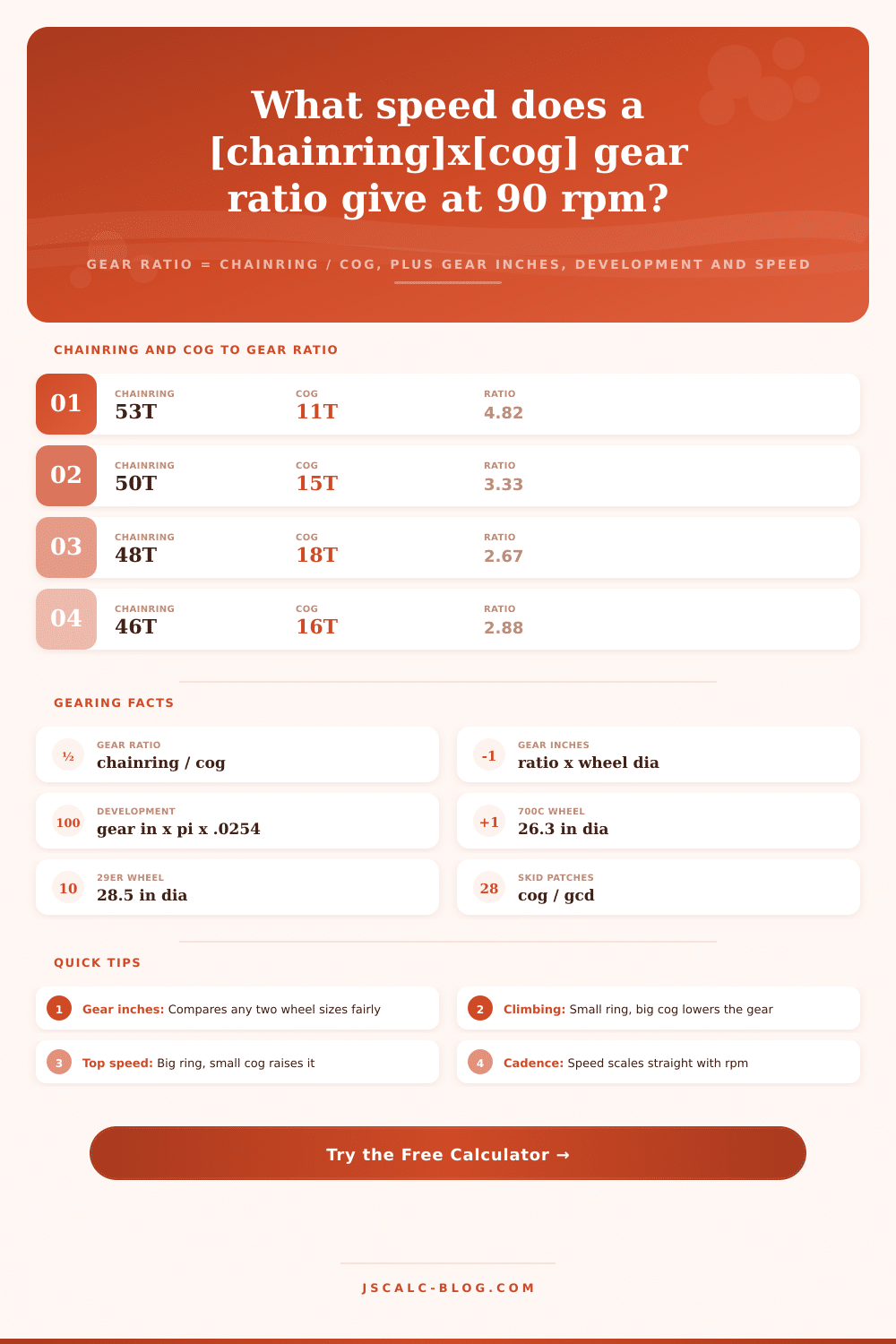
The ratio is calculated by dividing the front chainring teeth by the rear cog teeth. If you have a 53-tooth ring on your front and a 11-tooth cog on your back, then that’s a ratio of 4.82 (a fast gear). It tells us we’re going to turn our wheel almost five times per each time we turn the pedals.
But there’s something important hidden here. We don’t know what size those wheels are! Two bikes might have the same ratio yet be wildly different speeds. One has small BMX tires, while the other has huge road wheels. That’s the blind spot in ratios, which is where cyclists switch over to gear inches.
To do the math, multiply the ratio by total wheel diameter in inches (the tire plus the rest). This results in a theoretical wheel size that equals actual mechanical advantage. For example, a normal 700c road bike with a 25mm tire has a diameter of approximately 26.3 inches. Add this to our 4.82 ratio and we arrive at approximately 127 gear inches. This means we can now fairly compare a track bike’s sprint set-up to a mountain bike’s low granny gear. And it is this number that matters if you change disciplines.
With gear inches in hand, you’ll be able to calculate development… How far does the bike travel for each pedaling revolution? To determine that, multiply gear inches by pi (or 3.14) and convert into meters. Development links the turning movement of your legs with that of the bicycle moving forward. High-development gear covers ten meters per revolution requiring powerful legs to overcome the inertia. Low-development gear might only cover a meter or two and while it’s easier to get spinning, it’s difficult to sustain speed.
That explains why mountain bikers use enormous cogs on steep terrain, they’re willing to trade speed for controllable power. The final piece of the puzzle is Speed, which includes cadence (revolutions per minute, how fast you pedal), and factors into everything. For roadies, 90 rpm is a sweet spot between fatiguing and making maximum power output. According to the math, speed scales directly with cadence. Double your cadence, double your speed, assuming you’re able to maintain that gear.
Knowing this relationship lets you diagnose your gearing problems. Are you grinding along slowly? Your gear’s too tall for the terrain/your fitness level. Are you spinning out on flat ground? It’s too short. How do I choose? The answer lies between two extremes… Top end speed vs. Climbing ability. It’s one or the other.
For example: The lower your effective gear inches (i.e., a small chainring and big cog), the easier your hill climb will be. Conversely, a big ring with a small cog (a high gear) gives you max speed on downhills at the expense of grinding uphill. Once you input your exact tire width and wheel size into the calculator, it will crunch numbers for you. Gone are the days of guessing about these tradeoffs.
Why is tire width important? A wider tire is taller, which increases its rolling diameter. So while maintaining the same number of teeth on your drivetrain, a wider tire still makes your gear inch higher. Another thing to consider for fixed gear riders are skid patches; that’s those specific areas where your back tire wears out when you lock the pedals to brake. How many patches appear will be decided by commonalities in your cog and ring tooth counts. More patches means more evenly distributed wear on your whole tire, leading to longer life. This is another small mechanical detail that saves you money.
At the end of the day, it’s all about fitting the machine to your body and adjusting for the terrain. Whether you’re pedaling into the wind or attacking a hill, you want to be able to find an efficient rhythm. While reference tables make it easy to quickly benchmark common setups, only real world riding will tell you how these numbers translate to power at the pedals. Use them as a starting point.
Pick the preset that matches your bike type, then tweak it based on your tire size. Finally, use your resulting gear inches as a compass. Then when you choose a cassette, it won’t be a gamble anymore, it will be a careful engineering choice. You’ll know just what sort of hill you’re conquering before leaving the garage.
You should of known that!