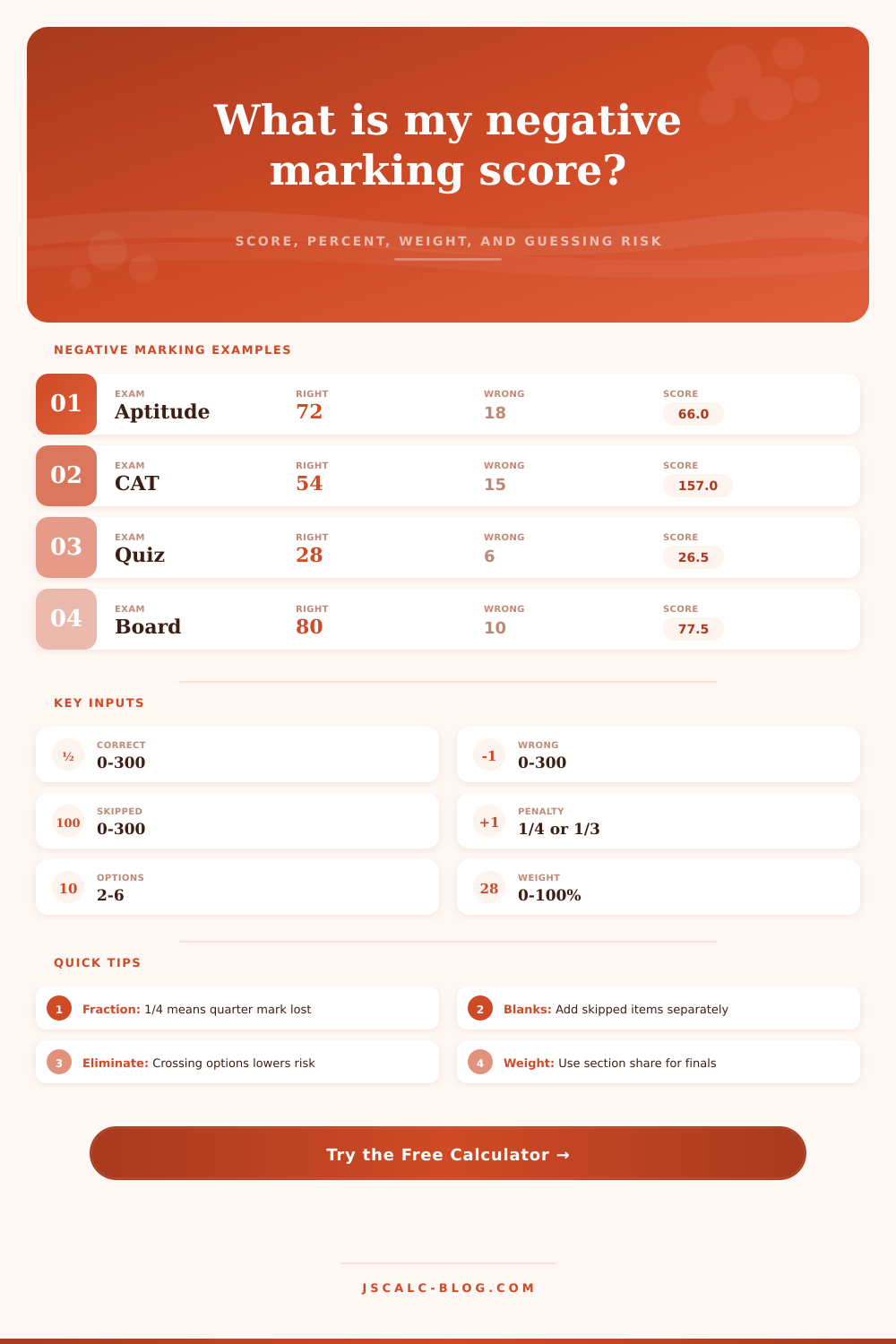
Negative Marking Calculator
Calculate exam score, percentage, weighted section value, unanswered penalties, and whether guessing is safe after eliminating options.
| Rule | If correct = 1 | If correct = 2 | If correct = 3 | Blind guess break-even |
|---|---|---|---|---|
| No penalty | 0.00 lost | 0.00 lost | 0.00 lost | Any chance helps |
| 1/5 negative | 0.20 lost | 0.40 lost | 0.60 lost | 1 in 6 |
| 1/4 negative | 0.25 lost | 0.50 lost | 0.75 lost | 1 in 5 |
| 1/3 negative | 0.33 lost | 0.67 lost | 1.00 lost | 1 in 4 |
| 1/2 negative | 0.50 lost | 1.00 lost | 1.50 lost | 1 in 3 |
| Full mark lost | 1.00 lost | 2.00 lost | 3.00 lost | 1 in 2 |
| Penalty | Needed confidence | 4 options, none cut | 4 options, one cut | 4 options, two cut |
|---|---|---|---|---|
| No penalty | 0.0% | Guess | Guess | Guess |
| 1/5 | 16.7% | Guess | Guess | Guess |
| 1/4 | 20.0% | Guess | Guess | Guess |
| 1/3 | 25.0% | Break even | Guess | Guess |
| 1/2 | 33.3% | Skip | Break even | Guess |
| Full mark | 50.0% | Skip | Skip | Break even |
| Scenario | Questions | Marks correct | Penalty fraction | Blank rule | Guess advice |
|---|---|---|---|---|---|
| School MCQ quiz | 20-50 | 1 | 0 to 1/4 | Usually zero | Guess after 1 cut |
| Aptitude test | 50-100 | 1 | 1/4 | Usually zero | Guess when narrowed |
| CAT-style paper | 60-90 | 3 | 1/3 | Zero | Avoid blind 4-way |
| Civil prelims | 80-120 | 2 | 1/3 | Zero | Need confidence |
| Banking section | 25-50 | 1 | 1/4 | Zero | Use elimination |
| Medical entrance | 100-200 | 4 | 1/4 | Zero | Cut options first |
| Language test | 40-80 | 1 | 0 to 1/4 | May vary | Use partial credit |
| Certification | 60-150 | 1 | 0 to 1 | May penalize | Compare to blank |
| Metric | Formula | Uses | Watch point |
|---|---|---|---|
| Earned score | C x M - W x N - S x P + PC | Main mark | Penalty as positive loss |
| Max score | Total x M | Percent base | Total must match paper |
| Percent | Earned / Max x 100 | Grade view | Can go below zero |
| Weighted value | Percent x Weight / 100 | Course total | Use section weight |
| Guess EV | p x M - (1-p) x N | Risk check | p rises after cuts |
| Safe threshold | (N - P) / (M + N) | Guess cutoff | Compare vs skipping |
When the time ticks down to zero and paper is still filled with empty boxes, the dread begins. Two questions answered correctly. I got three more wrong. Five were left unanswered. How did that work? Did I tank my score or not?
Negative marking calculators is an antidote to the jitters. They distill a confusing combination of correct responses, wrong guesswork and missed opportunities into one cold number. Input your numbers into the one above and let it crunch numbers for you. This takes the mental burden out of solving fractions while on the spot. It’s really just simple math, but it’s heavy on the psychological side.
Why You Should Use Negative Marking Calculators
Wrong answer hurt. Many competitive exam don’t want people to guess blindly. They penalize you for getting something wrong. Say each question is worth a point, they’ll take a quarter-point off for an incorrect answer. That means you need to calculate your risks. It doesn’t mean filling in all bubbles. It means choosing when to risk losing a point for a chance at gaining one.
Before taking the exam, you run through various scenarios with calculator and see where the tradeoffs land. The penalty fraction confuses many students. Some look at the one-third deduction and think, “No big deal.” But it’s huge. You have to get it right a third of the time before you’re breaking even. That’s a lot higher then your odds with a random guess. That chart on the page explains it well, demonstrating the break-even point given varying penalties. When the penalty is half a mark? You must answer questions correctly fifty percent of the time to stay neutral. This is not something most people naturaly understand about probability; it makes a difference when they see it laid out in black-and-white.
The best weapon at your disposal are eliminating possibilities. Eliminating one choice on a four-option question increases your odds to 50%. A hefty penalty becomes bearable. To show this benefit, the calculator has an eliminate option field. Enter that you’ve eliminated two options and suddenly taking a shot no longer carries a negative expectation. That’s the distinction between being a haphazard guesser versus a strategic risk-taker. It won’t change your life; it would of just matter.
Another level of complication come from section weighting. Questions aren’t all created equal. Certain sections will weigh in at just ten percent, whereas other sections could count toward thirty percent of your final grade. You can account for that with the calculator by inputting each section’s weight into it. That way, you’ll know what to focus on. Are you willing to take big risks with a section that is weighted lightly? Maybe it won’t be worth the potential points lost. Is a certain section weighted heavily? Then maybe you should of get aggressive when eliminating answers. Knowing the weight tells you where you should fight and where you shouldn’t expend much energy.
Penalties for skipping questions and partial credit are also missed. Exams vary in whether they penalise skips, or how much. If skips don’t cost any marks, skip whenever unsure to avoid losing points. If it does cost, well, then maybe take a longer shot rather than a sure loss? You can switch on/off skip-penalties on this calculator. It will tell you exactly what matters for the exam you’re taking. It makes you face the rules of that exam. There is no general strategy except the one suitable for those rules.
Ultimately, this all comes down to confidence. Confidence is worth more than calculation; the former can’t be calculated by the latter. While the former will inform you about where you’re statistically “safe” to take a chance on a guess, it won’t tell you whether or not you even know the material. It’ll help you discover your limits and then let you bet on yourself within those limits. We all know that risk isn’t something we want to avoid; it is something we need to manage. Understanding the price of failure helps you stop throwing darts at a wall blindfolded. Making strategic decisions is what separates a good score from a great score. The calculator simply shows you exactly how much is at stake.