Overtime Rate of Pay Calculator
Enter your base hourly wage and total hours worked this week to find your overtime hourly rate at time and a half or double time, your weekly gross pay, the split between regular and overtime pay, and an annualized income estimate under FLSA-style rules.
💼Real Payroll Presets
📝Wage and Hours Inputs
Your straight-time rate before any overtime premium.
All hours on the clock for the week, enter the number directly.
Hours over this line earn the overtime rate. Federal default is 40.
Rate paid on hours above the overtime threshold.
Used only when the multiplier is set to Custom.
Extra per hour for nights or weekends, added to the blended base.
Hours above this line pay double time. Set to 0 to disable.
Rate on the highest tier of hours, typically 2x the base.
Sets the paycheck amount and annualized estimate.
Controls how every dollar figure is displayed.
🧮Formula Snapshot
💵Overtime Rate by Base Wage
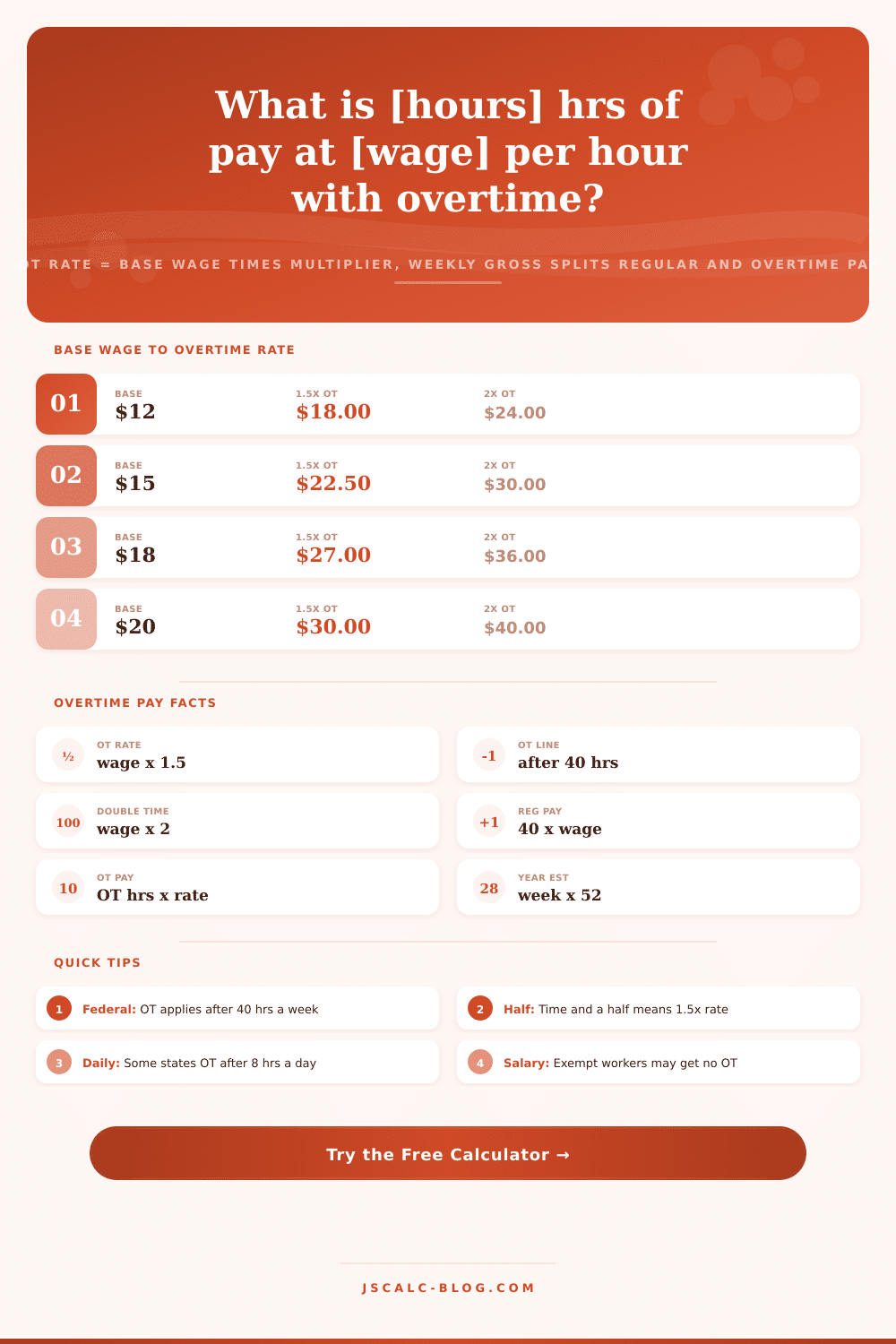
| Base Wage | 1.5x Time and a Half | 2x Double Time | 1.25x Reduced |
|---|---|---|---|
| $12.00 | $18.00 | $24.00 | $15.00 |
| $15.00 | $22.50 | $30.00 | $18.75 |
| $18.00 | $27.00 | $36.00 | $22.50 |
| $20.00 | $30.00 | $40.00 | $25.00 |
| $22.00 | $33.00 | $44.00 | $27.50 |
| $25.00 | $37.50 | $50.00 | $31.25 |
| $30.00 | $45.00 | $60.00 | $37.50 |
| $40.00 | $60.00 | $80.00 | $50.00 |
📊Weekly Gross at $20/hr by Hours
| Hours Worked | Regular Pay (40 max) | Overtime Pay (1.5x) | Weekly Gross |
|---|---|---|---|
| 40 hrs | $800.00 | $0.00 | $800.00 |
| 44 hrs | $800.00 | $120.00 | $920.00 |
| 46 hrs | $800.00 | $180.00 | $980.00 |
| 48 hrs | $800.00 | $240.00 | $1,040.00 |
| 50 hrs | $800.00 | $300.00 | $1,100.00 |
| 55 hrs | $800.00 | $450.00 | $1,250.00 |
| 60 hrs | $800.00 | $600.00 | $1,400.00 |
⚖FLSA Overtime Rules Summary
| Rule | Trigger | Pay Owed | Applies To |
|---|---|---|---|
| Federal weekly OT | Over 40 hrs/week | 1.5x base rate | Non-exempt hourly |
| Daily OT (some states) | Over 8 hrs/day | 1.5x base rate | CA, AK, NV rules |
| Daily double time | Over 12 hrs/day | 2x base rate | California rule |
| 7th consecutive day | First 8 hrs | 1.5x base rate | California rule |
| Blended rate OT | Two pay rates | 1.5x weighted avg | Multiple jobs/rates |
| Exempt salaried | Duties test met | No OT required | Exempt employees |
| Shift differential | Nights/weekends | Added to base | Included in OT base |
💵Gross Pay Comparison Grid by Wage and Hours
| Base Wage | 40 hrs | 45 hrs | 50 hrs | 55 hrs | 60 hrs |
|---|---|---|---|---|---|
| $12.00 | $480.00 | $570.00 | $660.00 | $750.00 | $840.00 |
| $15.00 | $600.00 | $712.50 | $825.00 | $937.50 | $1,050.00 |
| $18.00 | $720.00 | $855.00 | $990.00 | $1,125.00 | $1,260.00 |
| $20.00 | $800.00 | $950.00 | $1,100.00 | $1,250.00 | $1,400.00 |
| $22.00 | $880.00 | $1,045.00 | $1,210.00 | $1,375.00 | $1,540.00 |
| $25.00 | $1,000.00 | $1,187.50 | $1,375.00 | $1,562.50 | $1,750.00 |
| $28.00 | $1,120.00 | $1,330.00 | $1,540.00 | $1,750.00 | $1,960.00 |
| $30.00 | $1,200.00 | $1,425.00 | $1,650.00 | $1,875.00 | $2,100.00 |
| $35.00 | $1,400.00 | $1,662.50 | $1,925.00 | $2,187.50 | $2,450.00 |
| $40.00 | $1,600.00 | $1,900.00 | $2,200.00 | $2,500.00 | $2,800.00 |
⚙Formula Breakdown
💡Overtime Pay Tips
There are millions of paychecks issued each week with this question answered: How much do I get paid for working overtime? That’s what the overtime rate of pay calculator does. It will tell you exactly how much more money you should be earning when you put in extra hours.
It doesn’t just pay you more of whatever your normal hour pays you. It’s a premium. Time and a half is the most common premium for overtime, mandated by federal law, and kicks in once you’ve exceeded some number of hours per week. The calculator takes your total hours and base wage and returns your gross pay, the breakdown between overtime and regular earnings, your overtime rate, and even an estimate of what you’re owed on an annual basis. It makes a vague policy decision come to life in a very real amount of dollars.
How to Calculate Your Overtime Pay
A single multiplication is the core of overtime math: your overtime hourly rate are equal to your base wage times some premium multiplier. The standard premium is 1.5, also called “time and a half.” If you earn $18 an hour, then you get $27 per overtime hour worked. Depending on the job or in certain states, the premium can increase to double time… Resulting in a multiplier of two, turning that same $18 base into $36 an hour. The calculator allows you to select either 1.5x, 2x, a lower multiplier like 1.25x, or even to enter a custom multiplier, updating the rate immediately. This flexibility matters; contract terms differs widely across industries.
Your hours get split into tiers before they is ever counted for pay. All hours below the overtime threshold (which defaults to forty) are counted as “regular” hours. You get paid your base rate for those. Anything over the threshold is counted as an “overtime” hour and gets paid at higher “premium” rate. So if you put in forty-six hours with a threshold of forty, the tool will count it as forty regular hours and six overtime hours.
It’s the distinction between guessing and knowing. A lot of people think that their entire paycheck scales linearly with hours. It doesn’t. The additional pay comes on all hours after the threshold; everything else is just filling the bucket at standard price. That’s total weekly gross pay, combining regular pay (base rate times regular hours), overtime pay (overtime rate times overtime hours) and optional double-time pay (if you work beyond another threshold, such as sixty in a week). Add ’em up and there’s your gross for the week.
And the calculator also shows how much regular versus overtime pay you’re getting, because when you see that it includes $260 in premium pay vs. $720 in regular pay over a week, it makes the value of your extra hours come into focus. It really spells out what your paycheck comes from.
Shift Differentials complicate Overtime: In addition to straight-time pay, you might get paid more if you work nights or weekends (a “differential”). When you add a differential to your hourly pay, the system multiplies your blended rate by 1.5 (including the differential). For example, an employee who makes $15/hr plus a $2/hr night differential has a blended rate of $17. That means they’re paid a time and a half overtime rate of $25.50 instead of $22.50.
That is important mathematically and legally. Differentials should be included in your regular rate when you calculate your overtime. Instead of having it added on top of your base (e.g., $15 + $2), our calculator folds it into your base (i.e., $17), just like a compliant payroll system would do.
To that end, the tool also annualizes your gross; because it’s easier to imagine one good week than a whole year. Multiply your weekly number by 52 and you get an estimate of what it might look like if each week were identical. If you make $980/week, then you’d annualize to around $50,960 (if all your weeks are alike). That’s an estimate: Overtime hours don’t typically remains static. But this can be a helpful basis to judge if a heavy period of overtime work is worth the sacrifice in personal life, or to see how various job offers stack up. The preset jobs (such as warehousing, nursing) help anchor these estimates in reality.
You need to know your state’s regulations. If you work in one of many states that have gone beyond federal requirements, then good overtime math is essential. Under federal law, the minimum is 1.5x at 40 hours per week. However, this isn’t “daily” overtime. Some states, like California, do double-time when you work more than 12 hours in a day, or 1.5x after eight hours. And salaried workers can be exempt from all overtime pay if they pass certain duties tests. Don’t get surprised by a bad overtime number on your paycheck! Know what the rules are where you live.
A paycheck of hundreds of dollars per week swings on overtime, and overtime is where mistakes sneakily cost worker money. This calculator simplifies those three sources… Tiered hours, complicated rate formulas, and odd pay differentials, all in one location, so the confusing payroll question becomes a clear breakdown to inspect line-by-line. Input your actual hours and wage, read the result cards, and know exactly where every dollar comes from. If you’re considering extra shift work, or just checking a paystub, these trusty numbers helps you plan your budget confidently (and protect your income).