Mortgage Refinance Break-Even Calculator
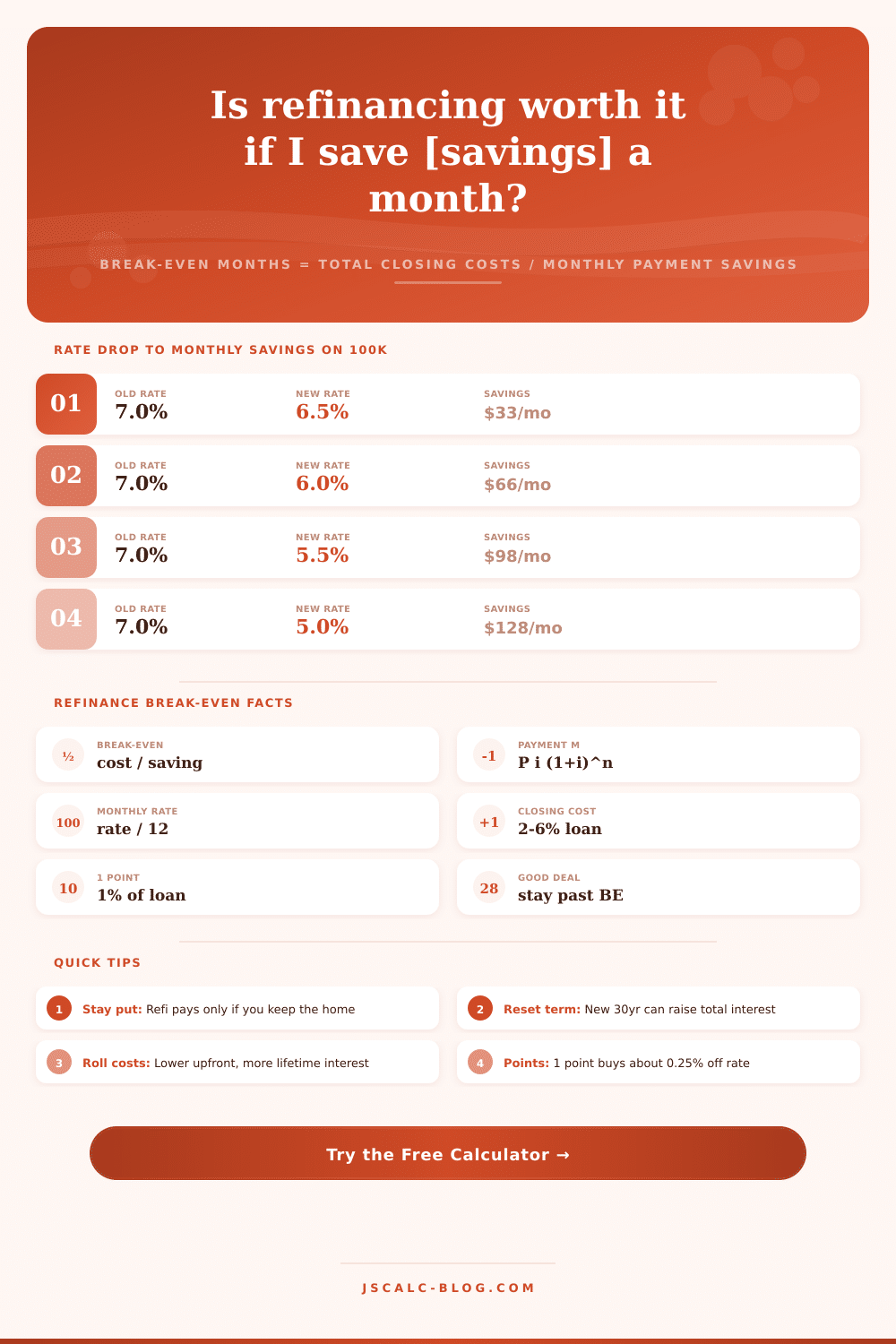
Compare your current loan against a new one to find the monthly payment savings, the total closing costs you must recover, and the exact break-even point in months and years. Payments use M = P i (1+i)^n / ((1+i)^n - 1), and break-even = total closing costs divided by monthly savings.
🎯Real Refinance Scenario Presets
💳Your Current Loan
The remaining principal you still owe today.
The note rate on your existing mortgage.
Years left on the current loan schedule.
Used to test if you pass the break-even point.
🏦Your New Refinance Loan
The rate you are being offered on the refinance.
Length of the new loan, often reset to 30 years.
Lender, title, appraisal and admin fees, roughly 2-6% of the loan.
Prepaid interest, one point equals 1% of the balance.
Rolling costs in raises the new balance and lifetime interest.
Controls how payment and interest figures display.
🔢Formula Snapshot
💵Typical Refinance Closing Cost Ranges
| Loan Size | 2% (Low) | 4% (Typical) | 6% (High) | What It Covers |
|---|---|---|---|---|
| $150,000 | $3,000 | $6,000 | $9,000 | Origination and title |
| $200,000 | $4,000 | $8,000 | $12,000 | Appraisal and escrow |
| $250,000 | $5,000 | $10,000 | $15,000 | Underwriting fees |
| $300,000 | $6,000 | $12,000 | $18,000 | Recording and credit |
| $400,000 | $8,000 | $16,000 | $24,000 | Lender and attorney |
| $500,000 | $10,000 | $20,000 | $30,000 | Points and prepaids |
📈How a Rate Drop Changes Payment on $100k (30yr)
| Old Rate | New Rate | Old P&I | New P&I | Monthly Savings |
|---|---|---|---|---|
| 7.0% | 6.5% | $665.30 | $632.07 | $33.23 |
| 7.0% | 6.0% | $665.30 | $599.55 | $65.75 |
| 7.0% | 5.5% | $665.30 | $567.79 | $97.51 |
| 7.0% | 5.0% | $665.30 | $536.82 | $128.48 |
| 8.0% | 7.0% | $733.76 | $665.30 | $68.46 |
| 6.5% | 5.5% | $632.07 | $567.79 | $64.28 |
| 6.5% | 6.0% | $632.07 | $599.55 | $32.52 |
💲Discount Points: Cost vs Rate Reduction
| Points | Cost on $300k | Approx Rate Cut | Example Rate | Best For |
|---|---|---|---|---|
| 0 points | $0 | None | 6.75% | Short stay |
| 0.5 point | $1,500 | 0.125% | 6.625% | Light buydown |
| 1 point | $3,000 | 0.25% | 6.50% | Long stay |
| 2 points | $6,000 | 0.50% | 6.25% | Forever home |
| 3 points | $9,000 | 0.75% | 6.00% | Max buydown |
📅Break-Even vs Years You Plan to Stay ($300k, 7% to 6%)
| Years in Home | Months Held | Savings Earned | Closing Costs | Net Result |
|---|---|---|---|---|
| 1 year | 12 mo | $2,367 | $4,500 | -$2,133 loss |
| 2 years | 24 mo | $4,734 | $4,500 | +$234 gain |
| 3 years | 36 mo | $7,101 | $4,500 | +$2,601 gain |
| 5 years | 60 mo | $11,836 | $4,500 | +$7,336 gain |
| 7 years | 84 mo | $16,570 | $4,500 | +$12,070 gain |
| 10 years | 120 mo | $23,671 | $4,500 | +$19,171 gain |
🗃Savings and Break-Even by Loan Size (1% Rate Drop, 30yr, 2% Costs)
| Loan Size | Old P&I 7% | New P&I 6% | Monthly Savings | Closing Costs | Break-Even |
|---|---|---|---|---|---|
| $150,000 | $997.95 | $899.33 | $98.63 | $3,000 | 30.4 mo (2.5 yr) |
| $200,000 | $1,330.60 | $1,199.10 | $131.50 | $4,000 | 30.4 mo (2.5 yr) |
| $250,000 | $1,663.26 | $1,498.88 | $164.38 | $5,000 | 30.4 mo (2.5 yr) |
| $300,000 | $1,995.91 | $1,798.65 | $197.26 | $6,000 | 30.4 mo (2.5 yr) |
| $400,000 | $2,661.21 | $2,398.20 | $263.01 | $8,000 | 30.4 mo (2.5 yr) |
| $500,000 | $3,326.51 | $2,997.75 | $328.76 | $10,000 | 30.4 mo (2.5 yr) |
⚙Formula Breakdown
💡Refinance Decision Tips
The concept of refinancing feels easy: You replace one loan with another at a lower interest rate, reducing your monthly payment, and you’re done. Well, not exactly. There’s a fee to make the switch, what we call closing costs, which are up-front taxes on your savings. The actual question isn’t “is this rate low?” Instead, ask how many months it takes to get your entry costs back. If you move before you break even, you’ve lost money.
That’s the logic behind the calculator above: It crunches the numbers after you enter your terms and balance, so you can spend time thinking through the timeline without having to guess the figures. How does it work? It’s simple: the nuts-and-bolts of this are based off the classic amortization equation. Take your current payment, which is your current rate plus the remaining amount owed, and compare it to your new payment (the new loan amount, at the new rate over the new term). That’s your “raw” savings each month. To determine how long it takes to recoup your closing costs, divide your total closing costs by the monthly savings. It’s just a math equation, but it’s loaded… And the answer tell you when you’ll be out-of-the-red (i.e. This answer shows whether refinancing saves you money.
Why Closing Costs Matter More Than The Interest Rate
So if the numbers indicate you’ll breakeven in twenty-four months but intend to sell after eighteen, technically speaking, you’ve just lost money… even though your interest rate is lower. And here’s where loan structure impact this timeline, which most folks ignore: You could take that same three-hundred-thousand-dollar loan and go from a 7% rate to a 6% rate, saving yourself almost two-hundred bucks per month. But now you’ve reset your clock; instead of having 24 years remaining, you’re looking at 30. Even if those payments is smaller, adding years onto the end of a loan will add a lot of interest throughout the rest of your life.
The calculator makes this trade-off obvious: Compare the amount of lifetime interest you’ll pay under both scenarios. Sure, you may save cash each month … but you’ll end up paying more over the life of the loan. That’s what most folks miss when they only focus on the monthly number.
Depending on where you live and who lends you money, closing costs are a wild beast. They range anywhere between two and six percent of your loan amount, and you have two choices: Pay them in full today or add them onto the balance of your loan. While that will save you some cash pain today, it also means your principal goes up, meaning you’ll shell out extra interest over time for those fees. Sounds convenient? Sure. But it’s a silent killer of your net gain. The same goes for points; each point you buy to lower your rate costs one percent of your loan balance. Just like traditional closing costs, this is an expense you need to recover via monthly savings. Toggle these expenses around within the tool to get a precise sense of how much they drain your break-even timeline.
So, more than the rate you have now. Or, at least equally as important, the most critical question is: How long do you plan to live there? A refinance is a bet on how long you will stay in the house. If it’s likely you’ll sell in three years (or less) you’re probably better off only refinancing if the rate decreased drastically enough to make up for expenses. Otherwise the initial cost will far exceed any savings. Stick around longer and all those little dollars you save each month add up to serious money. This table on the page shows net effects of various scenarios over varying periods of time, and makes clear that time is the single biggest factor.
What’s nice about this tool is that it gives you some stress tests of your own assumptions via its built-in presets. Want to see what would happen if you got a 15-year instead? You can also see how sensitive the interest rates are if you take out a jumbo loan instead of a smaller conventional mortgage. These examples make clear that there is no one-size-fits-all solution here. Depending on how long you intend to stay at the house, a great deal for someone else could be a poor bet for you.
In short, refinancing is all about matching your finances with your life. Know how much money you’ll save and how much it will cost you. Most critically, know when that happens. If you cross the break even point far ahead of schedule, then the math is on your side. If the numbers don’t support it, then there’s almost always little benefit in swapping one loan for another, keeping the higher rate protects more of your capital than refinancing ever would of.
It’s not just about finding the cheapest rate on the sign. It is about avoiding how closing costs secretly hurt your bottom line. When you have that clarity, a complicated process becomes a clear choice.