Odds Probability Calculator
Convert between odds and probability in every direction. Enter odds as X:Y for or against, a probability percent, or a 1-in-N chance, and read back the matching percent, simplified odds for, odds against, and decimal odds.
🎲Common Conversion Presets
📝Conversion Inputs
Left side of the ratio, for example the 3 in 3:1.
Right side of the ratio, for example the 1 in 3:1.
Between 0 and 100. Use for probability to odds mode.
A 1 in 100 chance means N = 100.
🔢Formula Snapshot
📊Odds For to Probability Reference
| Odds For | Probability | Odds Against | 1 in N | Decimal Odds |
|---|---|---|---|---|
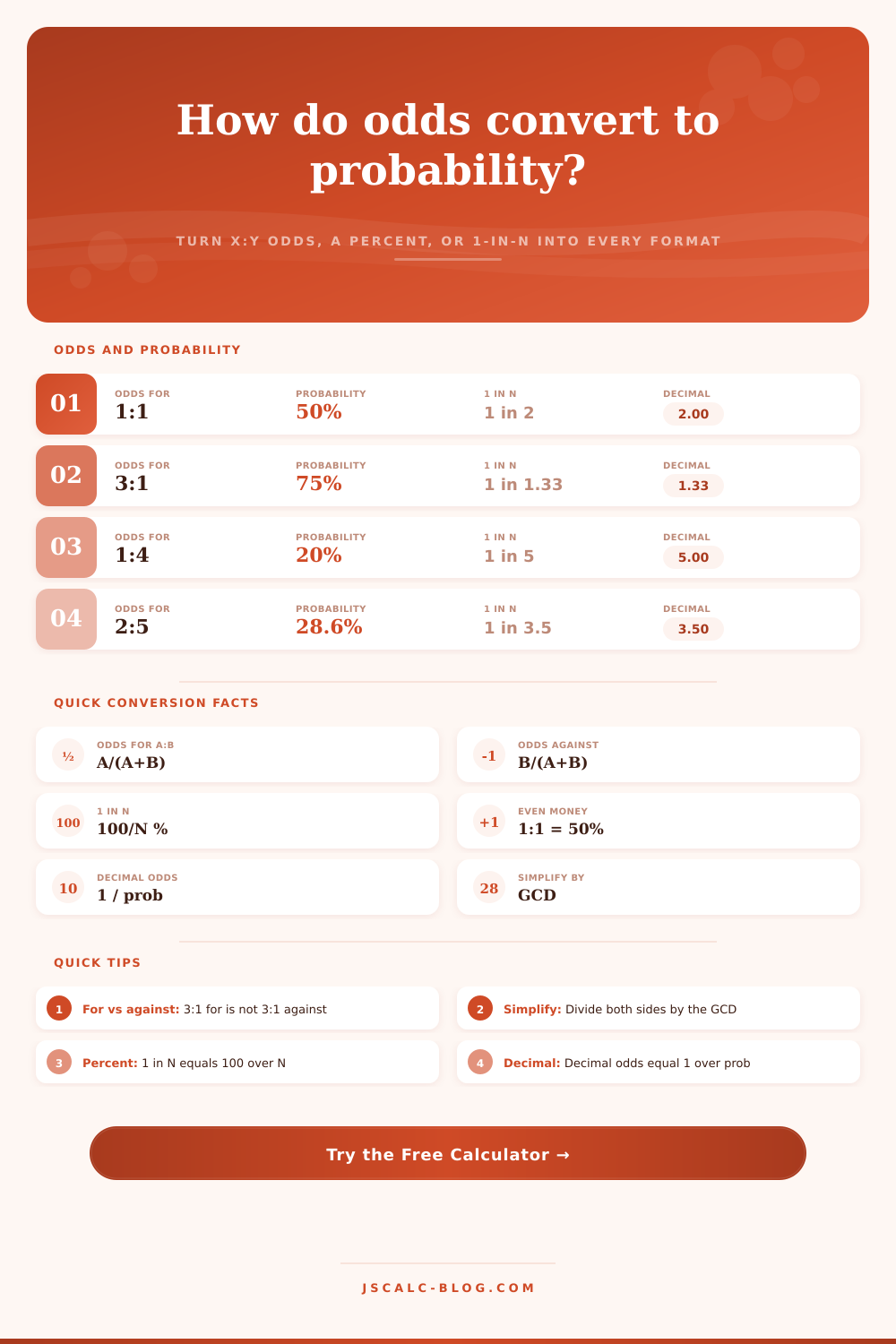
| 1:1 | 50.00% | 1:1 | 1 in 2 | 2.00 |
| 2:1 | 66.67% | 1:2 | 1 in 1.5 | 1.50 |
| 3:1 | 75.00% | 1:3 | 1 in 1.33 | 1.33 |
| 4:1 | 80.00% | 1:4 | 1 in 1.25 | 1.25 |
| 1:2 | 33.33% | 2:1 | 1 in 3 | 3.00 |
| 1:3 | 25.00% | 3:1 | 1 in 4 | 4.00 |
| 1:4 | 20.00% | 4:1 | 1 in 5 | 5.00 |
| 2:5 | 28.57% | 5:2 | 1 in 3.5 | 3.50 |
| 3:2 | 60.00% | 2:3 | 1 in 1.67 | 1.67 |
📈Percentage to Odds Reference
| Probability | Odds For | Odds Against | 1 in N | Decimal Odds |
|---|---|---|---|---|
| 10% | 1:9 | 9:1 | 1 in 10 | 10.00 |
| 20% | 1:4 | 4:1 | 1 in 5 | 5.00 |
| 25% | 1:3 | 3:1 | 1 in 4 | 4.00 |
| 33.33% | 1:2 | 2:1 | 1 in 3 | 3.00 |
| 40% | 2:3 | 3:2 | 1 in 2.5 | 2.50 |
| 50% | 1:1 | 1:1 | 1 in 2 | 2.00 |
| 60% | 3:2 | 2:3 | 1 in 1.67 | 1.67 |
| 75% | 3:1 | 1:3 | 1 in 1.33 | 1.33 |
| 90% | 9:1 | 1:9 | 1 in 1.11 | 1.11 |
🎯1 in N to Percent Reference
| 1 in N | Probability | Odds For | Odds Against | Decimal Odds |
|---|---|---|---|---|
| 1 in 2 | 50.00% | 1:1 | 1:1 | 2.00 |
| 1 in 4 | 25.00% | 1:3 | 3:1 | 4.00 |
| 1 in 6 | 16.67% | 1:5 | 5:1 | 6.00 |
| 1 in 10 | 10.00% | 1:9 | 9:1 | 10.00 |
| 1 in 20 | 5.00% | 1:19 | 19:1 | 20.00 |
| 1 in 100 | 1.00% | 1:99 | 99:1 | 100.00 |
| 1 in 1000 | 0.10% | 1:999 | 999:1 | 1000.00 |
| 1 in 1,000,000 | 0.0001% | 1:999999 | 999999:1 | 1,000,000 |
⚖Odds For vs Odds Against
| Event | Odds For | Odds Against | Probability | 1 in N | Meaning |
|---|---|---|---|---|---|
| Coin flip heads | 1:1 | 1:1 | 50.00% | 1 in 2 | Even, either reading matches |
| Roll a 6 on a die | 1:5 | 5:1 | 16.67% | 1 in 6 | Unlikely, against is larger |
| Draw an ace | 1:12 | 12:1 | 7.69% | 1 in 13 | 4 aces in 52 cards |
| Strong favorite | 4:1 | 1:4 | 80.00% | 1 in 1.25 | Likely, for is larger |
| Two to one shot | 1:2 | 2:1 | 33.33% | 1 in 3 | Against beats for two to one |
| Three to two edge | 3:2 | 2:3 | 60.00% | 1 in 1.67 | Slight favorite either way |
| Rare outcome | 1:99 | 99:1 | 1.00% | 1 in 100 | Very long odds against |
⚙Full Formula Breakdown
📋Reference Values
| Term | Definition | Formula | Quick Example |
|---|---|---|---|
| Odds in favor | Ways for to ways against | A : B | 3:1 means 3 for, 1 against |
| Odds against | Ways against to ways for | B : A | Reverse of odds in favor |
| Probability | Share of favorable outcomes | A / (A + B) | 3:1 for equals 75% |
| 1 in N | One chance out of N total | 1 / N | 1 in 4 equals 25% |
| Decimal odds | Payout multiplier reference | 1 / p | p = 0.20 gives 5.00 |
💡Practical Conversion Tips
I think we’ve all heard that our favorite has three to one odds before. Sounds good! Except that it doesn’t mean anything without context. Are those three-to-one odds in favor or opposed? It’s the latter point that confuses so many, which is precisely why knowing how to convert back and forth between percentages and ratios are valuable.
Once you enter your figures into the calculator above, it takes care of the math. You won’t have to fiddle with fractions by hand or try to determine if the risk is actualy one worth making. But it comes down to the fact we’re a species who’s innately awful at imagining ratios. Percentages we get. We know what twenty percent is because we learned it in school. Sales discounts taught us that fifty percent is half.
Why Knowing Probability Is Important
But three to two against? That takes some math. And even then we still don’t intuitivey understand how likely that is. Remember: three to two in favor means there are two chances of failure and three chances of success. There are five parts in the whole pie. If there are five total parts, what fraction does that leave? Not sixty percent. Not even seventy-five percent. Thirty divided by fifty equals…sixty percent.
That’s the tool for you. Put in the actual numbers of As and Bs. It’ll spit out the tidy percentage, a ratio, and a decimal. This also sheds light on why certain industries use certain formats. For example, bookies tend towards fractional odds (e.g., 2/9 or 5/1). Why? Because that’s traditional in the UK/Ireland. Lottery organisers like to say something along the lines of “one in N”. Why? To highlight how rare an event it is. One in a hundred sounds scarier than ten per cent… Yet they mean exactly the same thing. It’s all about framing things psychologically.
That’s what the page’s reference tables makes clear: the same basic probability expressed in different languages changes how you think about it. Newcomers can also be baffled by addition of decimal odds. On several Australian and European-based sites, payouts is given in decimal form such as 3.50. That’s how much you stand to win per unit staked (i.e., it includes your initial stake). Don’t confuse it with the profit. A decimal odd of 4.00 means there’s a 25% probability of success. Bet a dollar; recieve four dollars. Your profit is three dollars. Knowing this difference will save you from expensive calculation errors during comparisons between offers on various platforms/marketplaces.
Odds also depend on which way the arrow points. A three-to-one chance in favor means something is probable. A three-to-one chance against means it’s improbable. They are two sides of the same coin, but they shows opposite worlds. One represents a strong favorite; the other a long shot. Confuse the two and you will make bad bets; whether betting money or taking out insurance.
The lesson: Always check the label. When someone tells you the odds are three to one, ask whether they mean three to one against or three to one for. One thing that helps simplify things is simplifying your ratios. That 20 to 12 just looks clunky. Compare it to something else and it’s tough to see. Divide both sides by that number to get five to three. It is cleaner, easier to recall, and functionally the same thing. The calculator will do this for you so you’ll always recieve the most reduced form of a ratio. And when you’re looking at a bunch of scenarios trying to quickly see which one has the best chance or best value, that’s helpful.
So really, probability simply describes uncertainty. It doesn’t matter if you’re throwing dice, flipping coins, or assessing risk in business. Math is math. There’s still a numerator of favorable outcomes over a denominator of total possible outcomes. The form changes but the reason stays solid. Learning how to switch between forms makes things clear. You no longer guess, you know exactly what these numbers tell you relative to your situation. And that brings us full circle to our original question: Is three to one good? Or is it bad? It all depends. It depends on whose coin you happen to be staring down, and it could of been different if the math was more complex.