Energy Converter
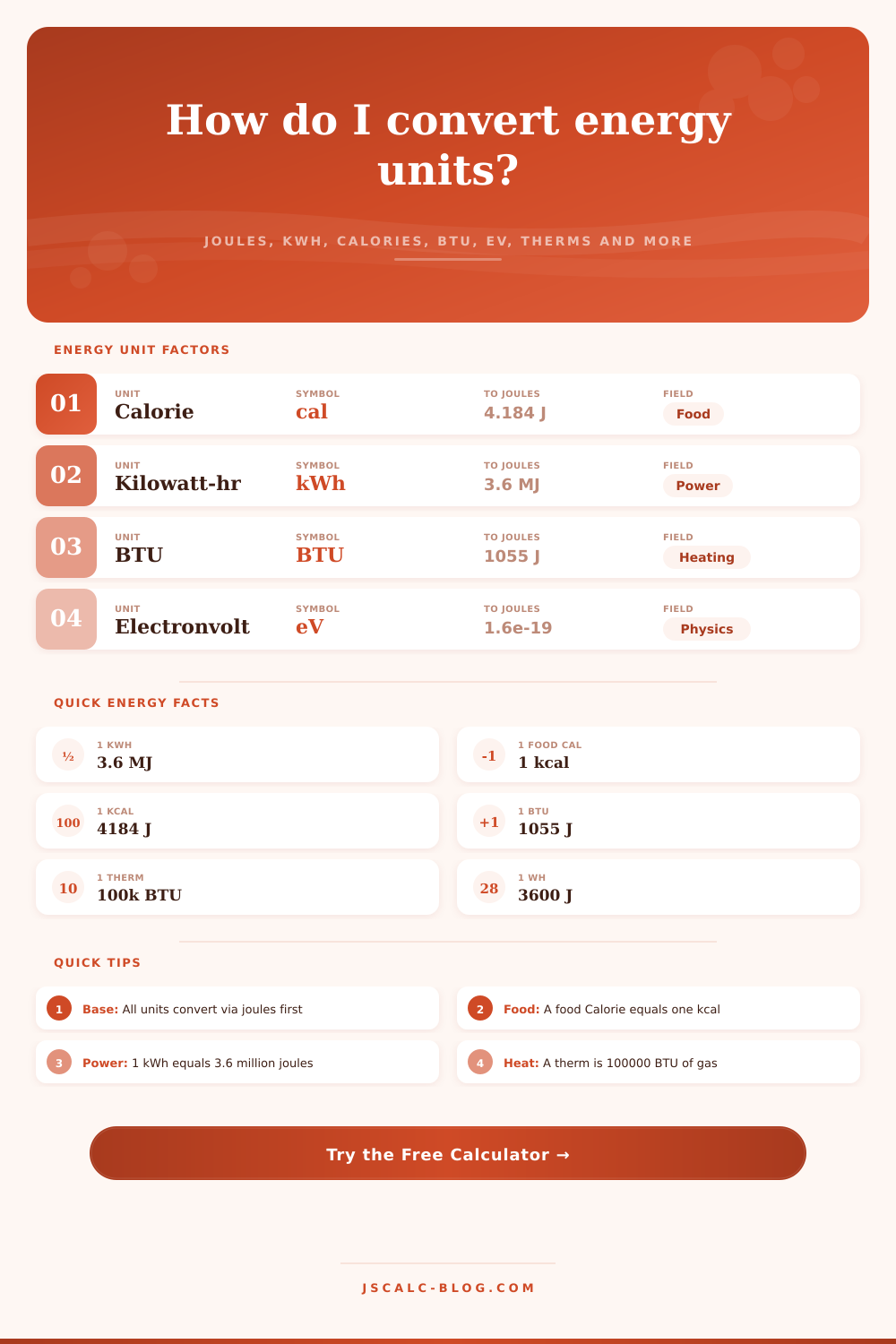
Convert any energy amount between joules, kilojoules, calories, kilocalories (food Calories), watt-hours, kilowatt-hours, BTU, foot-pounds, electronvolts, therms, and megajoules using a single joule base with exact factors.
⚡Real Energy Presets
🔢Conversion Inputs
Enter the number of the from-unit you want to convert.
📐Common Equivalents At A Glance
📋Full Conversion Factor Table
| Unit | Symbol | Joules Per Unit | Your Amount | Everyday Meaning |
|---|---|---|---|---|
| Enter a value above to see every unit converted from your input. | ||||
🍎Food And Nutrition Energy Reference
| Food Item | Food Calories | Kilojoules | Joules |
|---|---|---|---|
| Apple, medium | 95 Cal | 397 kJ | 397,480 J |
| Banana, medium | 105 Cal | 439 kJ | 439,320 J |
| Slice of bread | 80 Cal | 335 kJ | 334,720 J |
| Cup of rice, cooked | 205 Cal | 858 kJ | 857,720 J |
| Chicken breast, 100 g | 165 Cal | 690 kJ | 690,360 J |
| Chocolate bar, 45 g | 235 Cal | 983 kJ | 983,240 J |
| Big fast-food meal | 1,100 Cal | 4,602 kJ | 4,602,400 J |
| Daily 2,000 Cal diet | 2,000 Cal | 8,368 kJ | 8,368,000 J |
A nutrition label Calorie (capital C) is one kilocalorie, which equals 4,184 joules.
🏠Household Energy Reference (kWh)
| Appliance Use | Kilowatt-hours | Megajoules | BTU |
|---|---|---|---|
| LED bulb, 10 W for 10 h | 0.10 kWh | 0.36 MJ | 341 BTU |
| Laptop charge, full | 0.06 kWh | 0.22 MJ | 205 BTU |
| Microwave, 15 minutes | 0.25 kWh | 0.90 MJ | 853 BTU |
| Refrigerator, one day | 1.50 kWh | 5.40 MJ | 5,119 BTU |
| Electric oven, 1 hour | 2.30 kWh | 8.28 MJ | 7,849 BTU |
| Clothes dryer, one load | 3.00 kWh | 10.80 MJ | 10,239 BTU |
| EV charge, 40 kWh pack | 40.0 kWh | 144.0 MJ | 136,486 BTU |
| Home, one full day | 30.0 kWh | 108.0 MJ | 102,364 BTU |
🔥Heating BTU And Cross-Unit Comparison
| Energy Source | BTU | Joules | kWh | kcal | Therms |
|---|---|---|---|---|---|
| 1 BTU (match tip) | 1 | 1,055 | 0.000293 | 0.252 | 0.00001 |
| Space heater, 1 hr | 5,118 | 5.40 M | 1.50 | 1,291 | 0.051 |
| Cooktop burner, 1 hr | 9,000 | 9.50 M | 2.64 | 2,270 | 0.090 |
| Water heater, 1 hr | 40,000 | 42.2 M | 11.72 | 10,087 | 0.400 |
| Home furnace, 1 hr | 80,000 | 84.4 M | 23.45 | 20,174 | 0.800 |
| 1 therm natural gas | 100,000 | 105.5 M | 29.30 | 25,217 | 1.000 |
| Central AC, 1 day | 288,000 | 303.9 M | 84.40 | 72,626 | 2.880 |
| MMBtu (1 million BTU) | 1,000,000 | 1.055 G | 293.07 | 252,164 | 10.000 |
⚙Full Formula Breakdown
💡Practical Energy Tips
There’s energy all around, but depending on your location, you speak a different dialect. At home, maybe you read a nutrition label and estimate whether some snack will be worth the caloric price tag. Maybe when your utility bill arrives, you stare at the line for kilowatt-hours and wonder how much that abstract charge translate into heat compared to the therms listed on your furnace bill, a.k.a. British thermal units (BTUs).
In the kitchen: Calorie. From the utility company: kilowatt-hours. In the furnace manual: BTU. It’s a mishmash of random standards, and everything require translating before you can compare one thing to another. No matter what we call it, energy is simply energy. Whether you run on an apple or a tank of fuel, you’re expending the exact same amount of work and heat.
The Joule is the Universal Energy Unit
For this reason, the joule act as universal translator; it’s the SI base unit of everything from home appliances to particle physics. By plugging things into the calculator, you strip away all the confusing labels, reducing each input down to its joules-equivalent. Then it stretch that number out to whichever target unit you need. It does this in two steps to guarantee accuracy, rather than using those pesky direct-conversion factors hiding in the footnotes of textbooks.
It gets even more complicated because world of nutrition already has its system of measurements: the food industry refers to a kilocalorie (a thousand little calories, but called a Calorie with a big C) as a Calorie. If you’re trying to track how many calories you take in compared to the amount of mechanical work your body does each day, you should of be aware of that difference. Four thousand joules = one kilocalorie, which doesn’t sound like much until you consider that it takes several million joules of energy to walk a mile. Check out the chart of common foods in standard metric units from the page’s reference table to see how your diet plan numbers compare to actual physical work.
BTUs (British Thermal Units) reign supreme in many parts of the world, including the heating and cooling industry. One BTU is about amount of heat required to increase one pound of water by one degree Fahrenheit. While this makes BTUs a convenient unit for engineers, trying to match your electric bill against your gas bill using them can be frustrating. Many utilities sells natural gas by the therm (one therm equals one hundred thousand BTUs). That’s a huge chunk of energy when compared to most home appliances. Learning how they relate allows you to determine what type of improvements will affect your bottom line, i.e. Should I upgrade my insulation or switch out my appliances?
Another wrinkle: electrical energy combines power and time. Watts are a measure of power, yes… But a kilowatt-hour is a measure of how much power you used over an hour. That’s what a kilowatt-hour is. It’s easy to mix up watts with watt-hours which leads people astray when estimating solar panel production or battery life. One kilowatt-hour hold three point six million joules. Because each device appears individually low powered, your house consumption quickly adds up to this big number.
And on the other end of the spectrum, if you’re into semiconductor tech or physics, it will convert electronvolts to joules as well, that’s what an electronvolt is: the amount of energy picked up by an electron passing through a single volt of potential. Yes, it’s very tiny, but it’s the stuff that governs the absorption of solar cells and the release of energy in nuclear reactions. Converting this may seem ridiculous (bridging the gap from subatomic particles to furnace output!), but it show just how universally the joule can be used as a measuring stick.
It’s not so much about remembering the factors as it is getting perspective. When you realize that an hour of streaming your favorite show, a big meal, and a blast from your space heater have something in common the mysterious idea of utility bills dissapears. Suddenly, you’re thinking of energy in terms of one currency spent on many part of your life. The next time you glance at your bill or a product’s label, keep in mind that behind the confusing acronyms there’s just a straightforward tale of heat and work.