15 vs 30 Year Mortgage Comparison Calculator
Put a 15-year and a 30-year mortgage side by side. Enter your loan amount and a separate rate for each term, then see both monthly payments, the total interest a 15-year loan saves, how much cash flow a 30-year frees up, and what that monthly difference could grow to if you invested it instead.
🎯Real Comparison Presets
📝Loan and Rate Inputs
Purchase price before your down payment.
Cash down; loan amount = price minus this.
15-year loans usually run 0.5-0.75% lower.
The higher rate typical of a 30-year term.
Assumed yearly return if you invest the payment gap.
Optional add-on to the 15-year payment shown.
🔢Comparison Snapshot
🗃Loan Size Comparison Grid
| Loan Amount | 15-Yr Payment | 30-Yr Payment | Monthly Difference | Interest Saved 15-Yr | 30-Yr Total Interest |
|---|---|---|---|---|---|
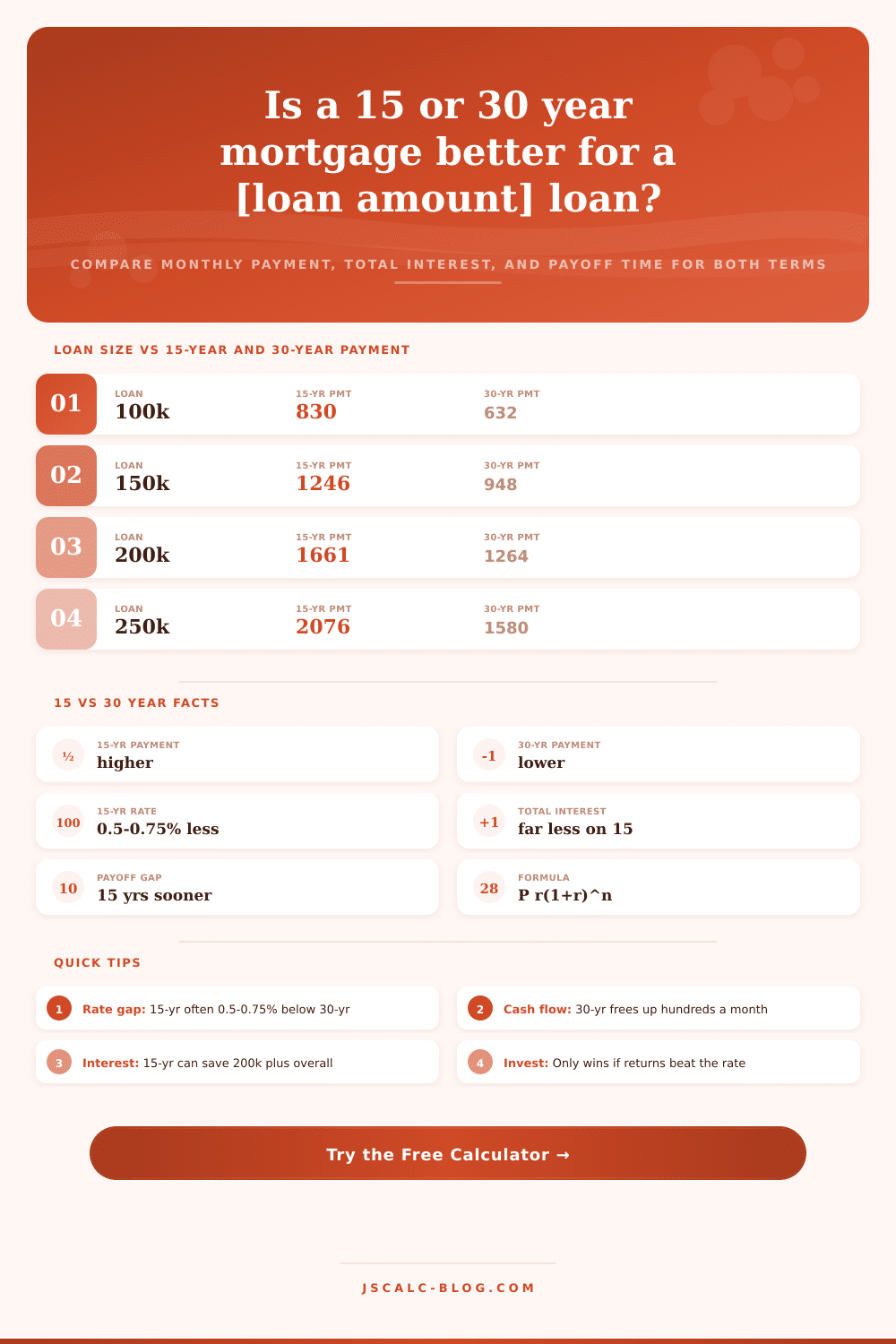
| $100,000 | $830 | $632 | $198 | $78,071 | $127,544 |
| $150,000 | $1,246 | $948 | $298 | $117,106 | $191,316 |
| $200,000 | $1,661 | $1,264 | $397 | $156,141 | $255,088 |
| $250,000 | $2,076 | $1,580 | $496 | $195,177 | $318,860 |
| $300,000 | $2,491 | $1,896 | $595 | $234,212 | $382,632 |
| $400,000 | $3,322 | $2,528 | $793 | $312,283 | $510,176 |
| $500,000 | $4,152 | $3,160 | $992 | $390,353 | $637,720 |
| $600,000 | $4,982 | $3,792 | $1,190 | $468,424 | $765,264 |
| $750,000 | $6,228 | $4,741 | $1,488 | $585,530 | $956,580 |
Assumes a 15-year rate of 5.75% and a 30-year rate of 6.50%. Principal and interest only, no taxes or insurance.
📊Typical Rate Gap by Term
| Market Level | 30-Year Rate | 15-Year Rate | Rate Gap |
|---|---|---|---|
| Very low | 4.00% | 3.25% | 0.75% |
| Low | 5.00% | 4.375% | 0.625% |
| Moderate | 6.00% | 5.375% | 0.625% |
| Current | 6.50% | 5.75% | 0.75% |
| Elevated | 7.00% | 6.375% | 0.625% |
| High | 7.50% | 6.875% | 0.625% |
📈30-Year Payment on $300k by Rate
| 30-Year Rate | 30-Yr Payment | 30-Yr Total Interest | vs 15-Yr Payment |
|---|---|---|---|
| 6.00% | $1,799 | $347,515 | lower monthly |
| 6.25% | $1,847 | $364,921 | lower monthly |
| 6.50% | $1,896 | $382,632 | lower monthly |
| 6.75% | $1,946 | $400,639 | lower monthly |
| 7.00% | $1,996 | $418,527 | lower monthly |
| 7.25% | $2,047 | $436,899 | lower monthly |
For scale, a $300k 15-year loan at 5.75% is about $2,491 a month with roughly $148,300 total interest.
⚙Formula Breakdown
💡Choosing Between the Terms
The house is new. You have the keys in your hand. A mortgage is on the table. And there’s a question before you: Should I accept the lower-rate, higher-payment fifteen-year loan? Or should I choose the thirty-year, which leaves me with more cash flow in my pocket every month? Most people view this as a black-and-white question, “I want more liquidity” or “I want to pay down less interest.”
It’s usually not that straightforward. Market timing, psychology, and opportunity costs all comes into play. The calculator above do the math for you so you can concentrate on strategy rather than the spreadsheet formulas.
15-Year vs 30-Year Mortgage: Which Is Better for You?
These loans is naturaly different types of risk for lenders, and therefore are priced differently by lenders. The interest rates on a fifteen-year mortgage are typically between one-half percent and three-quarters percent less then those for a thirty-year loan. That difference matter more than you might think. You’re paying a discount (cheaper) rate per dollar borrowed, and you’re also repaying your debt sooner. Plug in your own quotes into the tool and see how that little bit of a percentage point difference add up over time. It’s often the hidden reason behind total amount saved.
Standard amortization is the math at work here. It’s just an idea until you see it being done with real numbers from your budget. Here’s how it works: The formula takes your principal, divides your annual rate by twelve to get a monthly cost, and compounds that over either 180 or 360 payments. What emerges? There are two different payment amounts. If you have a fifteen year loan, you’ll pay more because the interest is accruing against a smaller principal balance, but you’re also reducing size of the debt more quickly every month. A thirty year loan keep its payment super-low since the bank is spreading that same principal across three decades. The calculator removes any uncertainty about which rate goes with which length. Side by side, it speaks for itself.
The monthly figure isn’t what sets these choices apart so much as the overall amount of interest you’ll pay. For instance, the thirty year payment will likely run you almost four hundred thousand dollars in interest by the time it’s all said and done, assuming you’re looking at a three hundred thousand dollar loan. On a three hundred thousand dollar loan, the fifteen year alternative might keep interest closer to one hundred fifty thousand. Well, it would of stay around one hundred fifty thousand. That’s a couple hundred grand worth of free money. Money that stays in your pocket, literally. If you opt for the shorter term.
But paying less on your mortgage isn’t necessarily the best way to save money. And here’s where invest-the-difference comes in, which means being honest with yourself (and your spending habits). You get to choose between taking the lower thirty-year payment or investing that difference. What does it mean if you invest that difference at a seven percent annual return in a market index fund? The tool models this for you. Compound growth over thirty years could turn your leftover dollars into a significant nest egg.
But the trick: Will you really invest these funds, or will they get spent on nicer vacations and better groceries? To do this, I’ve included some reference tables on the page so you can quickly check different rate scenarios and loan sizes. You’ll notice that the difference between payments grows as the loan size go up. And you’ll see just how sensitive the total cost is to even a quarter-point change in the interest rate.
It’ll help you know what your risk tolerance is, if you’re disciplined enough to auto-invest after you pay off, love your job, and already have a strong emergency fund, maybe the thirty-year term with heavy investing should be your winner. But if you hate debt more than anything, crave certainty, and don’t want to mess around with markets or predictions, then the fifteen-year loan will give you peace of mind that nothing in the market can match.
Bottom line: There’s no single right answer here. This depends entirely on your personal feelings about debt, your savings rate, and your job security. Load up one of the presets so it matches something similar to your situation, and then adjust the variables slightly to see which way the calculator sways. You’re not trying to get the lowest payment; rather, you want to know what’s most compatible with your overall lifestyle.
So go fast if you can handle the pace … or be flexible if that’s the way you roll. Just ensure your choice reflects real world (not the bank’s spreadsheet).