Mortgage Recast Calculator
A recast lets you make a large lump-sum principal payment and have the lender re-amortize your remaining balance at the same interest rate and the same payoff date. Your monthly payment drops, but the loan is not paid off any sooner. Enter your balance, rate, remaining term, and lump sum to see your new payment, the monthly reduction, and total interest saved.
🎯Real Recast Scenarios
📝Loan & Recast Details
Principal you owe today, before the lump sum.
Your current note rate; recast keeps it unchanged.
Time left on the loan, in the unit selected.
Applies to the remaining term above.
One-time principal payment applied at recast.
Flat lender charge, usually $150 to $500.
Principal and interest only. Leave blank to compute it.
Controls how every dollar result is shown.
🔢Recast Snapshot
⚖Recast vs Extra Payments vs Refinance
| Strategy | Interest Rate | Monthly Payment | Payoff Date | Typical Cost |
|---|---|---|---|---|
| Recast | Stays the same | Goes down | Stays the same | $150 - $500 flat fee |
| Extra principal only | Stays the same | Stays the same | Gets earlier | Usually free |
| Rate-and-term refinance | New rate | May rise or fall | Resets, often longer | 2% - 5% closing costs |
| Cash-in refinance | New rate | Lower | Resets | 2% - 5% plus cash |
| Loan modification | May change | Lower | Often extended | Hardship based |
💵Lump Sum Impact Comparison Grid
| Lump Sum | New Balance | New Payment | Monthly Savings | Interest Saved | Payoff Date |
|---|---|---|---|---|---|
| $0 | $400,000 | $2,701 | $0 | $0 | Unchanged |
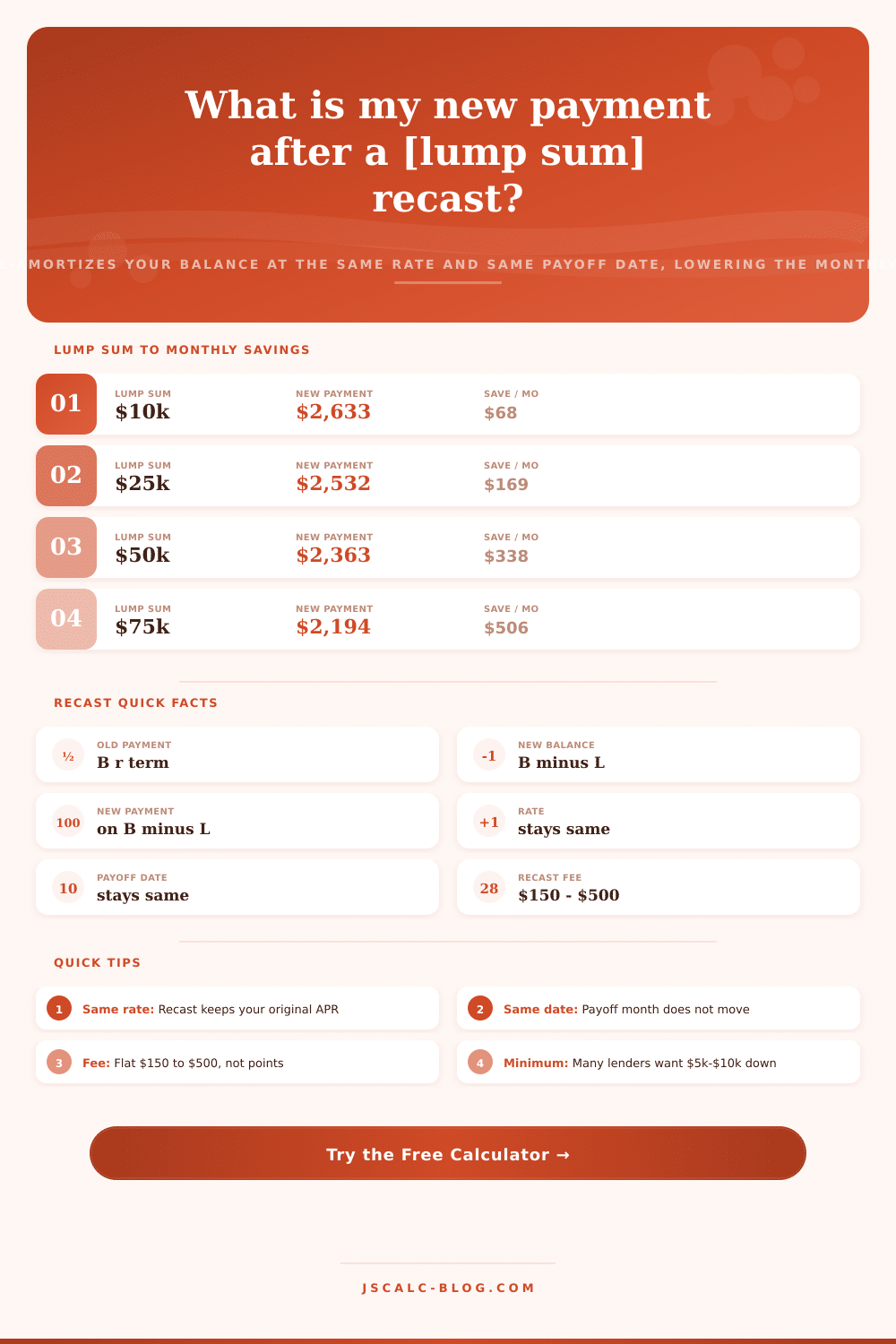
| $10,000 | $390,000 | $2,633 | $68 | $10,256 | Unchanged |
| $25,000 | $375,000 | $2,532 | $169 | $25,641 | Unchanged |
| $50,000 | $350,000 | $2,363 | $338 | $51,281 | Unchanged |
| $75,000 | $325,000 | $2,194 | $506 | $76,922 | Unchanged |
| $100,000 | $300,000 | $2,026 | $675 | $102,562 | Unchanged |
| $150,000 | $250,000 | $1,688 | $1,013 | $153,843 | Unchanged |
| $200,000 | $200,000 | $1,350 | $1,350 | $205,124 | Unchanged |
Grid assumes a $400,000 balance at 6.5% APR with 300 months (25 years) remaining. Your own numbers appear in the result cards above.
📋Typical Recast Rules by Lender Type
| Item | Common Range | Notes |
|---|---|---|
| Minimum lump sum | $5,000 - $10,000 | Some set it as a percent of balance |
| Recast fee | $150 - $500 | Flat charge, not points |
| Recasts allowed | Once per loan | A few permit more over time |
| Eligible loans | Conventional | FHA, VA, USDA usually not eligible |
| Payments current | Required | No recent late payments allowed |
| Processing time | 30 - 60 days | New payment starts next cycle after |
📏Term Length in Months
| Years Remaining | Months (n) | Example Use |
|---|---|---|
| 30 years | 360 | Brand new 30-year loan |
| 28 years | 336 | Two years into a 30-year |
| 25 years | 300 | Five years into a 30-year |
| 20 years | 240 | Halfway or a 20-year loan |
| 15 years | 180 | 15-year loan or paid down |
| 10 years | 120 | Late-stage payoff phase |
⚙Formula Breakdown
💡Recast Planning Tips
Mortgage recasting reduces your payment, but not the length of time to pay off the loan or with excessive closing costs. You send in a lump sum of principal, and the bank re-amortizes the new balance across existing term at exact same interest rate. Your monthly payment shrinks; your payoff date stays unchanged.
And this is an important difference because most borrowers believe that extra payments speeds up their debt elimination. With recasting, you stick to original schedule… While taking less from your paychecks each month. Cash flow now wins instead of speed. That’s a reason many homeowners have never heard of recasting, until they learn about it secondhand.
How Mortgage Recasting Works
Although it sounds like a lot of paperwork, it’s actualy pretty simple. Grab a sheet of paper. Write down your balance. Write down the number of months remaining on the note. Write down your existing payment. Using basic amortization math; which means the term (length) and rate determine your payment, calculate what you owe now. Apply the lump-sum. That reduces your balance. Plug that reduced amount into the equation, along with original rate and number of months remaining. Voila! Your required payment are lower.
Since interest rate remains static, you’re still enjoying the good deal you negotiated years ago. See the new payment amount for yourself without breaking out a spreadsheet thanks to the calculator here. It will also tell you exactly how much money vanishes from your future interest payments.
To illustrate this, let’s run through one of the scenarios where cost can be justified. Let’s say you have a 25-year mortgage and owe $400,000 at 6.5 percent. You’re paying ~$2,700 per month. If you recieve an inheritance or a bonus and pay off your loan in full by handing them $50,000 in cold hard cash, your balance becomes $350,000. When you recast that balance, the payment drop to ~$2,360 while retaining same 25 year time frame.
For life of the loan, you’ll save approximately $340 each month. In other words, lenders typically charge flat fees between $150 and $500. That fee will pay for itself in less than a month of savings. Any additional dollars thereafter are all gravy: no rate increase, no extended term.
Note that I’m talking about something different from the idea of throwing some extra payments against the loan each month. You might decide to increase your monthly payment, but unless you ask for the loan to be recast, your monthly payment remains unchanged: The loan will close sooner, but otherwise it’s the exact same thing. Great plan if you’d like to be out of debt at age fifty rather then sixty-five.
But what happens if your expenses increased (or your income decreased) and now you’re concerned about making the payment this year? A recast, on the other hand, reduces amount you must pay, which eases cash flow pressure. You’ll stay in low-rate position you’ve secured, and enjoy freedom to invest more or cover emergencies.
You may be tempted to go for refinancing, but here’s the thing: In most cases (especially when interest rates aren’t falling), there is far more cost to this strategy than benefit. A refi cancels out your existing mortgage. It creates a new one with a new rate and a new length, which typically resets the time limit back to thirty years. It also involves new closing costs, which can be as high as two to five percent of outstanding balance.
Recasting doesn’t do any of those things. Your old rate remains intact (so if you got a low one when rates were low, good for you, and it’ll stick around). So does your old pay-off date. And instead of wading through a full application process complete with underwriting slowdowns, your paperwork will consist of little more than single sheet.
If interest rates rose after your purchase, recasting is nearly always less expensive than refinancing in order to get lower monthly payments. The tool provides four results that clearly answer these practical questions, which is what homeowners really want to know:
One result is finding out how much less the principal-and-interest payment will be after applying the lump sum. Another: How many dollars do I save per month? What does that look like?
The third question is how much less total interest I will pay by the end of the loan, factoring in the cash you’ve paid up front. A fourth is that it won’t change the remaining term in months. Your payoff date remains intact. You’ll get all of this at once.
For example, a $100,000 windfall may seem huge and like a lot more than $25,000, yet it doesn’t have to be. Smaller contributions can shave hundreds off your monthly obligation. Because government-backed mortgages (VA, FHA) don’t typically provide this option, traditional mortgages are better candidates for recasting.
Your payments should be current, with no recent late marks, and you’ll typically need to pay a minimum lump sum of five or ten thousand dollars. It will take a month or two to process, so time it accordingly if you’re seeking relief on a certain date.
For people who have some cash sitting idly and wish to make it work harder against their debt, while preserving favorable terms on their loan, recasting is a smart move. Do the numbers before you sign anything; the monthly savings must justify initial outlay. More often than not, the math won’t lie as to whether the fee was paid back fast enough to even matter.
But ultimately, a recast is all about control. You get to take charge of your mortgage payments while maintaining the rate that you earned. And instead of having to reset your race to pay off, you don’t have to start back at zero. A recast turns a lump sum, whether it’s an inheritance, a work bonus, or money from a sold car, into a permanent reduction in your monthly payments.
This is not just a quicker escape, but a way to breathe easier on your family budget right now. There’s no denying the impact of a payment drop … and the significant interest saving you’ll get. You also keep the rate that you earned. That’s the subtle strength of a recast.