Balloon Payment Calculator
See a balloon loan the way lenders write it: payments amortized over a long 30 year schedule, but the full remaining balance due as a lump sum at a shorter 5 or 7 year balloon term. Enter your loan amount, APR, amortization years, and balloon term to get the monthly payment, the balloon due, total paid, and total interest.
🎯Real Balloon Loan Presets
📝Balloon Loan Inputs
The financed price before any down payment.
Subtracted from the amount to set the principal P.
Annual rate; monthly rate r = APR / 12 / 100.
Schedule the payment is based on, e.g. 30 years.
When the remaining balance comes due, e.g. 5 or 7.
Leave 0 to use the amortized payment above.
🔢Balloon Formula Snapshot
📊Balloon Term Comparison Grid
| Balloon Term | Monthly Payment | Payments Before | Balloon Due | Percent of Loan Left | Total Interest |
|---|---|---|---|---|---|
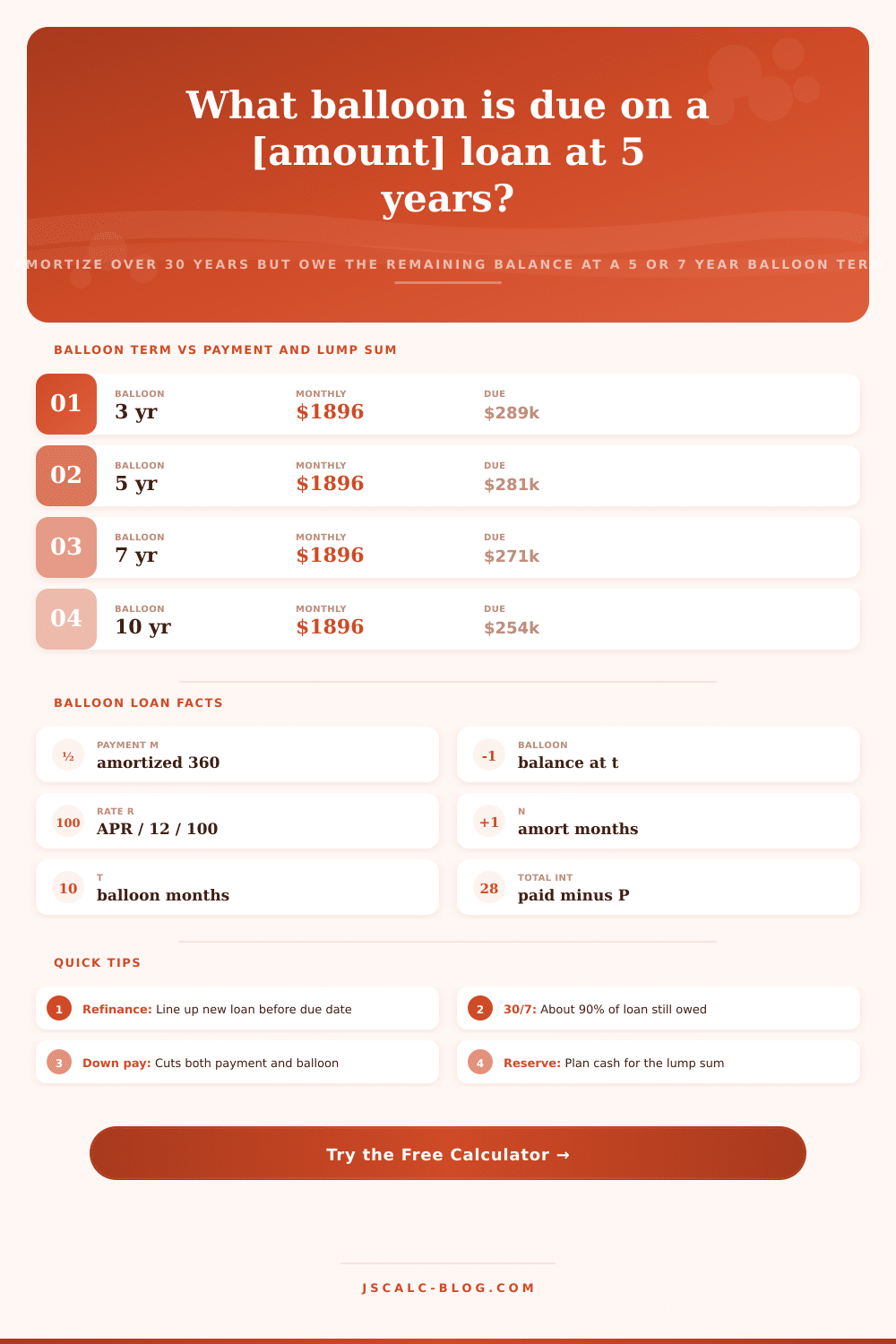
| 3 years | $1,896 | $68,263 | $289,252 | 96.4% | $57,515 |
| 5 years | $1,896 | $113,772 | $280,833 | 93.6% | $94,605 |
| 7 years | $1,896 | $159,281 | $271,249 | 90.4% | $130,530 |
| 10 years | $1,896 | $227,544 | $254,328 | 84.8% | $181,873 |
| 15 years | $1,896 | $341,316 | $217,677 | 72.6% | $258,994 |
| 20 years | $1,896 | $455,089 | $166,996 | 55.7% | $322,085 |
Same $300,000 loan at 6.5% APR amortized over 30 years. The monthly payment never changes; only the balloon due and total interest shift with the balloon term.
📋APR Sensitivity ($300k, 30 yr amort, 5 yr balloon)
| APR | Monthly Payment | Balloon Due at 5 yr | Interest in Period |
|---|---|---|---|
| 5.0% | $1,610 | $275,486 | $72,086 |
| 5.5% | $1,703 | $277,382 | $79,562 |
| 6.0% | $1,799 | $279,163 | $87,103 |
| 6.5% | $1,896 | $280,833 | $94,605 |
| 7.0% | $1,996 | $282,395 | $102,155 |
| 7.5% | $2,098 | $283,852 | $109,732 |
| 8.0% | $2,201 | $285,210 | $117,270 |
📏Amortization Term Effect ($300k, 6.5%, 5 yr balloon)
| Amortization | Monthly Payment | Balloon Due at 5 yr | Note |
|---|---|---|---|
| 15 years | $2,613 | $230,151 | Higher payment, smaller balloon |
| 20 years | $2,237 | $256,767 | Faster paydown |
| 25 years | $2,026 | $271,686 | Common commercial term |
| 30 years | $1,896 | $280,833 | Lowest payment, largest balloon |
| 40 years | $1,756 | $290,716 | Very slow equity build |
🏢Balloon vs Fully Amortized (same 30 yr, 6.5%)
| Loan Amount | Monthly Payment | Balloon at 7 yr | Interest over 7 yr |
|---|---|---|---|
| $200,000 | $1,264 | $180,832 | $87,020 |
| $300,000 | $1,896 | $271,249 | $130,530 |
| $400,000 | $2,528 | $361,665 | $174,041 |
| $500,000 | $3,160 | $452,081 | $217,551 |
| $600,000 | $3,792 | $542,497 | $261,061 |
| $750,000 | $4,741 | $678,121 | $326,325 |
⚙Formula Breakdown
💡Balloon Loan Planning Tips
Many borrowers don’t expect this question: How big would my final lump sum be if I pay every month as scheduled for 30 years, but then have to repay entire balance within five years? Enter the balloon payment calculator. By spreading your loan over a long-term schedule (e.g., 30 years), balloon loans helps you maintain lower monthly payments. They also force you to repay full balance at a far shorter maturity. This means a huge one-time payoff.
The tool will calculate your monthly payment, balloon due at term of your choice and total interest. That eliminates confusion, giving you a clear view of what’s owed when it ends.
How Balloon Loans Work
The third type is a hybrid: the balloon loan. Your monthly payment are based off a normal long-term mortgage. The kind that feels affordable. But it doesn’t run for the length of the loan. At some set date (typically five or seven years in), you’re required to make one huge payment, which covers all remaining balance. That’s the balloon.
By this point, very little of the loan amount will have been paid off. If you took out a $300,000 loan at 6.5%, you’ll owe around $280,000 after five years. In other words, you will owe about 93% of what you borrowed. Low monthly payments does not mean low total debt; you need to get that through your head.
Two clocks drive the deal. One determine the size of the payment (amortization). The other determines when the full balance is due. If we hear something like “30 over 5,” for example, that’s code for: 30 years to amortize; five years to call. Only the amortization term impact your month-to-month payment. So a “30 over 5” loan has exactly the same monthly payment as a “30 over 7” loan. The difference is more significant then the amount of principal repaid prior to the balloon. Most folks don’t understand this (but it makes a huge difference). It will either give you equity or a larger bill.
Once you understand the math, it’s pretty simple. Payments are calculated using the regular old amortization formula. A balloon is leftover amount after paying those off. It takes the remaining principal and grows it at the monthly payment rate. Then it subtracts the current value of the payments that is still owed. What remains is the balloon that will be owed. Don’t worry about deriving this stuff yourself. Let the calculator work out the algebra for you, so you can focus on the cash-flow impact.
Let’s use a worked example. A $300,000 mortgage at 6.5% over 30 years will balloon after five years. That comes to a monthly payment of $1,896. At that rate, your balance will be $280,833 after sixty payments. Those are installment payments of roughly $113,000 plus the balloon. The total is $394,000. Subtract the principal and you’ve still paid almost $95,000 in interest. And all of this has only dented the balance by a fraction. This continues until you get the bill.
But here’s the rub: The balloon term changes everything else. A longer balloon term means more payments, but the payment never moves. A seven-year term will have more money left on it than a three-year term. After ten years of payments, you’re still carrying over 84% of your original loan! That shows just how slowly principal are paid off during the first few years of a thirty year schedule. You’re paying for time, not reduction.
There are two levers you can pull to reduce your risk: First, there’s the principal reduction of the down payment itself. Second, there’s the time dimension. You can pay it off over fewer years. Paying off the loan over 25 instead of 30 years increases your monthly cost, but also speeds up principal repayment. That decreases your balloon dramaticly by the end of five years. That’s a tradeoff between current cash flow versus future debt.
An exit strategy means planning out your exit far in advance, which is the key habit for a balloon loan. Usually that means selling the house, refinancing, or paying off the balance with savings. You should of planned earlier. Don’t wait till the last few months to secure financing. Interest rates might be higher. The value of the property could be lower.
Plan like this is a pre-scheduled refinancing. Maintain cash reserves and keep your credit in shape. Use the calculator to size up your target. Your task is to swing and connect before time expires.