Adjustable Rate Mortgage Payment Calculator
Model a 5/1, 7/1, or 10/1 ARM end to end. See your low intro fixed payment, the fully-indexed reset payment once the fixed period ends (index plus margin, held down by your caps), and the worst-case payment if the rate climbs to the lifetime cap.
🎯Real ARM Product Presets
📝Loan and ARM Terms
Original financed balance in dollars.
Total payoff schedule the payment amortizes over.
Years the intro rate stays fixed before the first reset.
Low teaser rate charged during the fixed period.
Benchmark such as SOFR or the 1-yr Treasury at reset.
Fixed spread the lender adds on top of the index.
Max the rate can move at the very first reset.
Max change at each later adjustment (reference).
Ceiling above intro rate for the whole loan life.
Controls how payments and balance display.
🔢Rate Snapshot
📋Common ARM Cap Structures
| Cap Notation | Initial | Periodic | Lifetime | Reads As |
|---|---|---|---|---|
| 2/2/5 | 2% | 2% | 5% | Most common hybrid |
| 5/2/5 | 5% | 2% | 5% | Bigger first jump |
| 2/1/5 | 2% | 1% | 5% | Gentle later steps |
| 1/1/5 | 1% | 1% | 5% | Very borrower-friendly |
| 5/2/6 | 5% | 2% | 6% | Older 1-yr ARM |
| 2/2/6 | 2% | 2% | 6% | Higher ceiling |
| 3/2/6 | 3% | 2% | 6% | FHA hybrid style |
📊Fully-Indexed Rate = Index + Margin
| Index | Index Rate | Margin | Fully Indexed | Typical Use |
|---|---|---|---|---|
| 30-day SOFR | 4.30% | 2.75% | 7.05% | New 5/6, 7/6 ARMs |
| 1-yr Treasury | 4.00% | 2.75% | 6.75% | Legacy 5/1, 7/1 |
| 1-yr CMT | 4.10% | 2.25% | 6.35% | Conforming ARM |
| Prime Rate | 7.50% | 0.00% | 7.50% | HELOC-linked |
| 12-mo MTA | 3.80% | 2.50% | 6.30% | Option ARM era |
| COFI | 3.20% | 2.90% | 6.10% | Regional lenders |
🗃ARM Type vs Payment Comparison Grid
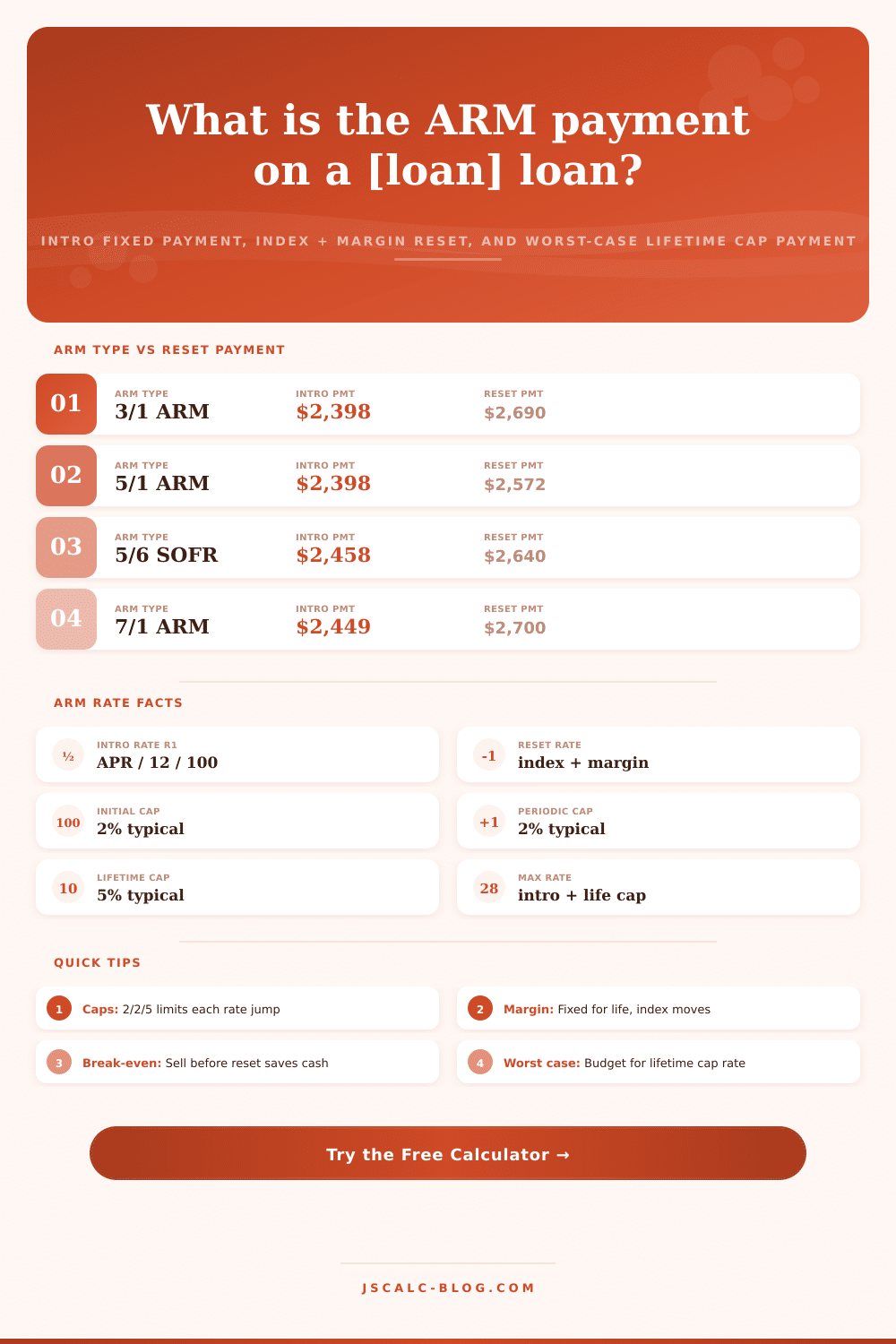
| ARM Type | Fixed Yrs | Intro Payment | Reset Payment | Worst-Case Max | Balance at Reset |
|---|---|---|---|---|---|
| 3/1 ARM | 3 yrs | $2,398 | $2,656 | $3,829 | $385,010 |
| 5/1 ARM | 5 yrs | $2,398 | $2,572 | $3,648 | $372,217 |
| 5/6 SOFR | 5 yrs | $2,458 | $2,640 | $3,700 | $372,900 |
| 7/1 ARM | 7 yrs | $2,449 | $2,681 | $3,595 | $355,180 |
| 7/6 SOFR | 7 yrs | $2,449 | $2,690 | $3,620 | $355,180 |
| 10/1 ARM | 10 yrs | $2,528 | $2,762 | $3,480 | $325,900 |
| 10/6 SOFR | 10 yrs | $2,528 | $2,770 | $3,510 | $325,900 |
| Jumbo 10/1 | 10 yrs | $5,370 | $5,865 | $7,390 | $692,540 |
⚙Formula Breakdown
💰Rate Reset Payment Reference ($400k, 25 yrs left)
| Reset Rate | Monthly Payment | vs 6% Intro | Yearly Change |
|---|---|---|---|
| 6.00% | $2,398 | Same | $0 |
| 7.00% | $2,646 | +$248 | +$2,976 |
| 8.00% | $2,903 | +$505 | +$6,060 |
| 9.00% | $3,166 | +$768 | +$9,216 |
| 10.00% | $3,435 | +$1,037 | +$12,444 |
| 11.00% | $3,710 | +$1,312 | +$15,744 |
💡ARM Strategy Tips
Deciding to take an ARM is financial decision about where you see yourself living over time. By agreeing to smaller monthly payments now, you’re taking risk of paying more in interest when (or if) you decide to sell or refinance property. That’s risky, but it isn’t reckless, as long as you know what kind of loan you have.
The calculator display the starting payment and reset payment. It also shows maximum payment if rates hit their legal limit.
How an Adjustable-Rate Mortgage Works
An adjustable-rate mortgage (ARM) is simple to understand, typically written as two numbers like 5/1 or 7/1. These number represent duration in years that interest rate stays the same. In other words, the first five or seven year of the loan are at a promotional rate; typically lower than current market rate on a traditional, 30-year fixed-rate mortgage. You’ll save money monthly.
The second number represent the frequency of the rate adjustment following the end of the fixed-rate term. A 5/1 ARM means it adjust once a year after fifth anniversary of your loan; you need to check market conditions and adjust your budget accordingly annually thereafter.
While the initial payment amount isn’t as significant as many think (anyone with a calculator knows how to do that), the part that realy counts is outstanding balance at the end of your set period. By then, youve paid down your mortgage and owe less then you did initially. The calculator use existing principal, i.e., what you owe today, and re-applies new rate against it for the remainder of term. That’s why most borrowers mistakenly assume they’ll see a spike in their payment due to initial loan amount; instead, it spikes due to the outstanding balance.
A margin plus an index equal a new rate. The margin is always constant; the index fluctuate with economic conditions. For example, you might be tied to one-year Treasury, or SOFR, for the index. Add those together, and you get fully indexed rate. Your caps will limit increase if that total exceeds your cap amount.
Caps are legal limit on how far your rate can adjust in any given period. For example, a popular format is 2/2/5 caps. This means the rate jump two percent at initial reset, then maxes out at two percent annually after that. There is also lifetime max of five percent above the intro rate. The lifetime cap is worst case. Your payment may go up (if interest rates spike), but that’s as far as it goes.
You’ll see how much you would of paid each month on the calculator. If it’s still affordable for you, the adjustable rate mortgage is a risky vehicle where you stand to save some cash early on. If it doesn’t fit in your budget, then don’t take the risk.
A common reason why many homeowners opt for an adjustable-rate mortgage is that they intend to sell prior to time their rate adjusts. If you’re confident you can predict your timetable, this can be a smart move, though life happens. Markets turn upside down, jobs change, and next thing you know you would prefer to hang onto the property longer then anticipated.
The comparison chart enable you to see at-a-glance which type of adjustable-rate mortgage would best suit your needs. For example, with a slight increase in initial rate for a 7/1 loan, you could gain up to two additional years of security different than a 5/1 loan.
While an ARM isn’t right for everyone, it can be the right solution in certain circumstances. It works if you think rates are going to decline before your fixed term ends. It also works if you have a solid plan for leaving home during the fixed phase. But don’t forget that there’s some arithmetic involved with the adjustable-rate move.
Don’t let yourself get excited by teaser rate alone. Consider the lifetime maximum, and consider the reset payment. Is that a number that concerns you? Then stick with a fixed rate. Otherwise, enjoy the reduced upfront expense.