Mortgage Rate Buydown Calculator
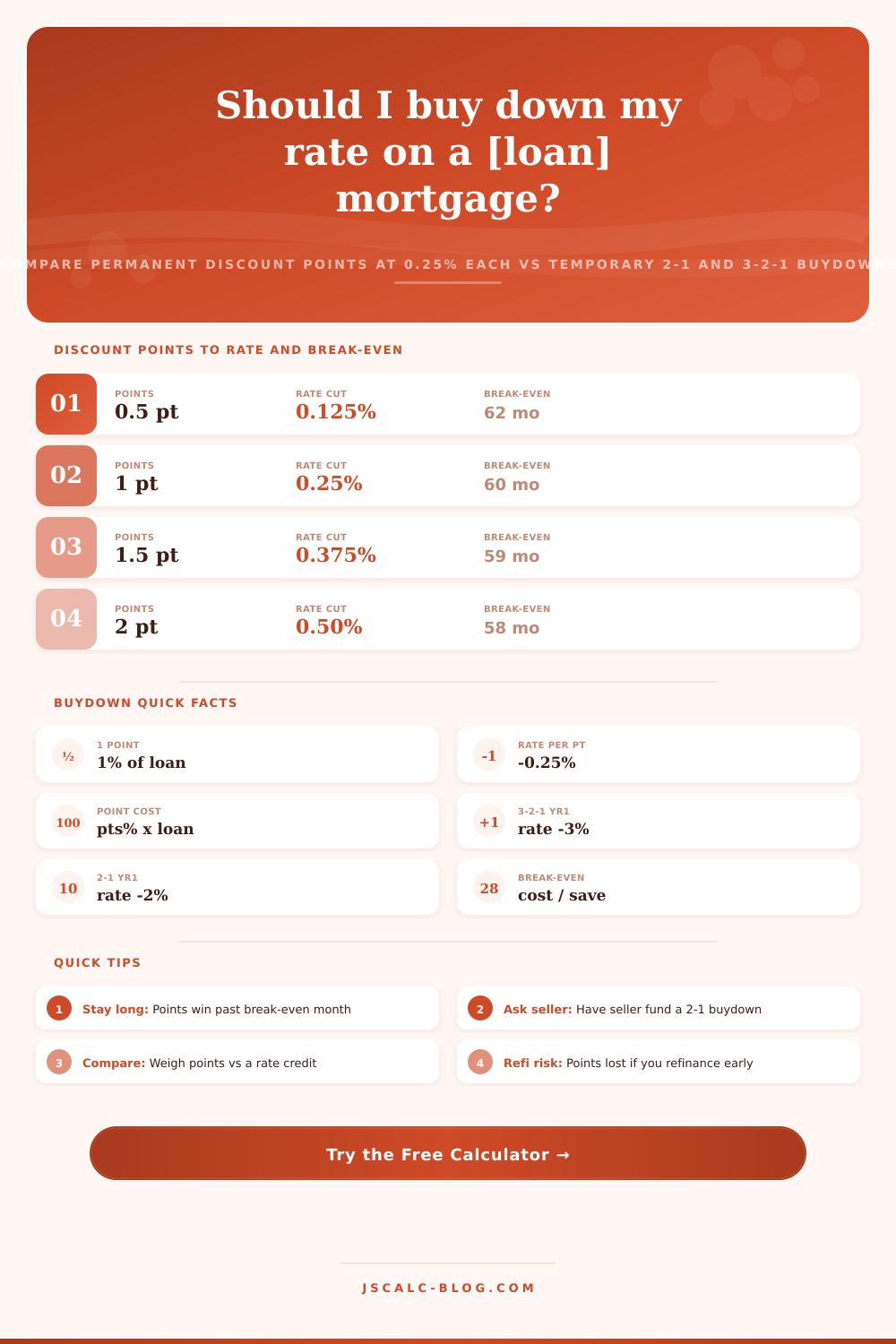
Price a permanent rate buydown with discount points, where each point costs 1% of the loan and typically shaves about 0.25% off your rate for the life of the loan, or model a temporary 2-1 or 3-2-1 buydown that steps the rate up over the first years. See your new payment, monthly savings, break-even month, and the total buydown cost.
🏠Choose a Buydown Type
🎯Real Buydown Scenarios
📝Loan and Buydown Inputs
Financed principal, not the purchase price.
Amortization length, usually 30 or 15 years.
Quoted rate before any buydown is applied.
Each point costs 1% of the loan amount.
Typical is 0.25% off the rate for each point.
Standard is 1%; some lenders vary this.
Rate steps back up to the note rate after.
Affects who covers the escrow subsidy cost.
Controls how result dollars are displayed.
🔢Formula Snapshot
📋Discount Points to Rate and Cost
| Points | Cost on $400k | Rate Cut | New Rate from 7% |
|---|---|---|---|
| 0.5 | $2,000 | 0.125% | 6.875% |
| 1.0 | $4,000 | 0.25% | 6.75% |
| 1.5 | $6,000 | 0.375% | 6.625% |
| 2.0 | $8,000 | 0.50% | 6.50% |
| 2.5 | $10,000 | 0.625% | 6.375% |
| 3.0 | $12,000 | 0.75% | 6.25% |
| 3.5 | $14,000 | 0.875% | 6.125% |
| 4.0 | $16,000 | 1.00% | 6.00% |
📊Temporary Buydown Rate Steps
| Schedule | Year 1 Rate | Year 2 Rate | Year 3 Rate | Year 4+ Rate |
|---|---|---|---|---|
| 3-2-1 | Note -3% | Note -2% | Note -1% | Note rate |
| 2-1 | Note -2% | Note -1% | Note rate | Note rate |
| 1-0 | Note -1% | Note rate | Note rate | Note rate |
| 1-1 | Note -1% | Note -1% | Note rate | Note rate |
| 2-2-1 | Note -2% | Note -2% | Note -1% | Note rate |
| 3-2-1 at 7% | 4.00% | 5.00% | 6.00% | 7.00% |
| 2-1 at 7% | 5.00% | 6.00% | 7.00% | 7.00% |
💵Payment by Rate on a $400k, 30-Year Loan
| Rate | Monthly P and I | Vs 7% Payment | Yearly Savings |
|---|---|---|---|
| 7.00% | $2,661.21 | baseline | - |
| 6.75% | $2,594.39 | -$66.82 | $801.84 |
| 6.50% | $2,528.27 | -$132.94 | $1,595.28 |
| 6.25% | $2,462.87 | -$198.34 | $2,380.08 |
| 6.00% | $2,398.20 | -$263.01 | $3,156.12 |
| 5.00% | $2,147.29 | -$513.92 | $6,167.04 |
| 4.00% | $1,909.66 | -$751.55 | $9,018.60 |
🗃Points Comparison Grid (7% base, $400k, 30-yr)
| Points | Point Cost | New Rate | New Payment | Monthly Savings | Break-Even |
|---|---|---|---|---|---|
| 0.5 | $2,000 | 6.875% | $2,627.75 | $33.46 | 60 mo |
| 1.0 | $4,000 | 6.75% | $2,594.39 | $66.82 | 60 mo |
| 1.5 | $6,000 | 6.625% | $2,561.20 | $100.01 | 60 mo |
| 2.0 | $8,000 | 6.50% | $2,528.27 | $132.94 | 60 mo |
| 2.5 | $10,000 | 6.375% | $2,495.44 | $165.77 | 60 mo |
| 3.0 | $12,000 | 6.25% | $2,462.87 | $198.34 | 60 mo |
| 3.5 | $14,000 | 6.125% | $2,430.47 | $230.74 | 61 mo |
| 4.0 | $16,000 | 6.00% | $2,398.20 | $263.01 | 61 mo |
⚙Formula Breakdown
💡Buydown Strategy Tips
At some point, everyone finds out how much mortgage math resemble a hostage negotiation rather than good old-fashioned arithmetic. It usually happens at the closing table. You are looking at numbers that will control your budget for the next 30 years, and then somebody says something about buying down the rate. On the face of it, this sounds easy: I’ll give you money today if you give me a break on my interest tomorrow. But the way the tradeoff works make all the difference.
Buying down the rate isn’t one product; it’s two entirely distinct financial products with the same laid-back name. One of them subsidizes your initial months worth of payment until true rate kicks in. The other permanently alters terms of your loan. Don’t confuse the two, or you’re going to make an expensive mistake. This is especially true if you’re deciding whether to take the cash up front in exchange for some relief on future monthly payments.
Buying Down Your Mortgage Rate: A Simple Guide
Discount points are a permanent buydown. What’s a point? A point equals one percent of the principal balance of your mortgage. For example: if you have a $400,000 mortgage, each point will cost you $4,000. And what do you get in return? You get a reduced interest rate (by a quarter percentage point) for the life of the loan.
The amortization math is all figured out for you in the calculator I mentioned above, and yes, it will tell you how much your monthly payment decreases. But more importantly, it will tell you when the savings add up to equal the upfront cost. This is known as the break-even month, it’s the most critical number here. If you’re not going to be living in this house long enough to reach the break-even month, then you lost money by purchasing points. Basically, you’re paying extra interest to get the hell out early.
How does this compare to temporary buydowns? Temporary buydowns don’t reduce your note rate. Rather, they put a lump sum into escrow that will subsidize part of your payment for next couple of years. For example, a 3-2-1 buydown means your rate will be 3 percent below your note in year one, 2 percent below in year two and 1 percent below in year three, before rising back to the full rate.
Why is this so popular? Because it smooths out the shock of a higher mortgage payment after moving in. You may not have adjusted your income to match your new standard of living just yet. A lower payment at the outset buys you some breathing room.
Who pays? That’s where temporary buydowns can offer a significant advantage. If a builder or seller is willing to pay, that’s essentially a concession they’ll make in order to sell. This is very common in many markets. You receive the same benefit of reduced monthly payments, no strings attached… But don’t have to dip into your own cash reserves. This allows you to negotiate a lower price while keeping your down payment intact and maintaining a healthy loan-to-value ratio.
By toggling between modes, the tool lets you model these scenarios. You can see how much it costs to pay for permanent points out-of-pocket versus what you would save by accepting a temporary subsidy from the seller.
People often overthink the break-even calculation for permanent points. Oh man, I ran the numbers. Five or six years… nope. It is not worth it. But the truth is, life doesn’t follow a straight line. Market shifts, job changes, family growth, these all impact your actual holding period on any given mortgage. Permanent points tend to be the right math if you think there’s a decent chance you’ll put down roots somewhere (and yes, pretty much every one of us will, at some point). Then, the compounding savings just keep adding up decade after decade.
If you’re not sure about this, OR if your cashflow is already pretty tight, then temporary buydown gives you immediate relief while removing the lock-in of having to hit a long-term break-even goal. Ultimately, this all boils down to liquidity and timeline. Can you afford the rate for the life of the loan? Do you want/need to reduce your payments today, potentially with help from others, in order to make it work over the first few years? No one will tell you what’s right; that question depends entirely based off where you are headed financially.
If you run the numbers using the reference tables in the tool, you can see the raw data for each schedule and point value. These tables helps anchor your intuition in concrete dollars instead of theoretical percentages. Then, as you see the “break even” month next to the time period you expect to live in this home, the right option will become clear, most times.
You might be purchasing a discounted rate. What you’re buying is peace of mind, on your own terms. That might be a cushion to buy you time … or it might be a permanent reduction based off your future plans. Just ensure that the math matches the life you think you are living.