Mortgage Insurance (PMI) Calculator
Estimate your monthly and annual private mortgage insurance premium from your loan-to-value ratio and credit score, then see how many months of PMI you will pay before the balance reaches 80 percent LTV and PMI can be removed, along with the total PMI cost over that window.
🎯Real PMI Scenarios
📝Loan and Borrower Inputs
Contract price or appraised value of the property.
Choose how you want to enter your down payment.
Percent (e.g. 5) or dollars (e.g. 15000) per the mode above.
Higher scores earn a lower PMI rate for the same LTV.
Auto uses a typical rate table; manual lets you type a quote.
Used only when the source above is set to manual.
Drives how fast principal is paid toward 80 percent LTV.
Shorter terms build equity faster and drop PMI sooner.
🔢Formula Snapshot
📊PMI Rate by LTV and Credit Score
| Credit Score | LTV 80-85% | LTV 85-90% | LTV 90-95% | LTV 95-97% |
|---|---|---|---|---|
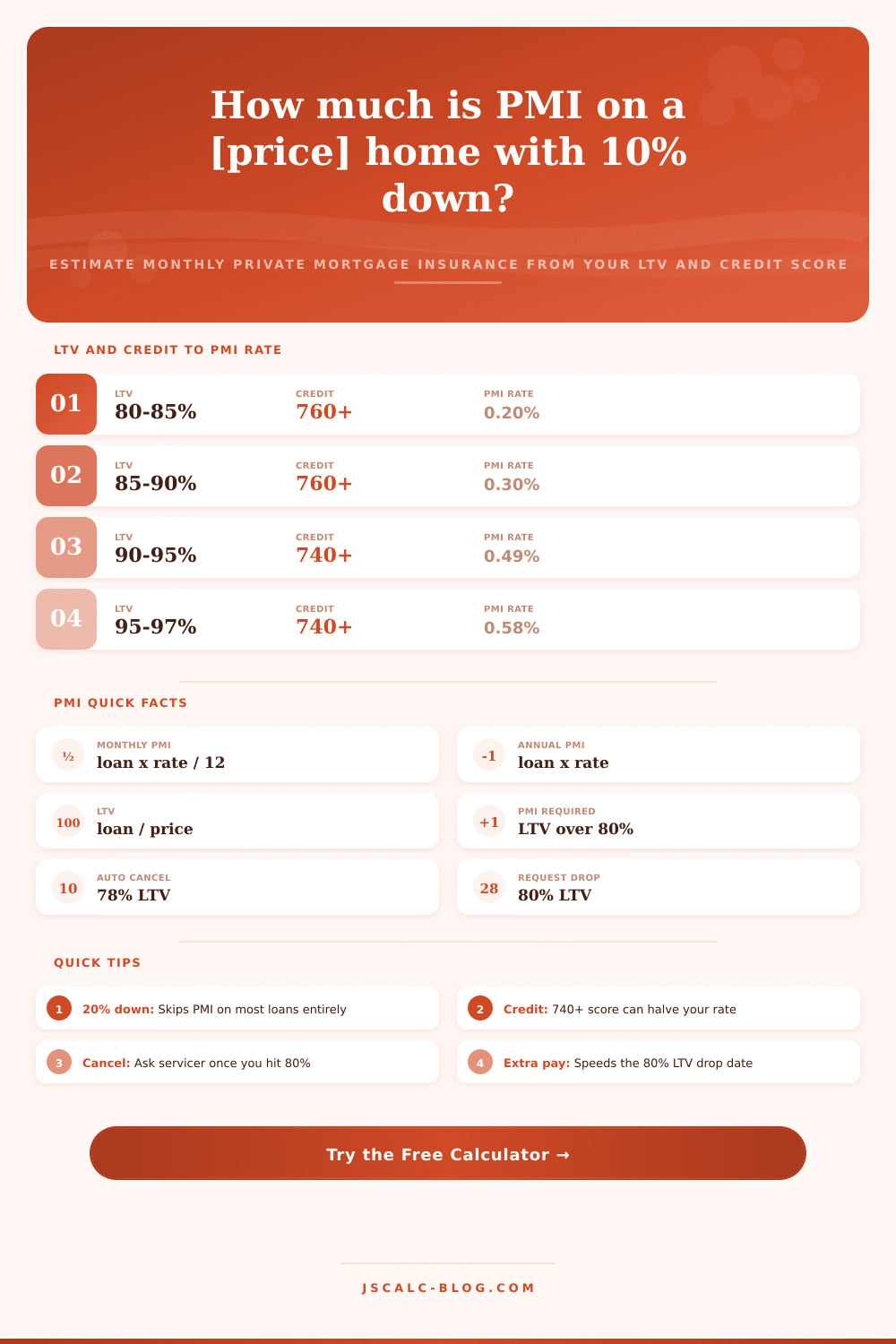
| 760 and above | 0.20% | 0.30% | 0.49% | 0.58% |
| 740 to 759 | 0.25% | 0.37% | 0.54% | 0.66% |
| 720 to 739 | 0.28% | 0.42% | 0.62% | 0.75% |
| 700 to 719 | 0.35% | 0.55% | 0.79% | 0.94% |
| 680 to 699 | 0.43% | 0.65% | 0.94% | 1.13% |
| 660 to 679 | 0.55% | 0.82% | 1.10% | 1.35% |
| 640 to 659 | 0.68% | 0.98% | 1.24% | 1.52% |
| 620 to 639 | 0.79% | 1.08% | 1.37% | 1.62% |
💵Down Payment to LTV Guide
| Down Payment | Loan-to-Value | PMI Needed | Typical Rate |
|---|---|---|---|
| 3% | 97% | Yes | 0.58% to 1.6% |
| 3.5% (FHA) | 96.5% | MIP for life* | 0.55% MIP |
| 5% | 95% | Yes | 0.49% to 1.6% |
| 10% | 90% | Yes | 0.30% to 1.1% |
| 15% | 85% | Yes | 0.20% to 0.8% |
| 18% | 82% | Yes | 0.19% to 0.7% |
| 20% | 80% | No PMI | None |
| 25% | 75% | No PMI | None |
💰Monthly PMI by Loan Amount and Rate
| Loan Amount | 0.30% | 0.50% | 0.75% | 1.00% | 1.50% |
|---|---|---|---|---|---|
| $150,000 | $38 | $63 | $94 | $125 | $188 |
| $200,000 | $50 | $83 | $125 | $167 | $250 |
| $250,000 | $63 | $104 | $156 | $208 | $313 |
| $300,000 | $75 | $125 | $188 | $250 | $375 |
| $400,000 | $100 | $167 | $250 | $333 | $500 |
| $500,000 | $125 | $208 | $313 | $417 | $625 |
| $600,000 | $150 | $250 | $375 | $500 | $750 |
⚙Formula Breakdown
📋PMI Milestones You Should Know
| Milestone | LTV | What Happens | Action |
|---|---|---|---|
| Loan closes | Over 80% | PMI starts | Budget the premium |
| Request removal | 80% | You may cancel | Write servicer |
| Automatic termination | 78% | Lender cancels | Happens on schedule |
| Midpoint of loan | Varies | PMI ends by law | No request needed |
| New appraisal | 80% or less | Early removal | Pay for appraisal |
| Extra principal | Reaches 80% fast | PMI drops sooner | Add to principal |
*FHA loans use MIP rather than PMI. With less than 10 percent down, FHA MIP typically lasts the life of the loan unless refinanced. This calculator estimates conventional PMI and applies the same math to an FHA MIP rate for comparison.
💡PMI Money-Saving Tips
Almost every buyer who makes less than a 20% down payment is surprised by this question: How much more per month will my mortgage be? For how many months? The answer comes in a feature of our mortgage calculator above called “private mortgage insurance” (PMI). It’s there because lenders want to protect themselves; you don’t need protection. But it falls right onto your budget line. Enter your loan-to-value ratio and credit score (the two most important numbers) into the calculator below. It will estimate both your monthly and annual PMI premiums, then project how many months, or years!, you’ll be carrying it.; you’ll be carrying it, before it goes away. If you put less than twenty percent down on a house, you’ll have to pay for private mortgage insurance, a policy which insures the lender in case you default on the loan. Because the low down payment makes the loan larger, the lender has less of a safety net if the borrower fails to make payments. Therefore, the lender charges a premium for taking on this additional risk. PMI is typically required on conventional mortgages as soon as the loan-to-value ratio exceeds eighty percent. This means that as long as your LTV is below eighty percent, your loan doesn’t need PMI. Unlike some fees, PMI isn’t something that provides you with any direct benefit; rather, it’s often simply the cost of purchasing a home several years sooner then you would if you were forced to wait until you had saved up a full twenty percent. If you’re aware of the duration of the insurance period, then that tradeoff is one worth making. But when you know what goes in, the math is refreshingly straightforward. Annual PMI = (loan) x (annual PMI rate). Monthly premium = (annual PMI) / 12. In other words, monthly PMI = (loan) x (PMI rate) / 12. (Loan) = (home price), (down payment). If you’re considering a house for three hundred thousand dollars and you’ve got five percent down, then your loan will be two hundred eighty-five thousand. With a zero point five eight percent PMI rate, you’ll pay an annual premium of approximately one thousand six hundred fifty-three dollars. Which breaks down to around one hundred thirty-eight per month. This calculator lets you plug in your own figures for this equation, and it displays all of the middle values in a breakdown panel. The PMI rate is shown below. This is not a nationwide figure. There are two inputs: 1) Your LTV (loan-to-value), where LTV = loan / price x 100; a 97% LTV (three percent down) is riskier than 90% LTV (ten percent down). So, it costs more. 2) This is about your credit score. If both of these variables stay constant; such as if a borrower’s LTV changes slightly due to rising home prices, then the PMI rate will change only if your credit score moves. A borrower with a score of seven hundred sixty and above may get charged zero point five eight percent compared with a borrower hovering around six hundred twenty who might be charged more than one point six percent for the exact same mortgage. Common PMI rates range between roughly zero point two percent annually for good borrowers with large down payments and as high as two percent for the most risky combinations. You can enter the PMI rate manually, or the calculator has a built-in table of suggestions that will auto-calculate based on your inputs. But this doesn’t mean the PMI will last forever. You have the right to cancel PMI as soon as your balance reaches 80% of the purchase price. This triggers the lender to automatically cancel the policy once the LTV drops below 78%. To calculate how long it will take to get to that 80%, the calculator assumes your loan terms and interest rate and then steps down the monthly balance in a real amortization schedule until it reaches 80%. On a $300k house, for instance, the target balance (to drop PMI) would be $240k. Your term and APR are huge factors in determining how many months later this will occur. A 30-year mortgage with high interest starts off paying most of its money to interest. This means the early part of your schedule is almost entirely about paying back interest. However, if you’ve got a 15-year loan, you’ll shave years off your PMI. There are four cards to every calculation. This is the dollar amount your mortgage payments get increased with. Times this by 12, and you have the annual PMI cost. This is great when shopping around for quotes. The months until PMI drops estimates how long you will pay, converted to years for a quick gut check. Finally, multiply the monthly PMI premium by the number of months, then you know the grand total of PMI paid over the life of the loan. That’s the number no buyer ever sees on their nose, unless they’re reading this blog first. It totals several thousand dollars, so it’s totally worth knowing before you sign. And it loads ten real scenarios for you to play side-by-side: A 5% downpayment on a $300K house with good credit. An FHA style three-and-a-half-percent purchase. One scenario involves high PMI because the buyer has fair credit. There is also a 15% downpayment that reduces his premium size. The tool will let you input your down payment as a dollar figure or as a percentage. Use whichever one makes more sense to you when considering the purchase, and it’ll convert it for you when necessary. If you change the loan term or the credit band, it instantly changes the rate and the timeline and the whole picture. You have levers to pull here: Credit + LTV = PMI. Even a couple of additional percentage points will move you down the rate tiers and shave time off the payout. The best single money-saver here is usually improving your credit score before locking the loan. If you’re paying a six hundred twenty versus a seven hundred sixty rate at high LTV, that’s a difference of over two hundred forty bucks a month on average in this era. That difference drops even more as you increase your LTV. If you add an extra principal payment per month once you become the owner, the balance will reach the eighty percent mark even quicker. You can then mail them a letter canceling the coverage the instant you hit it, instead of waiting until they automatically cut you off at seventy-eight percent. You can also get a new appraisal when home prices go up, which may knock you below the bar sooner. Maybe you are shopping for lender rates or planning to cancel your PMI. You might also be a first-time homebuyer wondering if you should buy now with a low down payment. This PMI calculator turns that confusing line item into simple, easy-to-defend numbers. Select a preset, tweak the price, downpayment, term, and credit band to fit your situation, then read the formula breakdown and the four cards. Before you sign on the dotted line, know what you’ll be paying each month and how much it will cost you over time. Also, know when you’ll have paid off enough of the property to stop. That is how you save. Almost every buyer who makes less than a 20% down payment is surprised by this question: How much more per month will my mortgage be? For how many months? The answer comes in a feature of our mortgage calculator above called “private mortgage insurance” (PMI). It’s there because lenders want to protect themselves; you don’t need protection. But it falls right onto your budget line. Enter your loan-to-value ratio and credit score (the two most important numbers) into the calculator below. It will estimate both your monthly and annual PMI premiums, then project how many months, or years!; you’ll be carrying it. (you’ll be carrying it), before it goes away. If you put less than twenty percent down on a house, you’ll have to pay for private mortgage insurance, a policy which insures the lender in case you default on the loan. Because the low down payment makes the loan larger, the lender has less of a safety net if the borrower fails to make payments. Therefore, the lender charges a premium for taking on this additional risk. PMI is typically required on conventional mortgages as soon as the loan-to-value ratio exceeds eighty percent. This means that as long as your LTV is below eighty percent, your loan doesn’t need PMI. Unlike some fees, PMI isn’t something that provides you with any direct benefit; rather, it’s often simply the cost of purchasing a home several years sooner then you would if you were forced to wait until you had saved up a full twenty percent. If you’re aware of the duration of the insurance period, then that tradeoff is one worth making. But when you know what goes in, the math is refreshingly straightforward. Annual PMI = (loan) x (annual PMI rate). Monthly premium = (annual PMI) / 12. In other words, monthly PMI = (loan) x (PMI rate) / 12. (Loan) = (home price), (down payment). If you’re considering a house for three hundred thousand dollars and you’ve got five percent down, then your loan will be two hundred eighty-five thousand. With a zero point five eight percent PMI rate, you’ll pay an annual premium of approximately one thousand six hundred fifty-three dollars… Which breaks down to around one hundred thirty-eight per month. This calculator lets you plug in your own figures for this equation, and it displays all of the middle values in a breakdown panel. The PMI rate is shown below. This is not a nationwide figure. There are two inputs: 1) Your LTV (loan-to-value), where LTV = loan / price x 100; a 97% LTV (three percent down) is riskier than 90% LTV (ten percent down). So, it costs more. 2) This is about your credit score. If both of these variables stay constant… Such as if a borrower’s LTV changes slightly due to rising home prices, then the PMI rate will change only if your credit score moves. A borrower with a score of seven hundred sixty and above may get charged zero point five eight percent compared with a borrower hovering around six hundred twenty who might be charged more than one point six percent for the exact same mortgage. Common PMI rates range between roughly zero point two percent annually for good borrowers with large down payments and as high as two percent for the most risky combinations. You can enter the PMI rate manually, or the calculator has a built-in table of suggestions that will auto-calculate based on your inputs. But this doesn’t mean the PMI will last forever. You have the right to cancel PMI as soon as your balance reaches 80% of the purchase price. This triggers the lender to automatically cancel the policy once the LTV drops below 78%. To calculate how long it will take to get to that 80%, the calculator assumes your loan terms and interest rate and then steps down the monthly balance in a real amortization schedule until it reaches 80%. On a $300k house, for instance, the target balance (to drop PMI) would be $240k. Your term and APR are huge factors in determining how many months later this will occur. A 30-year mortgage with high interest starts off paying most of its money to interest. This means the early part of your schedule is almost entirely about paying back interest. However, if you’ve got a 15-year loan, you’ll shave years off your PMI. There are four cards to every calculation. This is the dollar amount your mortgage payments get increased with. Times this by 12, and you have the annual PMI cost. This is great when shopping around for quotes. The months until PMI drops estimates how long you will pay, converted to years for a quick gut check. Finally, multiply the monthly PMI premium by the number of months, then you know the grand total of PMI paid over the life of the loan. That’s the number no buyer ever sees on their nose, unless they’re reading this blog first. It totals several thousand dollars, so it’s totally worth knowing before you sign. And it loads ten real scenarios for you to play side-by-side: A 5% downpayment on a $300K house with good credit. An FHA style three-and-a-half-percent purchase. One scenario involves high PMI because the buyer has fair credit. There is also a 15% downpayment that reduces his premium size. The tool will let you input your down payment as a dollar figure or as a percentage. Use whichever one makes more sense to you when considering the purchase, and it’ll convert it for you when necessary. If you change the loan term or the credit band, it instantly changes the rate and the timeline and the whole picture. You have levers to pull here: Credit + LTV = PMI. Even a couple of additional percentage points will move you down the rate tiers and shave time off the payout. The best single money-saver here is usually improving your credit score before locking the loan. If you’re paying a six hundred twenty versus a seven hundred sixty rate at high LTV, that’s a difference of over two hundred forty bucks a month on average in this era. That difference drops even more as you increase your LTV. If you add an extra principal payment per month once you become the owner, the balance will reach the eighty percent mark even quicker. You can then mail them a letter canceling the coverage the instant you hit it, instead of waiting until they automatically cut you off at seventy-eight percent. You can also get a new appraisal when home prices go up, which may knock you below the bar sooner. Maybe you are shopping for lender rates or planning to cancel your PMI. You might also be a first-time homebuyer wondering if you should buy now with a low down payment. This PMI calculator turns that confusing line item into simple, easy-to-defend numbers. Select a preset, tweak the price, downpayment, term, and credit band to fit your situation, then read the formula breakdown and the four cards. Before you sign on the dotted line, know what you’ll be paying each month and how much it will cost you over time. Also, know when you’ll have paid off enough of the property to stop. That is how you save. Almost every buyer who makes less than a 20% down payment is surprised by this question: How much more per month will my mortgage be? For how many months? The answer comes in a feature of our mortgage calculator above called “private mortgage insurance” (PMI). It’s there because lenders want to protect themselves; you don’t need protection. But it falls right onto your budget line. Enter your loan-to-value ratio and credit score (the two most important numbers) into the calculator below. It will estimate both your monthly and annual PMI premiums, then project how many months; or years!; you’ll be carrying it… You’ll be carrying it, before it goes away. If you put less than twenty percent down on a house, you’ll have to pay for private mortgage insurance, a policy which insures the lender in case you default on the loan. Because the low down payment makes the loan larger, the lender has less of a safety net if the borrower fails to make payments. Therefore, the lender charges a premium for taking on this additional risk. PMI is typically required on conventional mortgages as soon as the loan-to-value ratio exceeds eighty percent. This means that as long as your LTV is below eighty percent, your loan doesn’t need PMI. Unlike some fees, PMI isn’t something that provides you with any direct benefit; rather, it’s often simply the cost of purchasing a home several years sooner then you would if you were forced to wait until you had saved up a full twenty percent. If you’re aware of the duration of the insurance period, then that tradeoff is one worth making. But when you know what goes in, the math is refreshingly straightforward. Annual PMI = (loan) x (annual PMI rate). Monthly premium = (annual PMI) / 12. In other words, monthly PMI = (loan) x (PMI rate) / 12. (Loan) = (home price); (down payment). If you’re considering a house for three hundred thousand dollars and you’ve got five percent down, then your loan will be two hundred eighty-five thousand. With a zero point five eight percent PMI rate, you’ll pay an annual premium of approximately one thousand six hundred fifty-three dollars; which breaks down to around one hundred thirty-eight per month. This calculator lets you plug in your own figures for this equation, and it displays all of the middle values in a breakdown panel. The PMI rate is shown below. This is not a nationwide figure. There are two inputs: 1) Your LTV (loan-to-value), where LTV = loan / price x 100; a 97% LTV (three percent down) is riskier than 90% LTV (ten percent down). So, it costs more. 2) This is about your credit score. If both of these variables stay constant, such as if a borrower’s LTV changes slightly due to rising home prices, then the PMI rate will change only if your credit score moves. A borrower with a score of seven hundred sixty and above may get charged zero point five eight percent compared with a borrower hovering around six hundred twenty who might be charged more than one point six percent for the exact same mortgage. Common PMI rates range between roughly zero point two percent annually for good borrowers with large down payments and as high as two percent for the most risky combinations. You can enter the PMI rate manually, or the calculator has a built-in table of suggestions that will auto-calculate based on your inputs. But this doesn’t mean the PMI will last forever. You have the right to cancel PMI as soon as your balance reaches 80% of the purchase price. This triggers the lender to automatically cancel the policy once the LTV drops below 78%. To calculate how long it will take to get to that 80%, the calculator assumes your loan terms and interest rate and then steps down the monthly balance in a real amortization schedule until it reaches 80%. On a $300k house, for instance, the target balance (to drop PMI) would be $240k. Your term and APR are huge factors in determining how many months later this will occur. A 30-year mortgage with high interest starts off paying most of its money to interest. This means the early part of your schedule is almost entirely about paying back interest. However, if you’ve got a 15-year loan, you’ll shave years off your PMI. There are four cards to every calculation. This is the dollar amount your mortgage payments get increased with. Times this by 12, and you have the annual PMI cost. This is great when shopping around for quotes. The months until PMI drops estimates how long you will pay, converted to years for a quick gut check. Finally, multiply the monthly PMI premium by the number of months, then you know the grand total of PMI paid over the life of the loan. That’s the number no buyer ever sees on their nose, unless they’re reading this blog first. It totals several thousand dollars, so it’s totally worth knowing before you sign. And it loads ten real scenarios for you to play side-by-side: A 5% downpayment on a $300K house with good credit. An FHA style three-and-a-half-percent purchase. One scenario involves high PMI because the buyer has fair credit. There is also a 15% downpayment that reduces his premium size. The tool will let you input your down payment as a dollar figure or as a percentage. Use whichever one makes more sense to you when considering the purchase, and it’ll convert it for you when necessary. If you change the loan term or the credit band, it instantly changes the rate and the timeline and the whole picture. You have levers to pull here: Credit + LTV = PMI. Even a couple of additional percentage points will move you down the rate tiers and shave time off the payout. The best single money-saver here is usually improving your credit score before locking the loan. If you’re paying a six hundred twenty versus a seven hundred sixty rate at high LTV, that’s a difference of over two hundred forty bucks a month on average in this era. That difference drops even more as you increase your LTV. If you add an extra principal payment per month once you become the owner, the balance will reach the eighty percent mark even quicker. You can then mail them a letter canceling the coverage the instant you hit it, instead of waiting until they automatically cut you off at seventy-eight percent. You can also get a new appraisal when home prices go up, which may knock you below the bar sooner. Maybe you are shopping for lender rates or planning to cancel your PMI. You might also be a first-time homebuyer wondering if you should buy now with a low down payment. This PMI calculator turns that confusing line item into simple, easy-to-defend numbers. Select a preset, tweak the price, downpayment, term, and credit band to fit your situation, then read the formula breakdown and the four cards. Before you sign on the dotted line, know what you’ll be paying each month and how much it will cost you over time. Also, know when you’ll have paid off enough of the property to stop. That is how you save. Almost every buyer who makes less than a 20% down payment is surprised by this question: How much more per month will my mortgage be? For how many months? The answer comes in a feature of our mortgage calculator above called “private mortgage insurance” (PMI). It’s there because lenders want to protect themselves; you don’t need protection. But it falls right onto your budget line. Enter your loan-to-value ratio and credit score (the two most important numbers) into the calculator below. It will estimate both your monthly and annual PMI premiums, then project how many months, or years!; you’ll be carrying it.; you’ll be carrying it, before it goes away. If you put less than twenty percent down on a house, you’ll have to pay for private mortgage insurance; a policy which insures the lender in case you default on the loan. Because the low down payment makes the loan larger, the lender has less of a safety net if the borrower fails to make payments. Therefore, the lender charges a premium for taking on this additional risk. PMI is typically required on conventional mortgages as soon as the loan-to-value ratio exceeds eighty percent. This means that as long as your LTV is below eighty percent, your loan doesn’t need PMI. Unlike some fees, PMI isn’t something that provides you with any direct benefit; rather, it’s often simply the cost of purchasing a home several years sooner then you would if you were forced to wait until you had saved up a full twenty percent. If you’re aware of the duration of the insurance period, then that tradeoff is one worth making. But when you know what goes in, the math is refreshingly straightforward. Annual PMI = (loan) x (annual PMI rate). Monthly premium = (annual PMI) / 12. In other words, monthly PMI = (loan) x (PMI rate) / 12. (Loan) = (home price), (down payment). If you’re considering a house for three hundred thousand dollars and you’ve got five percent down, then your loan will be two hundred eighty-five thousand. With a zero point five eight percent PMI rate, you’ll pay an annual premium of approximately one thousand six hundred fifty-three dollars. Which breaks down to around one hundred thirty-eight per month. This calculator lets you plug in your own figures for this equation, and it displays all of the middle values in a breakdown panel. The PMI rate is shown below. This is not a nationwide figure. There are two inputs: 1) Your LTV (loan-to-value), where LTV = loan / price x 100; a 97% LTV (three percent down) is riskier than 90% LTV (ten percent down). So, it costs more. 2) This is about your credit score. If both of these variables stay constant, such as if a borrower’s LTV changes slightly due to rising home prices, then the PMI rate will change only if your credit score moves. A borrower with a score of seven hundred sixty and above may get charged zero point five eight percent compared with a borrower hovering around six hundred twenty who might be charged more than one point six percent for the exact same mortgage. Common PMI rates range between roughly zero point two percent annually for good borrowers with large down payments and as high as two percent for the most risky combinations. You can enter the PMI rate manually, or the calculator has a built-in table of suggestions that will auto-calculate based on your inputs. But this doesn’t mean the PMI will last forever. You have the right to cancel PMI as soon as your balance reaches 80% of the purchase price. This triggers the lender to automatically cancel the policy once the LTV drops below 78%. To calculate how long it will take to get to that 80%, the calculator assumes your loan terms and interest rate and then steps down the monthly balance in a real amortization schedule until it reaches 80%. On a $300k house, for instance, the target balance (to drop PMI) would be $240k. Your term and APR are huge factors in determining how many months later this will occur. A 30-year mortgage with high interest starts off paying most of its money to interest. This means the early part of your schedule is almost entirely about paying back interest. However, if you’ve got a 15-year loan, you’ll shave years off your PMI. There are four cards to every calculation. This is the dollar amount your mortgage payments get increased with. Times this by 12, and you have the annual PMI cost. This is great when shopping around for quotes. The months until PMI drops estimates how long you will pay, converted to years for a quick gut check. Finally, multiply the monthly PMI premium by the number of months, then you know the grand total of PMI