Mortgage Amortization Calculator
Generate a full month-by-month amortization schedule, compare monthly against biweekly payments, and see exactly how recurring extra payments and a one-time lump sum accelerate your payoff and cut total interest.
🎯Amortization Presets
📝Loan & Schedule Inputs
Biweekly and weekly use the accelerated method: monthly payment split into equal parts, paid more often.
Payment index in the chosen frequency (e.g. 12 = end of year one when monthly).
🔢Schedule Snapshot
📅Month-by-Month Amortization Schedule
| Payment # | Date | Payment | Principal | Interest | Extra | Balance |
|---|---|---|---|---|---|---|
| Enter values above to generate the payment schedule. | ||||||
The schedule shows every payment for the first year, then each anniversary milestone and the final payoff row. Highlighted rows are yearly milestones.
📊Yearly Summary
| Year | Payments | Principal Paid | Interest Paid | Extra Paid | Ending Balance |
|---|---|---|---|---|---|
| The yearly summary appears after calculation. | |||||
⚡Payoff Comparison: Standard vs Accelerated
| Scenario | Payoff Time | Total Paid | Total Interest | Interest Saved |
|---|---|---|---|---|
| The payoff comparison appears after calculation. | ||||
🗓How Payment Frequency Changes Payoff
| Frequency | Payments / Year | Each Payment | Yearly Total | Est. Payoff | Est. Interest |
|---|---|---|---|---|---|
| The frequency reference appears after calculation. | |||||
Frequency rows use your loan amount, rate, and term with no recurring extra so you can isolate the effect of paying more often.
🗂Extra-Payment Comparison Grid
| Strategy | Extra / Period | Lump Sum | Payoff | Total Interest | Interest Saved |
|---|---|---|---|---|---|
| No extra | $0 | $0 | 30 yr | Baseline | — |
| Round up payment | ~$60 | $0 | ~28 yr | Lower | Small |
| Extra $100/mo | $100 | $0 | ~26 yr | Lower | Moderate |
| Extra $200/mo | $200 | $0 | ~24 yr | Much lower | Large |
| Biweekly switch | Half x 26 | $0 | ~26 yr | Lower | Moderate |
| One-time $10k lump | $0 | $10,000 | ~28 yr | Lower | Moderate |
| Extra $200 + lump | $200 | $10,000 | ~22 yr | Lowest | Largest |
Illustrative ranges for a $300k, 30-year loan near 6.5%. Use the calculator above for exact figures on your numbers.
⚙Amortization Formula & Method
📋Reference: Where Your Money Goes
| Stage | Typical Split | What Happens | Best Move |
|---|---|---|---|
| Year 1 to 5 | Mostly interest | Balance barely moves | Extra now saves the most |
| Year 6 to 15 | Split evens out | Equity builds faster | Consider a recast or refi |
| Year 16 to 25 | Mostly principal | Interest shrinks fast | Extra matters less here |
| Final years | Almost all principal | Payoff accelerates | A lump sum clears the tail |
| Any biweekly | 13 months / year | One extra month yearly | Confirm lender applies it right |
💡Payoff Tips
Most mortgages are largest contracts you’ll ever sign, except most people ignore them as though they’re a utility bill: Set it and forget it. Pay the $1,800 per month for three decades then walk away debt-free.
If all you care about is keeping the bank happy, this works out fine. If you want to save money over time or build equity efficienty, it fails completely.
How to Save Money on Your Mortgage
Amortization is simple enough that you can understand it with a few minutes’ effort … and complicated enough that most borrowers never see beyond their own monthly payment amount. They overlook interest drag that eats their principal in the early years of a loan.
Each and every month, here’s what your payment does: It repays the interest the bank charges against your outstanding loan balance. Whatever’s left over gets applied to your loan balance itself. For most of the first few year, most of your payment go toward interest and virtually none of it is applied towards principal. You build equity at a very slow rate during this period.
This process feels painfully slow … and that’s the point. The amortization schedule are designed that way.
Want to see how much of each dollar goes toward your home’s value vs going towards the bank? Use calculator above; it’ll do math for you.
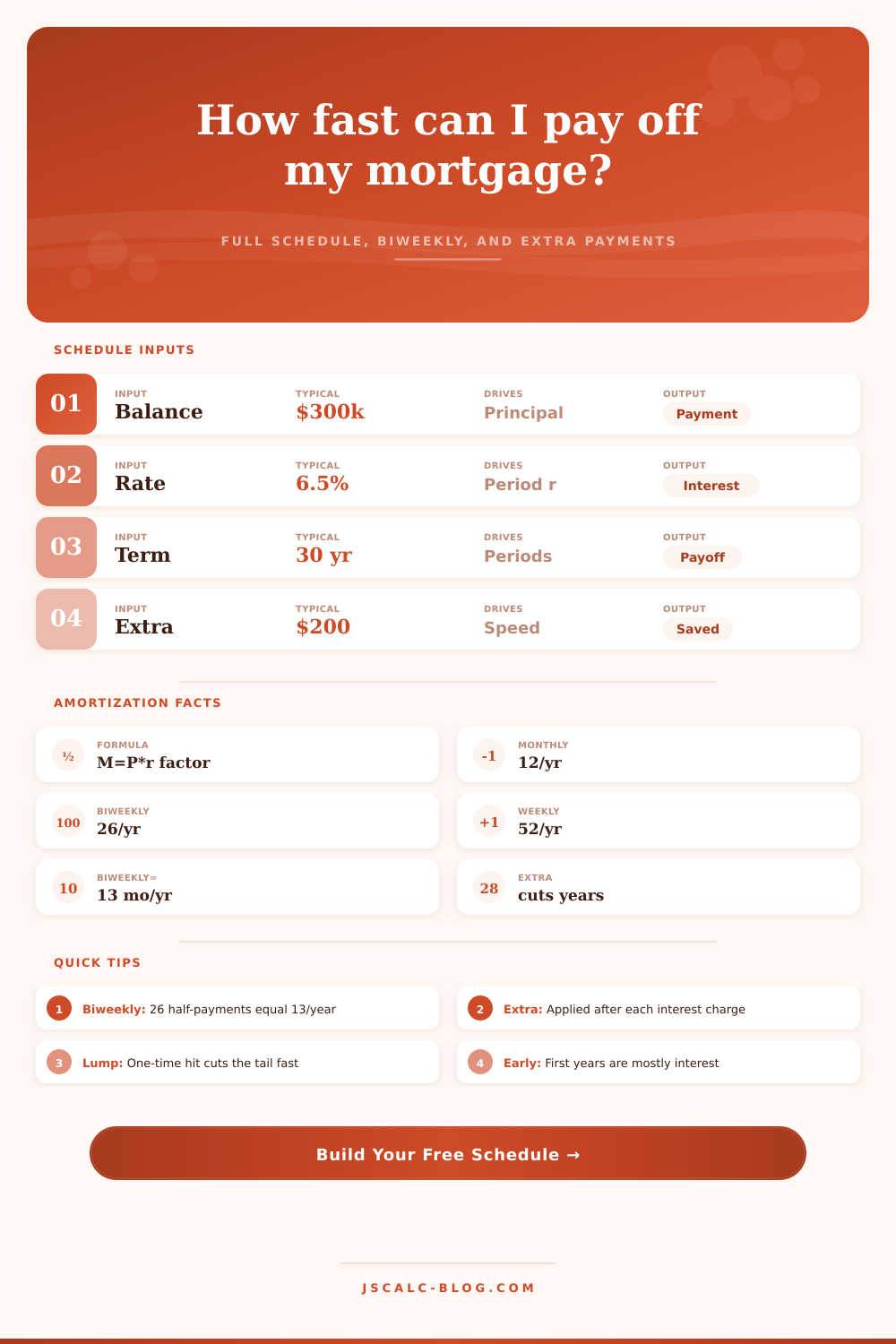
Here’s how: Alter timing of your payments. Going from monthly to bi-weekly doesn’t seem like much, but add it all up: Bi-weekly = Half Payment Every Two Weeks. Thirteen Full Payments Per Year vs. This equals twelve payments per year. One more month toward paying off that principal may not seem like much, but here’s what happens.
Compound interest works for you if you’re paying down debt. It works against you if you’re borrowing. Pay down debt sooner and you trim years off the back-end of a 30-year loan. Now you’re not paying interest on a lump sum you already repayed early. That effect is even sharper when you’re adding money directly to principal. Particularly at the beginning.
When you think about it, throwing an extra $200 per month straight to principal seems like a tiny pinprick to your budget. But over 30 years, that habit cuts hundreds of thousands of dollars from total interest due. The chart on the page makes this clear: compare aggressive repayment plans versus standard repayment. You can see how every dollar of extra payments saved earlier results in less interest paid. Throwing an extra dollar at the bill in year one saves you way more than throwing the same extra dollar at year twenty. It’s simply that you owe more, so you’ve got more interest accruing each day.
While recurring extras are nice, they aren’t as effective as lump sum payments. Throwing a big chunk of cash (e.g., an inheritance or bonus) into the principal lowers your balance right now which means it will lower each month’s interest charge going forward. In other words, it resets path of your loan while not altering your monthly habit. You don’t have to sweat over whether you can afford larger payments on a permanent basis. The one-time hit changes your future math once and for all.
Most people wait to pay down the mortgage until they’re halfway done. That’s backwards. When you have the biggest balance, meaning the most interest charges (that’s at the beginning of the loan). Paying yourself first (frontloading) maximizes your return. Essentially, it’s like earning after-tax equivalent of your mortgage interest rate. That’s an insanely high return, far higher than what you get in savings accounts.
With this tool, you can mix and match those tactics. Want to throw in an occasional lump sum payment? Do it and see how that affects the results. You can also use biweekly payments.
The point isn’t only to repay your loan, it’s to do so without wasting as much money as possible on interest. Pay attention not only to the month-to-month price tag but also to the payoff date. If you save a few years off the loan timeline, you’ll build wealth that much faster … freeing up money sooner so you can use it for other stuff.
It requires a bit of discipline, but follow the plan and the schedule shows you exact day that balance goes to zero. Paying down a mountain of debt becomes less of a chore once you see how tiny tweaks remove big hunks of interest from your calculations.
You should of seen it sooner.