Ratio Calculator
Simplify a ratio to its lowest terms, solve a proportion for an unknown value, scale a ratio up or down by any factor, or reduce a three-part ratio, with decimal, percentage, and fraction forms shown alongside.
🎯Real Ratio Presets
📝Ratio Inputs
Used for proportion and three-part modes. Leave the unknown term blank in proportion mode.
Only used in proportion mode. The term you solve for is ignored.
Multiply every term by this. Use a value below 1 to scale down.
🔢Method Snapshot
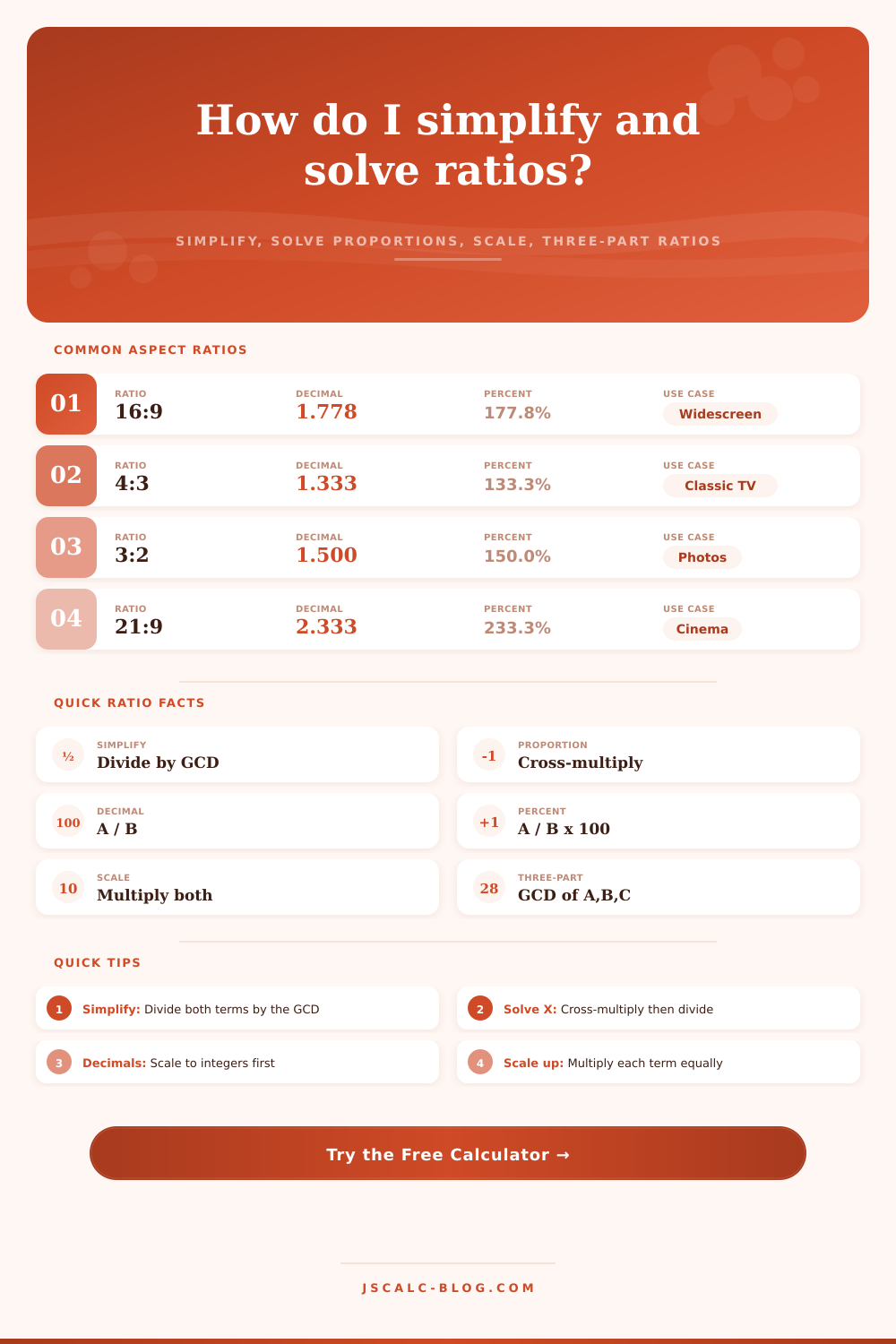
🖥Common Aspect Ratios
| Aspect Ratio | Decimal | Percent | Example Size | Common Use |
|---|---|---|---|---|
| 16:9 | 1.778 | 177.8% | 1920 × 1080 | HDTV, YouTube, monitors |
| 16:10 | 1.600 | 160.0% | 1920 × 1200 | Laptops, tablets |
| 4:3 | 1.333 | 133.3% | 1024 × 768 | Classic TV, iPad |
| 3:2 | 1.500 | 150.0% | 1080 × 720 | 35mm photos, DSLR |
| 21:9 | 2.333 | 233.3% | 2560 × 1080 | Ultrawide, cinema |
| 1:1 | 1.000 | 100.0% | 1080 × 1080 | Square, Instagram |
| 9:16 | 0.563 | 56.3% | 1080 × 1920 | Phone, Reels, Shorts |
📐Ratio, Fraction, Decimal & Percent
| Ratio | Fraction | Decimal | Percent | Part of Whole |
|---|---|---|---|---|
| 1:1 | 1/1 | 1.000 | 100% | 1 of 2 (50%) |
| 1:2 | 1/2 | 0.500 | 50% | 1 of 3 (33.3%) |
| 2:3 | 2/3 | 0.667 | 66.7% | 2 of 5 (40%) |
| 3:4 | 3/4 | 0.750 | 75% | 3 of 7 (42.9%) |
| 1:4 | 1/4 | 0.250 | 25% | 1 of 5 (20%) |
| 3:1 | 3/1 | 3.000 | 300% | 3 of 4 (75%) |
| 5:1 | 5/1 | 5.000 | 500% | 5 of 6 (83.3%) |
🗂Ratio Comparison Grid
| Ratio | Decimal | Percent | Fraction | Total Parts | Typical Use Case |
|---|---|---|---|---|---|
| 2:1 | 2.000 | 200% | 2/1 | 3 | Coolant, syrup dilution |
| 4:1 | 4.000 | 400% | 4/1 | 5 | Cleaner concentrate mix |
| 3:2 | 1.500 | 150% | 3/2 | 5 | Photo prints, layout |
| 5:1 | 5.000 | 500% | 5/1 | 6 | Two-stroke fuel/oil |
| 3.73:1 | 3.730 | 373% | 373/100 | 4.73 | Axle gear ratio |
| 1.618:1 | 1.618 | 161.8% | 809/500 | 2.618 | Golden ratio design |
| 1:50000 | 0.00002 | 0.002% | 1/50000 | 50001 | Topographic map scale |
⚙Full Method Breakdown
📋Reference Values
| Task | What You Enter | Method Used | What You Get |
|---|---|---|---|
| Simplify | A and B | Divide by GCD | Lowest-term ratio |
| Solve X | Three of A,B,C,D | Cross-multiply | The missing term |
| Scale | A, B and factor | Multiply terms | Enlarged ratio |
| Three-part | A, B and C | GCD of all three | Reduced A:B:C |
| Convert | A and B | A/B and A/B×100 | Decimal and percent |
💡Practical Ratio Tips
The word ratio may bring to mind two numbers separated by a colon. But that’s just shorthand for a relationship between values: One number is related to the other. And it’s how much of one value can go into a fixed recipe or how one value change when another does. Most folks have the idea, but mess up the arithmetic and end up with a screen dimension out of whack or an impossible paint mix. Time for some math help. No, you don’t have to be a mathematician; just get your head around what question you’re asking.
The most important part is that most people begin with a complex ratio and simplify it into something simpler. What’s my screen size? It’s probably 1920:1080. That’s big, it’s unwieldy in your head. But it reduces to something easier. How do we find that? The greatest common divisor come into play. The calculator goes through each number and divides them as many times as possible without leaving a remainder. So in our example above, the ratio reduce to 16:9.
What is a Ratio?
Why does that matter? This is because 16:9 is the standard widescreen video ratio. Your television, computer, even your mobile phone use this aspect ratio. Next time you’re prepping a presentation or resizing an image, knowing what it reduces to makes things easier. You won’t have to guess whether or not it’ll squash or stretch the contents.
One thing’s easy. Finding the unknown is better. Picture it like this: Your recipe calls for 3 parts sugar to 4 parts flour. That’s a ratio problem. You’ve got 9 cups of sugar, how much should you use? It’s a matter of cross-multiplication; that’s how the math works. Keep things on the same scale. Double the sugar? Double the flour. By using three of the four variables, you can avoid wasting materials or making a kitchen disaster. Just let the calculator fill in the rest.
Scaling: Sometimes what you need isn’t a solution or a simplification but instead a scale-up. For example, you might use a certain ratio to mix your concrete or even a cleaner, and then do a larger job that requires 10x more. Multiplication is simple; it’s just called scaling. Folks tend to multiply one half of the ratio and that’s where they go wrong. With the calculator, you can simply input your factor (3) and it will multiply both halves equally. So the relationship between the two values remain. That’s true with a budget expansion as well as a coolant dilution.
Bringing the abstract world of ratios into the concrete one of percentages and decimals connects the two. As a decimal, a ratio such as 3:2 equals 1.5. Considered in relation to a whole, it’s 150 percent. That can be useful when judging choices whose bases aren’t common. You may find it difficult to compare a 16:9 aspect ratio to a 4:3 one visually, but it’s easy to compare their respective decimals: 1.33 and 1.78. The page’s reference table provides an example of what all those figures mean in various formats.
Three-part ratios add another layer of complexity because you are balancing three variable instead of two. Consider blending red, white, and blue paint into a certain color. Each number has to be divisible by the same thing. You could easily concentrate on only two parts while forgetting about the third. That will throw off the outcome. All three numbers gets reduced at the same time in the tool. This guarantees that everything in the mix remain proportionate.
So yes, ratios can be scaled infinitely, but they’re not free-form. There’s a tight mathematical logic to them. Whether it’s mixing chemicals or sizing a video frame or adjusting a recipe, it all works on the same principle. You change the quantities, but you keep the relationship. Plug in your raw numbers. Let the tool do the conversions and let it reduce. It spits out an answer, and you believe it. The math isn’t drudgery, just plugging knowns into this equation that makes sense because you know what you’re measuring. It feels less like math and more like a map. You should of used it sooner.